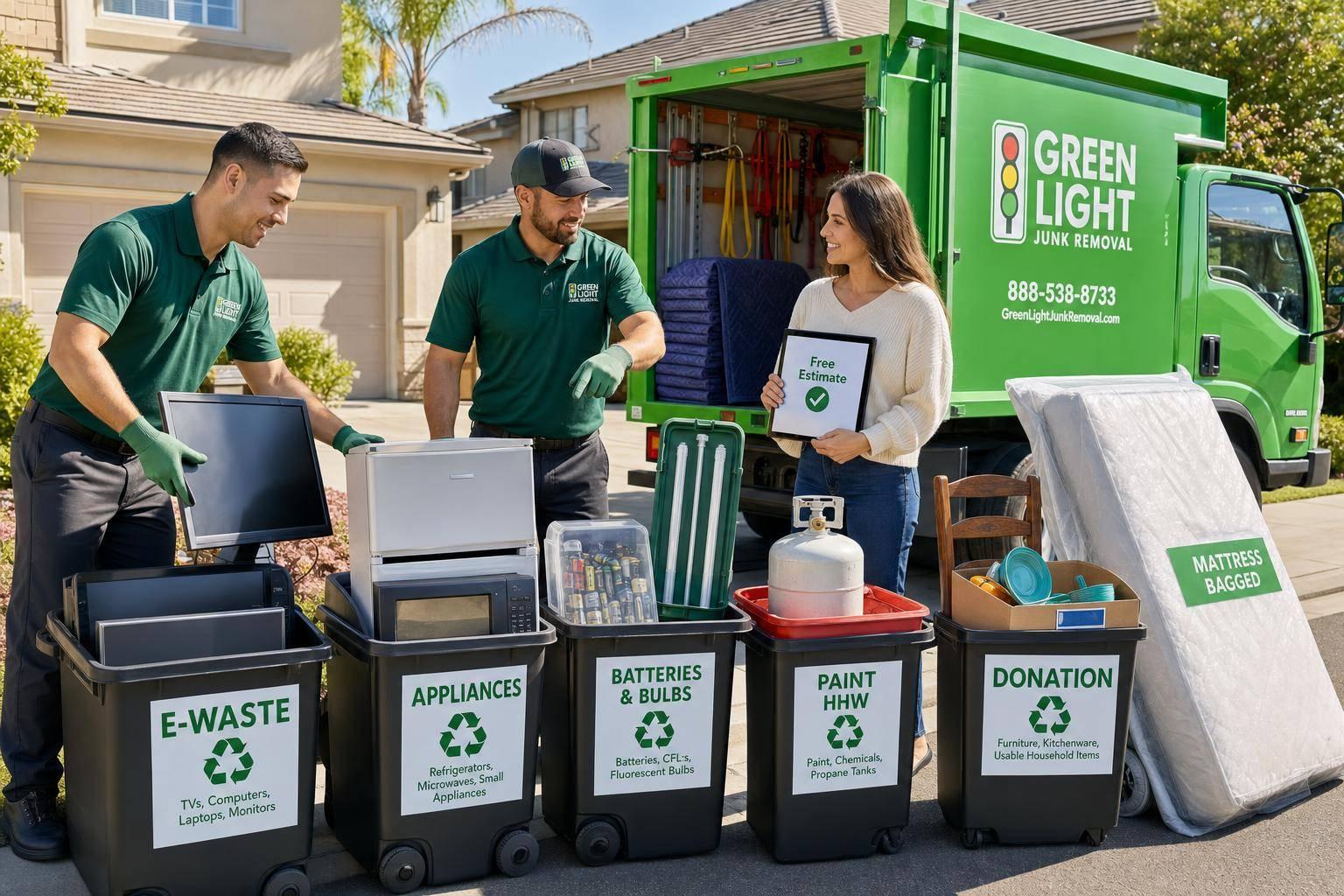
A lot of common household items should never go in your regular trash. Batteries can start fires. Paint and cleaners can leak. Electronics, bulbs, and car fluids can put harmful materials into soil and water. Some states also ban certain items from landfills, and fines can reach $1,500 or even $10,000 in some cases.
At Green Light Junk Removal, we help people across Sacramento, Elk Grove, Roseville, Folsom, Rancho Cordova, Citrus Heights, Rocklin, West Sacramento, Davis, Carmichael, Fair Oaks, Natomas, Antelope, Galt, and nearby areas sort out what goes where during cleanouts.
Here’s the short version:
- Take to HHW: batteries, paint, solvents, cleaners, mercury bulbs, thermostats, and automotive fluids
- Recycle or use take-back programs: electronics, some batteries, oil filters, and working appliances
- Book bulky pickup or junk removal: mattresses, couches, appliances, and hot tubs
- Donate first when items still work: furniture, electronics, and some appliances
Simple rule: if it’s flammable, toxic, corrosive, battery-powered, or too bulky for curbside trash, stop and check the disposal rules first.
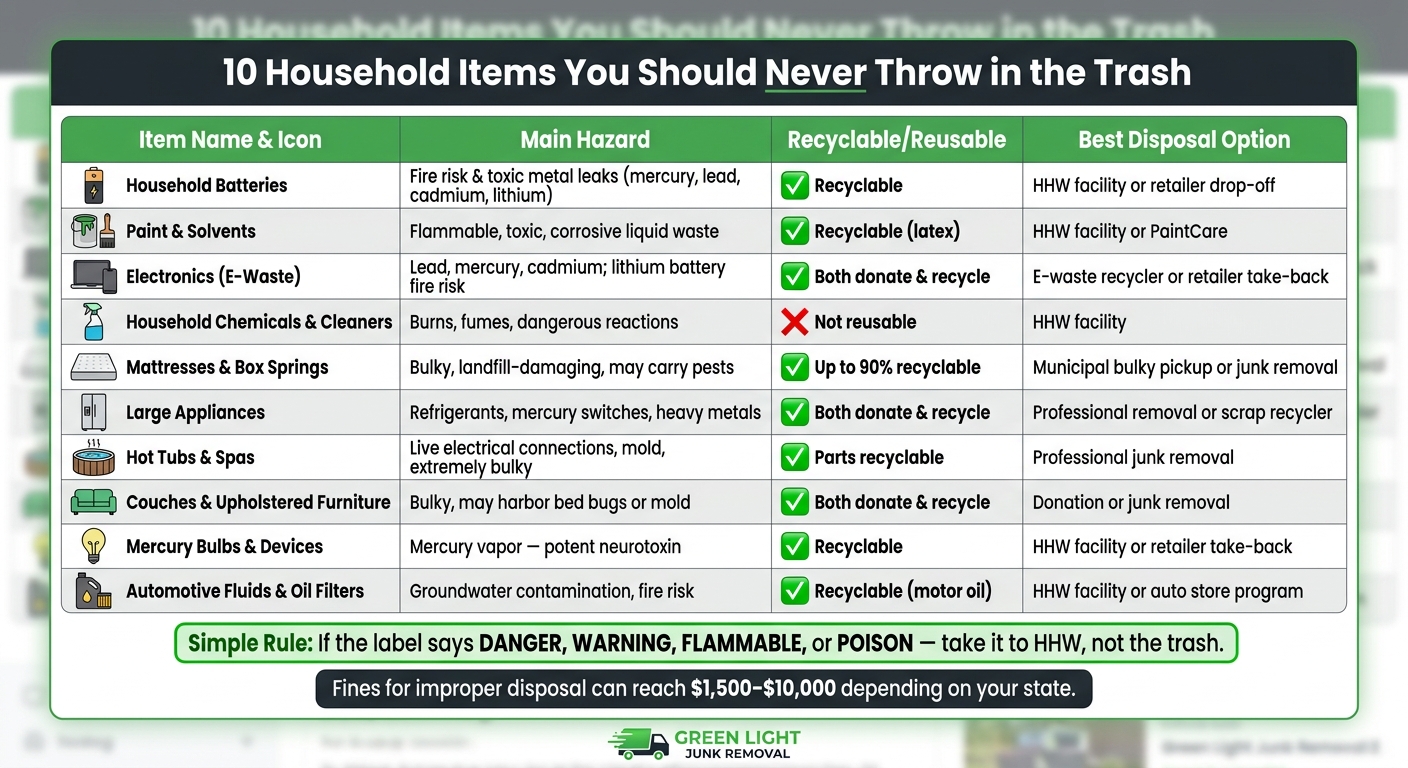
10 Items You Should Never Trash: Hazards & Disposal Guide
Quick Comparison
| Item | Main issue | Best next step |
|---|---|---|
| Household batteries | Fire risk and metal leaks | HHW or store drop-off |
| Paint and solvents | Flammable liquid waste | HHW or PaintCare |
| Electronics | Metal hazards and battery fires | E-waste recycling |
| Household chemicals | Burns, fumes, reactions | HHW drop-off |
| Mattresses | Bulky and often restricted | Bulky pickup or removal |
| Large appliances | Refrigerants and heavy parts | Pickup, recycler, or haul-away |
| Hot tubs | Heavy, wired, hard to break down | Professional removal |
| Couches and upholstered furniture | Bulky, may hold pests or mold | Donation or removal |
| Mercury bulbs and devices | Mercury exposure | HHW or retailer take-back |
| Automotive fluids and oil filters | Groundwater pollution and fire risk | HHW or auto store program |
If you’re cleaning out a home, garage, office, rental, or estate, our team can handle the heavy, non-hazardous items and help you figure out what needs a special drop-off. For local bulky-item pickup help, appliance removal, or a full property cleanout, request a free estimate from Green Light Junk Removal.
sbb-itb-096ce5b
Why Proper Disposal Matters for U.S. Homeowners
During a cleanout, using the wrong trash bin can turn everyday junk into a safety problem. Corrosive liquids and household chemicals can hurt sanitation workers and send toxic fumes into the air. Lithium batteries are a big one. If a garbage truck compactor crushes them, they can spark fires inside the truck. Lead, mercury, and cadmium can also leak from trash into soil and groundwater. What starts at the curb doesn’t stay there. It can keep causing harm in landfills and waterways.
There’s also a legal side that many homeowners miss. At least 19 U.S. states, including California, Illinois, and New York, ban electronics from landfills.[6] In Illinois, fines can go up to $1,500 per violation. In California, improper motor oil disposal can lead to penalties of up to $10,000. And these penalties don’t just hit businesses. Individual homeowners can face them too.[5]
The good news? Safer disposal options are often easy to find. County Household Hazardous Waste (HHW) facilities often take paints, pesticides, and automotive fluids on set drop-off days. Major retailers also offer take-back programs for electronics, rechargeable batteries, and CFL bulbs. Many cities and towns schedule bulky-item curbside pickup for furniture and large appliances. But appliances with refrigerants usually need an EPA-certified technician to remove the refrigerant first.[5] Recycling helps in another way too: it cuts demand for new raw materials.
First: household batteries.
1. Household Batteries
Batteries can look harmless sitting in a junk drawer. But they shouldn’t go in the trash.
The EPA treats many batteries as regulated waste that should be recycled, not tossed out [2][3]. That’s because they can contain toxic materials like mercury, lead, cadmium, lithium, and nickel. If those materials end up buried in a landfill, they may leak into soil and groundwater [2][4].
Lithium-ion batteries come with an added risk. If a cell gets damaged, it can ignite nearby paper and plastic [7].
Legal Restrictions
Rules differ by state, but the practical takeaway is simple: keep household batteries out of regular trash and use HHW or retailer drop-off programs instead [2][5].
Best Disposal Route
Most county Household Hazardous Waste (HHW) facilities and community take-back events accept all battery types, often at no cost for local residents [2][1]. Many major retailers also take rechargeable batteries through in-store drop-off bins [2][7]. And for lead-acid car batteries, auto parts stores often give you a deposit refund when you return the old battery with a new purchase [7].
A few small steps help make drop-off safer:
- Tape the terminals before you transport batteries. Put clear tape over the positive and negative ends, especially on lithium and 9V batteries, to help prevent accidental sparks [7][3].
- If you find a swollen lithium battery, do not place it in a regular bin. Store it in a non-flammable container filled with sand or kitty litter and contact a specialty recycler right away [7].
Paint and solvents create a different disposal problem: liquid waste.
2. Paint, Solvents, and Paint Thinners
Leftover paint and solvents tend to linger on garage shelves for months, sometimes years. That’s a problem because they can be flammable, toxic, and tough to get rid of the right way. Paint is also one of the most common household hazardous materials found in residential garages [9].
Main Hazard
Paint thinner, turpentine, stripper, and varnish often come with labels like DANGER, WARNING, FLAMMABLE, or POISON. Those labels aren’t just there for show. Oil-based paints and solvents are more toxic and more likely to catch fire than latex paint, so they need extra care when you store, move, and dispose of them.
Legal Restrictions
California limits hazardous-material transport to 15 gallons or 125 pounds per trip. Any containers you bring to a drop-off site need to be leak-proof, clearly labeled, and kept separate. In plain terms: don’t mix products together, even if they seem similar [8][11].
Best Disposal Route
In the Sacramento area, HHW facilities take oil-based and latex paints, thinners, solvents, varnishes, and strippers [8][10]. The Elk Grove Special Waste Collection Center (SWCC) also accepts many paint products and solvents [10]. If you have latex paint, PaintCare offers free recycling at participating drop-off sites [9].
Latex paint usually has the best chance of being reused. Sacramento HHW facilities offer a reuse drop-off for paint that’s still usable [9]. If you want leftover paint to stay in good shape a little longer, put plastic wrap over the can opening before sealing the lid. Then store it indoors, away from freezing temperatures and moisture [9].
Oil-based paint products usually need HHW disposal instead of reuse or standard trash handling [10].
Household chemicals and cleaners bring many of the same fire and contamination risks.
3. Electronics and E-Waste
Electronics are a different kind of disposal issue. Unlike paint or household cleaners, they can create two problems at once: toxic metal exposure and battery fire risk. That’s why electronics and e-waste should never go in the regular trash. In California, many of these items are banned from landfill disposal, and breaking those rules can lead to steep fines [15].
Main Hazard
Older electronics can contain harmful materials that should not end up in a landfill. CRT monitors, for example, may contain lead, mercury, and cadmium. Those materials can create serious health risks if dumped the wrong way [14].
There’s also another side to this. Electronics contain useful metals like gold, silver, platinum, and copper. Recycling helps recover those materials instead of burying them. In plain terms, e-waste is a recycling issue, not a trash issue.
Legal Restrictions
California does not allow many electronic devices in the trash. That includes TVs, monitors, computers, printers, phones, and mercury-containing thermostats [14]. Battery-powered items need extra care too. Lithium-ion battery fires in garbage trucks and landfills are a growing problem, which is one reason rules for rechargeable batteries keep getting tighter [15].
For homeowners, landlords, and business owners in Sacramento, Elk Grove, Roseville, Folsom, Rancho Cordova, Citrus Heights, Rocklin, West Sacramento, Davis, Carmichael, Fair Oaks, Natomas, Antelope, Galt, and nearby areas, this matters more than most people think. A single wrong item in the trash can create a safety issue during pickup or at the landfill.
Best Disposal Route
If you live in the Sacramento area, Kiefer Landfill and the North Area Recovery Station both accept e-waste drop-offs [14]. Some retail drop-off programs also take small devices. Before you recycle any phone, tablet, laptop, or computer, make sure your personal data is removed the right way. Simply deleting files is not enough [14].
For work computers or other devices with private records, certified hard-drive shredding is the safest route [13]. That’s often the best fit for property managers, contractors, offices, and real estate teams that need to protect client or business information.
A few smart steps before drop-off or pickup:
- Back up any files you want to keep
- Sign out of accounts and remove saved passwords
- Do a full factory reset when possible
- Remove loose batteries if the item allows it
- Keep cracked or swollen battery devices away from heat
Reuse or Recycling Potential
If a device still works, donation may make sense. Sacramento Public Library, Goodwill, or a local school may be able to use working electronics [14]. That can help keep usable items out of the waste stream a little longer.
When the items are large, heavy, or awkward to move, the job becomes more than a recycling task. It becomes a hauling issue too. Old copiers, desktop towers, and CRT TVs are not easy to lift or load safely. Our team at Green Light Junk Removal handles the heavy lifting, removes bulky electronics from homes and businesses, and takes them to certified recycling facilities.
If you’re clearing out a garage, office, rental, or estate property in Sacramento or the surrounding communities, we can help sort what can be donated, what needs e-waste recycling, and what requires safe hauling. For larger cleanouts, this section also pairs well with internal links to office cleanouts, appliance removal, and property cleanout services. If you want help figuring out the next step, request a free estimate from our team at Green Light Junk Removal.
4. Household Chemicals and Cleaners
A lot of common cleaning products belong in household hazardous waste (HHW), not your trash can. We see this all the time during cleanouts in Sacramento, Elk Grove, Roseville, Folsom, Rancho Cordova, and nearby areas. Items like bleach, drain openers, oven cleaners, pool chemicals, pesticides, and partially full aerosol cans may seem harmless once they’re sitting on a shelf, but they can still cause serious problems after pickup day.
Like batteries and paint, these products can leak, spark fires, or spread contamination if they’re thrown out the wrong way.
"These products may contain corrosive, toxic, ignitable, or reactive ingredients which can start a fire in the refuse truck or at the sorting facility." [16]
Main Hazard
The danger is pretty simple. When these products go into the trash, they can leak, mix with other waste, or give off fumes. That puts sanitation workers at risk and can pollute the air, soil, and water.[16][17]
"It’s illegal to dispose of hazardous waste in the garbage, down storm drains, or onto the ground because it can harm health and cause fires." [17]
If you’re clearing out a garage, rental, shed, or storage area in Citrus Heights, Rocklin, West Sacramento, Davis, Carmichael, Fair Oaks, Natomas, Antelope, Galt, or surrounding communities, this is one of the first things to sort out.
Legal Restrictions
California law does not allow residents to transport more than 15 gallons or 125 pounds of hazardous materials at one time.[8] If a product label says DANGER, WARNING, FLAMMABLE, or POISON, it counts as household hazardous waste and needs special handling.[8]
That applies to local homeowners, renters, landlords, and property managers across the Sacramento area. In plain terms, proper drop-off is the safe move.
Best Disposal Route
Sacramento County and city HHW sites often provide free drop-off for residents, though it’s smart to call first and check accepted items and current hours.[14][18] Small businesses usually need to pay a fee and schedule a drop-off appointment.[18] If a container is completely empty, check local rules before tossing it, since disposal rules can change by area.[17]
When we help with mixed-property cleanouts, our team always recommends separating chemical products first. That keeps the rest of the junk removal job safer and easier, whether you’re cleaning out a home in Sacramento or managing a property in Elk Grove or Roseville.
A few smart steps can help right away:
- Keep products in their original containers if you can
- Don’t mix different cleaners together
- Set aside anything labeled DANGER, WARNING, FLAMMABLE, or POISON
- Check your local HHW facility before loading your vehicle
If you need help sorting a cleanout and figuring out what can go with regular junk and what needs special handling, Green Light Junk Removal is here to help. Reach out for a free estimate, and we’ll help you plan the safest next step.
5. Mattresses and Box Springs
Not everything that stays out of the regular trash is dangerous. Some items are just big, hard to move, and subject to disposal rules. In Sacramento, old mattresses and box springs fall into that group. Our team at Green Light Junk Removal helps customers across Sacramento, Elk Grove, Roseville, Folsom, Rancho Cordova, Citrus Heights, Rocklin, West Sacramento, Davis, Carmichael, Fair Oaks, Natomas, Antelope, Galt, and nearby areas deal with them the right way.
Main Hazard
Mattresses take up a lot of landfill space, can damage equipment, and may carry pests such as bed bugs.
Legal Restrictions
California has a mattress stewardship program that gives residents legal ways to dispose of mattresses across the state. In Sacramento County, dumping a mattress at the curb, in an alley, or in a dumpster can lead to a $1,000 fine for a first offense [19].
Best Disposal Route
Once you know the risks, the next step is picking the right disposal method. Up to 90% of a mattress can be recycled, and both mattresses and box springs can often be processed through approved recycling channels [19].
In many cities, bulky item pickup requires an appointment [20]. Legal options often include:
- City-approved bulky waste pickup
- Self-drop-off at a transfer station
- Professional junk removal [21]
If you’re buying a new mattress, ask the retailer if haul-away is included. Many retailers take part in California’s mattress stewardship program [15]. That can save you a trip and help you stay within local rules.
If the mattress is stained, waterlogged, or has been treated for pests, it should be handled with extra care. In those cases, professional junk removal is the safest route [19]. We’ve seen plenty of these in estate cleanouts, move-outs, and rental turnovers, and they usually aren’t something people want sitting in a garage or side yard any longer than needed.
Reuse and Recycling Potential
Clean, undamaged mattresses may be accepted by local charities.
When donation is not an option, recycling is often the next best step. We help customers sort out what can be reused, what needs special handling, and what should go through approved disposal channels.
Green Light Junk Removal handles mattress and box spring removal across the Sacramento region, including pest-treated and estate-cleanout items. If you need help in Sacramento or any nearby community, request a free estimate from our team and we’ll make the pickup process simple.
6. Large Appliances
Large appliances need extra care because they’re heavy, hard to move, and can hide safety risks inside. Refrigerators, freezers, washers, dryers, ovens, and water heaters are not meant for the regular trash. Some also contain parts that need special handling. In California, large appliances do not go in regular trash [14].
Main Hazard
Refrigerators and freezers contain refrigerants that EPA-certified technicians must recover before recycling [22]. Older units may also have mercury-containing switches that need separate handling [22]. This is why appliance disposal is more than just hauling something to the curb. It’s a safety job and a recycling job.
At Green Light Junk Removal, we’ve seen how easy it is for these items to become a problem during a cleanup. A refrigerator might look harmless sitting in a garage in Sacramento or Elk Grove, but inside, it can still hold materials that must be removed the right way.
Legal Restrictions
Improper disposal can trigger fines, citations, or liens [23]. For Sacramento-area property owners, that often means setting up approved pickup or using a certified hauling service. These rules apply whether you’re cleaning out a house in Folsom, turning over a rental in Rancho Cordova, or clearing a property in Citrus Heights.
If you own or manage property in Roseville, Rocklin, Carmichael, Fair Oaks, Natomas, Antelope, Galt, West Sacramento, Davis, or nearby areas, the same basic rule applies: don’t leave large appliances out with normal trash and hope for the best.
Best Disposal Route
Sacramento residential customers can schedule two free appliance and e-waste collection appointments per year, with a limit of two appliances per appointment [24]. You can book through the Sacramento 311 app or by calling 311. Before pickup, disconnect gas, water, and power, and empty refrigerators completely.
If the appliance still works, check SMUD or PG&E rebate programs for recycling incentives [22]. That can be a smart move if you’re replacing an older unit and want to save a little money in the process.
For items that don’t qualify, or if you’ve already used your yearly city pickups, our team can help. A standard full-size refrigerator can weigh 100 to 150 pounds, so professional removal can save time and help avoid wall, floor, and doorway damage. That matters a lot in tight hallways, upstairs units, and older homes around Sacramento and surrounding communities.
A few simple steps can make pickup smoother:
- Unplug the appliance ahead of time
- Remove all food, water, and loose items
- Clear a path to the door
- Make sure gas and water lines are disconnected before removal
Reuse and Recycling Potential
Working appliances in good condition may be accepted by organizations like Habitat for Humanity ReStore or the Salvation Army Sacramento, and donations typically come with a tax-deductible receipt [12]. If donation is not an option, there is still recycling value in many appliances. Steel, copper, and aluminum can all be recovered during the recycling process [22].
That’s one reason we always tell customers not to treat old appliances like plain junk. Even when a unit no longer works, parts of it can still be processed the right way instead of dumped.
For heavy or multiple appliances, Green Light Junk Removal provides pickup across Sacramento and nearby communities, including Elk Grove, Roseville, Folsom, Rancho Cordova, Citrus Heights, Rocklin, West Sacramento, Davis, Carmichael, Fair Oaks, Natomas, Antelope, and Galt. We haul items to certified recycling facilities and make the process easier on you. Request a free estimate if you want our team to handle the heavy lifting.
7. Hot Tubs and Spas
Hot tubs and spas are a different kind of junk removal job. Unlike a mattress or couch, they need to be drained, disconnected, and, in many cases, taken apart before they can be hauled away. They’re heavy, awkward, and built with a mix of fiberglass, wood, metal, wiring, and electronic parts that can’t just go out with the regular trash.
Most city trash service won’t take a hot tub. Trying to move one on your own can also lead to damage to fencing, decking, gates, or walls. Since these units combine electrical parts, plumbing lines, and structural materials, they need a disposal plan that fits the job.
Main Hazard
The biggest safety issue with hot tubs is that they bring several risks together in one large item. The main concerns are live electrical connections and mold, mildew, or standing water when a spa has been sitting unused [25][26].
That’s why our team treats hot tub removal with care. Before anything gets moved, the unit needs to be checked, drained, and made safe.
Legal Restrictions
Hot tubs are too large and too heavy for standard curbside pickup. Spa chemicals also need to be handled separately. Drain and separate those chemicals before pickup, since they belong in a hazardous waste collection program, not inside the tub [28].
If you’re in Sacramento, Elk Grove, Roseville, Folsom, Rancho Cordova, Citrus Heights, Rocklin, West Sacramento, Davis, Carmichael, Fair Oaks, Natomas, Antelope, Galt, or nearby areas, this is one of the big reasons people call our team instead of trying to deal with it alone.
Best Disposal Route
Hot tub removal usually involves:
- Draining the unit
- Disconnecting power and plumbing
- Dismantling the tub if needed
- Loading, hauling, and cleaning up the area afterward [25][26]
If your gate opening is less than 36 inches wide, we can cut the shell into smaller pieces on-site so it can be removed without tearing out fencing or causing extra damage [25].
Reuse and Recycling Potential
A lot of hot tub material can be recycled when it goes to the right type of facility. That can include metal frames, copper wiring, plastic shells, and wood siding [27][12]. Once the chemicals are removed and the spa is fully drained, the rest of the work comes down to safe lifting, sorting, and proper drop-off.
At Green Light Junk Removal, we handle hot tub and spa removal across Sacramento and surrounding Northern California communities. We take care of draining, dismantling, hauling, and disposal, so you don’t have to wrestle with a heavy, awkward unit on your own. Request a free estimate and our team will handle the job from start to finish.
8. Couches and Upholstered Furniture
Old couches, sectionals, and recliners usually shouldn’t go in the trash. They’re bulky, hard to move, and they often need an approved bulky-item pickup or a special haul-away. On top of that, upholstered furniture can trap pests, moisture, and other messes you do not want spreading around your property.
Around Sacramento, Elk Grove, Roseville, Folsom, Rancho Cordova, Citrus Heights, Rocklin, West Sacramento, Davis, Carmichael, Fair Oaks, Natomas, Antelope, Galt, and nearby areas, this is one of the most common problems we help people deal with. A couch may look like simple junk, but getting rid of it the right way takes a bit more care.
Main Hazard
The biggest issue with upholstered furniture is not just the size. It’s what can be hiding inside the fabric and padding.
Couches, chairs, and recliners can hold bed bugs, mold, and deep moisture. If a piece has bed bugs, it should be clearly labeled "Bed Bugs" before disposal to help stop the infestation from spreading [30]. If a couch was soaked by floodwater or has mold contamination, it should be set aside for disposal because foam and fabric absorb moisture deep inside [30].
That matters for safety. A couch may seem dry on the surface, but the inside can still be damp and dirty. We’ve seen this after leaks, storms, plumbing problems, and move-outs. In those cases, trying to drag it through the house or leave it at the curb can make a bad situation worse.
Legal Restrictions
Sacramento’s appointment-based bulky-item pickup service requires piles to stay out of bike lanes and away from storm drains [20]. Nearby cities follow similar rules with limits on volume and accepted materials. In places like Folsom, Roseville, and Rocklin, residents usually need to schedule bulky-item pickups, and large items may not fit within those set limits [20].
Large sectionals, sleeper sofas, and oversized recliners often go over what city pickup programs allow. That’s where many homeowners, landlords, and property managers get stuck. The item is too big for regular trash, but it also does not fit local bulky-item rules.
A few smart steps can help before you move anything outside:
- Check your city’s pickup rules and size limits
- Keep furniture away from storm drains, sidewalks, and bike lanes
- Do not place infested or mold-damaged items where others may take them
- If the item is too heavy, avoid lifting it without help
Best Disposal Route
If the furniture is still in decent shape, donation is usually the first move to make. Local groups like Goodwill, Habitat for Humanity ReStore, and the Salvation Army may accept gently used furniture and help put it back into use for families who need it [12].
If the item is torn up, stained, unsafe, or just too heavy to handle, a removal service is often the most practical route. Our team at Green Light Junk Removal helps customers across Sacramento and surrounding communities clear out bulky furniture without the strain, damage, or guesswork. That’s often a big help for move-outs, estate cleanouts, remodels, rental turnovers, and last-minute property prep.
Reuse and Recycling Potential
Even if a couch cannot be donated, it may still contain parts that can be recycled. Wood frames and metal hardware can often be separated and sent to special processing facilities, which helps keep material out of the landfill [29][12].
At Green Light Junk Removal, we take a donate-first, recycle-second approach on every job. That means we look at what can still be reused, what can be broken down for recycling, and what needs proper disposal.
For homeowners and property managers, that saves time and cuts down on hassle. Instead of wrestling a sleeper sofa down a stairwell or trying to figure out city rules in Sacramento, Roseville, Folsom, or Rocklin, you can have our team handle the heavy lifting and sort out the best next step.
If you need help removing a couch, sectional, recliner, or other bulky furniture, request a free estimate from Green Light Junk Removal. We’ll help you clear the space safely and handle the item the right way.
Next: mercury-containing bulbs and devices need separate handling because they contain hazardous materials.
9. Mercury-Containing Bulbs and Devices
Fluorescent tubes, CFLs, older thermostats, and mercury thermometers all have one big issue: they contain mercury, a potent neurotoxin that can damage the brain, kidneys, and nervous system [14]. Around Sacramento, Elk Grove, Folsom, Roseville, and nearby areas, we often see these items mixed into garage cleanouts, rental property turnovers, and estate cleanups. They need special handling from the start.
Main Hazard
If a mercury-containing bulb or device breaks in a trash can or at a landfill, it can release toxic mercury vapor into the air, soil, and water [31]. That vapor can move into the ground, pollute soil and groundwater, and over time reach drinking water sources [11].
"Mercury-containing lamps can not be disposed in trash or household recycling collection bins intended to receive other non-hazardous waste and/or recyclable materials: it is prohibited by law." [31]
That’s why tossing these items in with everyday junk is a bad idea. A single broken bulb may seem small, but the risk grows fast during a large cleanout or remodel.
Legal Restrictions
In California, these items are classified as "universal waste", which means they must be collected and processed separately [31]. State law also limits how much hazardous material a resident can move at one time: no more than 15 gallons or 125 pounds per trip [8].
That matters if you’re cleaning out a home, duplex, office, or shop in Sacramento, Elk Grove, Folsom, Roseville, Rancho Cordova, Citrus Heights, Rocklin, West Sacramento, Davis, Carmichael, Fair Oaks, Natomas, Antelope, Galt, or surrounding communities. If you find a large batch of old bulbs, thermostats, or thermometers, don’t just load them all up without checking the rules.
Best Disposal Route
For most Sacramento-area residents, the safest option is to use an approved drop-off location. SRTS, Kiefer Landfill, and NARS accept these items, and Elk Grove residents may also get a $5 rebate for turning in mercury thermometers [10][14]. Some retailers, including Best Buy and Staples, also take CFLs and certain electronics through take-back programs [14].
A few simple tips can help:
- Keep bulbs and devices unbroken if possible.
- Place them in a box or container so they don’t roll around in your vehicle.
- Don’t mix them with yard waste, household trash, or metal recycling.
- If you have a large volume, check transport limits before making the trip.
If a bulb breaks, ventilate the area and follow local cleanup guidance.
Reuse and Recycling Potential
Recycling helps keep mercury out of landfills and allows processing centers to recover glass and metal safely [14]. From our side, this is one of those materials where doing it the right way protects your property, the workers handling the load, and the local water supply.
If you’re sorting a property cleanout and aren’t sure what can go in the junk pile and what needs a separate drop-off, our team at Green Light Junk Removal can help you sort it out and point you in the right direction. You can also request a free estimate if you need help with the rest of the cleanup.
10. Automotive Fluids and Oil Filters
Automotive fluids need special handling. We see them all the time during garage cleanouts, rental property cleanups, estate cleanouts, and move-out jobs in Sacramento, Elk Grove, Roseville, Folsom, Rancho Cordova, Citrus Heights, Rocklin, West Sacramento, Davis, Carmichael, Fair Oaks, Natomas, Antelope, Galt, and nearby areas. Common items include used motor oil, antifreeze, brake fluid, transmission fluid, and oil filters. These items should not go in the trash.
Main Hazard
When these fluids end up in a garbage truck or landfill, they can leak out and pollute soil and groundwater.
Legal Restrictions
California limits how much hazardous material a resident can transport in one trip. In most cases, that limit is 15 gallons or 125 pounds [8]. In Folsom, residential pickup programs limit used motor oil and antifreeze to 5 gallons each per appointment [32].
Best Disposal Route
The City of Sacramento and the City of Elk Grove accept used motor oil, antifreeze, brake fluid, transmission fluid, and oil filters at HHW facilities and HHW collection sites [8][10]. Before drop-off, make sure each container is leak-proof and clearly labeled [8].
Some auto parts stores also accept used oil and oil filters [11]. If your city has door-to-door pickup for these items, that’s often the easiest place to start [32].
A few simple tips can help:
- Keep each fluid in its own container
- Do not overfill containers
- Wipe off the outside if anything has spilled
- Store oil filters in a way that won’t drip during transport
Recycling Potential
Used motor oil, antifreeze, and oil filters are often accepted for recycling through HHW drop-off sites or retail take-back programs [11]. Do not mix fluids together. Mixing can cause dangerous reactions and may keep the material from being recycled at all [11].
If you’re cleaning out a garage, shed, storage unit, or rental in Sacramento or surrounding communities and you’ve got fluids mixed in with other junk, our team at Green Light Junk Removal can help sort everything out and point you to the right next step. We also help customers separate items during larger property cleanouts so nothing gets missed.
Need help with a garage cleanout or property cleanup? Request a free estimate from Green Light Junk Removal, and we’ll help you figure out what can be hauled, what needs special drop-off, and how to make the cleanup easier.
For a quick side-by-side summary, use the reference table below.
Quick Disposal Reference Table
Use this quick reference before your next cleanout, whether you’re clearing out a garage, estate, or rental property in Sacramento, Elk Grove, Roseville, Folsom, Rancho Cordova, Citrus Heights, Rocklin, West Sacramento, Davis, Carmichael, Fair Oaks, Natomas, Antelope, Galt, or nearby areas. Our team put this together to help you sort items fast before you load anything.
Before you scan the table, here’s the big one: we cannot haul hazardous waste like paint, automotive fluids, or household chemicals. Those items need to go to a local HHW facility.
If you need the fastest answer, start here.
| Item | Why It’s Unsafe or Restricted | Reusable/Recyclable? | Best Disposal Option |
|---|---|---|---|
| 1. Household Batteries | Contain corrosive chemicals and heavy metals. | ✅ Recycling | HHW facility or retailer take-back |
| 2. Paint & Solvents | Flammable, toxic, and corrosive. | ✅ Recycling (latex paint) | HHW facility |
| 3. Electronics (E-Waste) | Contain lead, mercury, and cadmium. | ✅ Both | E-waste recycler or retailer take-back |
| 4. Household Chemicals | Can cause burns, poisoning, or dangerous reactions. | ❌ No | HHW facility |
| 5. Mattresses & Box Springs | Bulky; difficult for landfills to process. | ✅ Recycling | Municipal bulky pickup or professional junk removal |
| 6. Large Appliances | Contain refrigerants and heavy metals. | ✅ Both | Professional junk removal, scrap recycler, or retailer take-back |
| 7. Hot Tubs & Spas | Extremely bulky; requires specialized dismantling. | ✅ Recycling (parts) | Professional junk removal |
| 8. Couches & Upholstered Furniture | Bulky; may contain flame retardants. | ✅ Both | Donation or junk removal |
| 9. Mercury Bulbs & Devices | Mercury is a potent neurotoxin. | ✅ Recycling | HHW facility or retailer take-back |
| 10. Automotive Fluids | Highly toxic and flammable; can contaminate groundwater and soil. | ✅ Recycling (motor oil) | HHW facility or certified collection center |
A simple rule helps: if the label says Danger, Caution, Warning, Flammable, or Poison, take it to HHW, not the trash.
For the non-hazardous bulky stuff, like mattresses, couches, appliances, and hot tubs, our team at Green Light Junk Removal can do the heavy lifting and help keep your cleanout on track.
When to Call Green Light Junk Removal
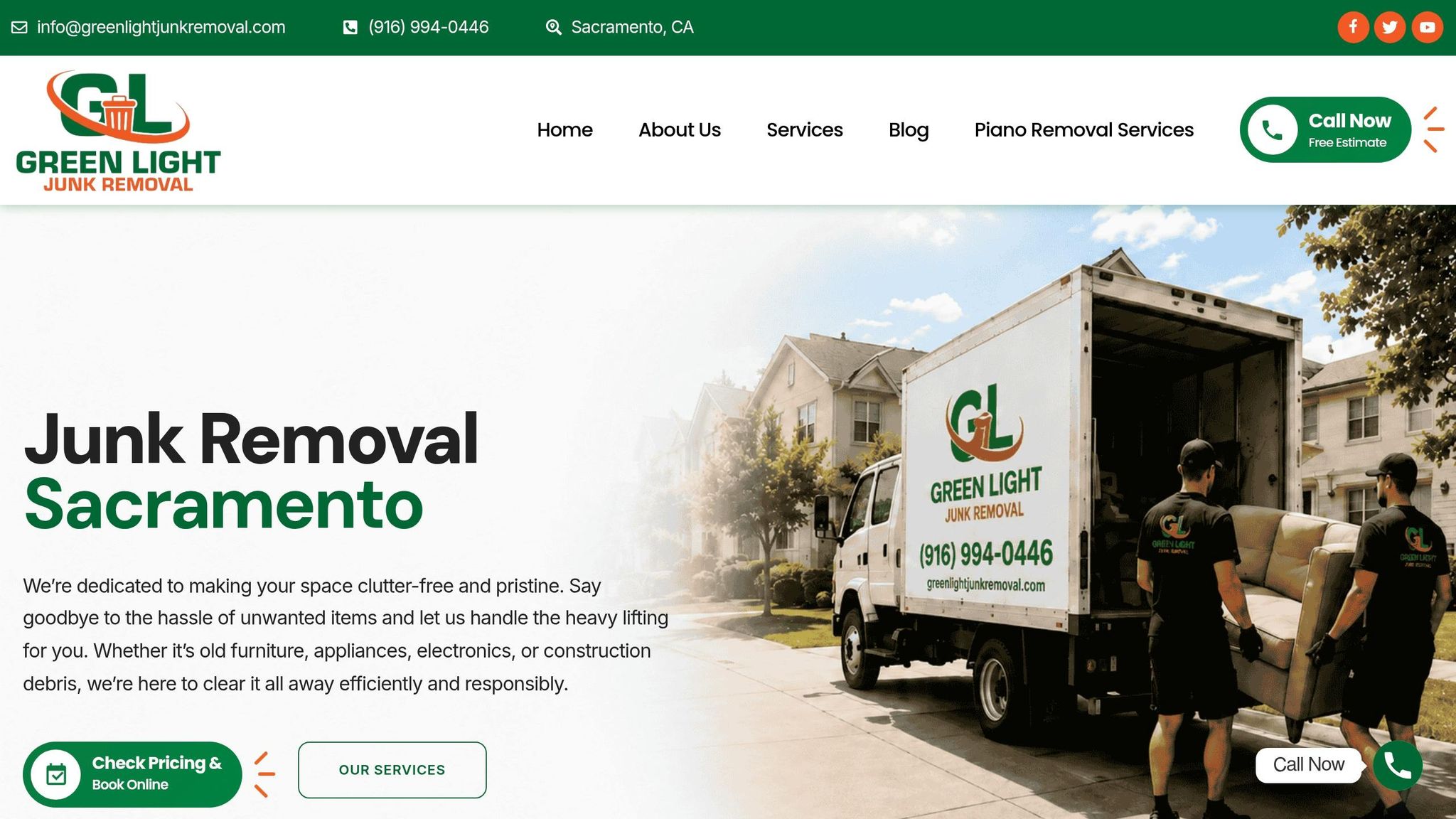
When bulky items won’t fit in your trash service, we’re the team to call. If it’s too large for curbside pickup but it’s not hazardous waste, we can haul it away. Our team removes heavy, awkward items like mattresses, appliances, furniture, and hot tubs. We do the lifting, loading, and hauling from wherever the item is sitting. You don’t need to move anything before we arrive.
Bigger cleanouts are a different beast. A garage cleanout, estate cleanout, move-out cleanup, or rental turnover usually comes with a mix of junk, donation items, and things that need proper disposal. We sort those materials as we load, so the job feels less stressful for you. We also route items toward donation or recycling when possible, which helps cut down on what goes to the landfill.
We serve Sacramento and nearby communities across Northern California, including Elk Grove, Roseville, Folsom, Rancho Cordova, Citrus Heights, Rocklin, West Sacramento, Davis, Carmichael, Fair Oaks, Natomas, Antelope, Galt, and surrounding areas. Same-day and next-day appointments are often available, which helps when you need a property cleared out fast.
Getting pricing is simple:
- Book online for a free estimate
- Text us a photo for a fast, upfront price estimate
There is one main exception. We do not haul hazardous waste such as paint, oils, or solvents. Those items need to go to a local HHW facility. If you’re not sure what counts, reach out and our team can point you in the right direction.
If you’re dealing with bulky junk, mixed debris, or a full property cleanout, request a free estimate from Green Light Junk Removal and we’ll help you get it handled.
Conclusion
After all 10 items, the takeaway is simple: the trash is not the right place for hazardous or bulky waste. Before you throw anything out, check the label for warning words and disposal instructions.
Once you know what not to toss, the next step is picking the right disposal method. Paint, chemicals, and automotive fluids should go to local HHW sites. Usable furniture and appliances may be good candidates for donation. Electronics usually need to be recycled. From batteries and paint cans to mattresses and hot tubs, each item has its own proper path.
Proper disposal helps keep waste out of landfills and supports safer neighborhoods across Sacramento, Elk Grove, Roseville, Folsom, Rancho Cordova, Citrus Heights, Rocklin, West Sacramento, Davis, Carmichael, Fair Oaks, Natomas, Antelope, Galt, and nearby areas.
When the job gets too big, our team at Green Light Junk Removal is here to help with bulky-item pickup and mixed cleanouts. Take a moment before you toss anything, check your local rules, and reach out to us when you need a hand. If you need bulky-item pickup or a full cleanout in Sacramento or the surrounding area, request a free estimate from Green Light Junk Removal.
FAQs
What counts as HHW?
Household Hazardous Waste (HHW) includes everyday household items that contain corrosive, toxic, ignitable, or reactive ingredients. These products may seem harmless sitting in a garage, shed, or under the sink, but they can lead to fires, leaks, and chemical pollution if they’re tossed into the regular trash.
At Green Light Junk Removal, we help customers across Sacramento, Elk Grove, Roseville, Folsom, Rancho Cordova, Citrus Heights, Rocklin, West Sacramento, Davis, Carmichael, Fair Oaks, Natomas, Antelope, Galt, and nearby areas understand what belongs in a safe disposal stream and what does not.
Common HHW items include:
- Paint
- Motor oil
- Antifreeze
- Pesticides
- Pool chemicals
- Household cleaners
- Propane tanks
- Batteries
- Electronics like TVs, monitors, and laptops
- Fluorescent lamps
If you’re cleaning out a home, rental, garage, or storage area and find any of these items, it’s best to separate them from normal junk right away. That simple step can help prevent damage to your property and avoid problems during pickup or disposal.
Can I throw away empty paint cans?
No. We do not recommend putting empty or partly full paint cans in your regular trash or recycling bin. In California, paint is handled as household hazardous waste. That matters for one simple reason: it can hurt sanitation workers and cause damage if it leaks or gets handled the wrong way.
The safer move is to bring paint cans to a designated PaintCare retailer, a local household hazardous waste facility, or the Sacramento Recycling and Transfer Station. If you’re in Sacramento, Elk Grove, Roseville, Folsom, Rancho Cordova, Citrus Heights, Rocklin, West Sacramento, Davis, Carmichael, Fair Oaks, Natomas, Antelope, Galt, or nearby areas, our team at Green Light Junk Removal can also help you sort through other household items and point you in the right direction.
If you’re not sure what can go where, contact Green Light Junk Removal for a free estimate and help with the rest of your cleanout.
What will Green Light Junk Removal take?
Green Light Junk Removal hauls non-hazardous junk from homes, apartments, offices, retail spaces, and job sites across Sacramento, Elk Grove, Roseville, Folsom, Rancho Cordova, Citrus Heights, Rocklin, West Sacramento, Davis, Carmichael, Fair Oaks, Natomas, Antelope, Galt, and nearby areas.
Our team removes items like:
- Furniture
- Appliances
- Yard waste
- Renovation debris
- E-waste
We help make sure these items are disposed of, recycled, or donated in line with California rules. That matters for homeowners clearing out a garage, landlords turning over a rental, contractors cleaning up a project, and business owners dealing with old equipment.
There are some items we cannot take. We do not haul hazardous waste, including paint, chemicals, gasoline, motor oil, pesticides, medical waste, or sharps. These materials need special handling and must be taken to a certified local household hazardous waste facility.
If you’re unsure whether an item is okay for pickup, our team can help you sort it out before your appointment. It’s a simple way to avoid delays and keep your cleanout moving.