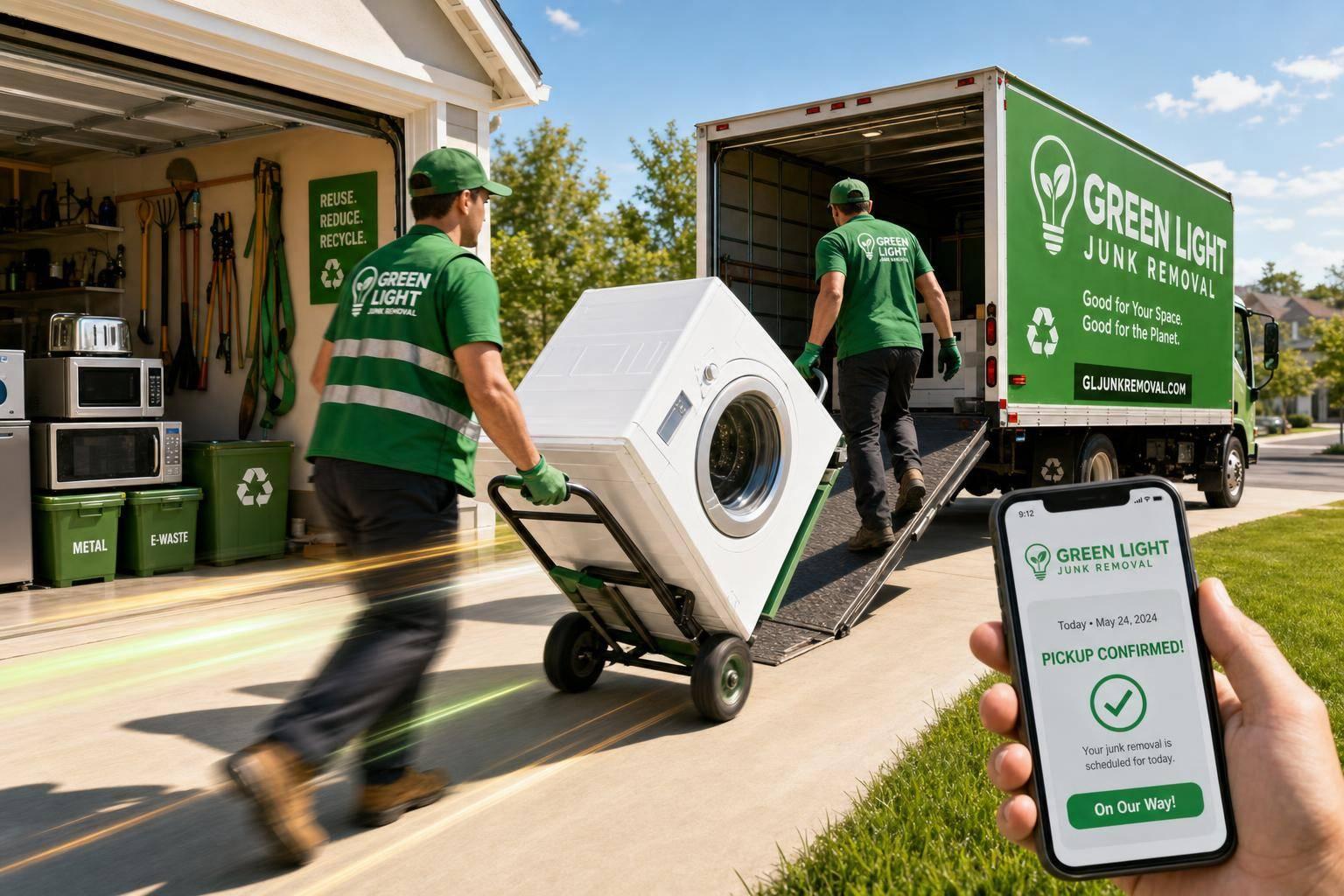
If I need an old appliance gone fast, full-service pickup is usually the top choice. In many cases, I can book same-day or next-day service, pay about $115 to $160 for one item, and avoid lifting a 150- to 300-pound machine myself.
Here’s the short version:
- Full-service removal is often the best pick when I need fast pickup, inside-the-home removal, and help with heavy lifting.
- Retailer haul-away works well if I’m buying a new appliance and the old one is already disconnected. It often costs $25 to $50.
- Recycling drop-off can be fast if I already have a truck, a helper, and a site that accepts the item.
- City bulk pickup can cost less, but I may need to wait a week or more and move the appliance to the curb myself.
- Fridges and freezers need special handling because refrigerant must be recovered by a certified technician.
- Gas appliances should be disconnected by a licensed pro before pickup.
What slows things down most? Not just weight. It’s often gas, water, or power hookups, tight doorways, stairs, and local disposal rules.
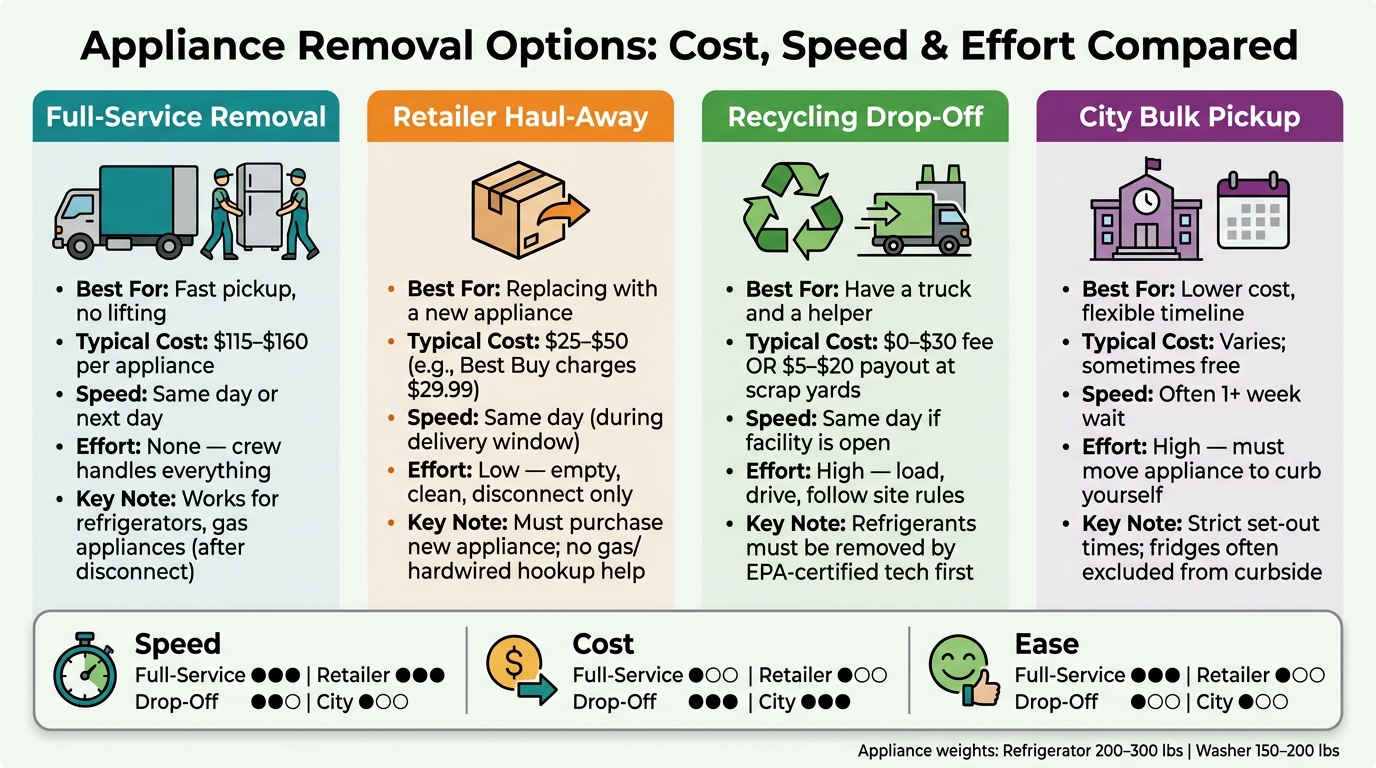
Appliance Removal Options: Cost, Speed & Effort Compared
Quick Comparison
| Option | Best for | Typical cost | How fast | What I need to do |
|---|---|---|---|---|
| Full-service removal | Fast pickup and no lifting | $115–$160 for one appliance | Same day or next day in many cases | Empty it, unplug it, clear a path |
| Retailer haul-away | Replacing with a new unit | $25–$50 | During delivery | Have it cleaned and disconnected |
| Recycling drop-off | I have a truck and help | $0–$30 fee, or $5–$20 scrap payout | Same day if site is open | Load, drive, and follow site rules |
| City bulk pickup | Lower cost and flexible timing | Varies; sometimes free | Often 1+ week | Schedule it and move it to the curb |
My main takeaway: if time matters most, I’d pick the option that matches the appliance hookup, the home layout, and the local rules before booking. That cuts down on delays, leaks, damage, and wasted trips.
sbb-itb-096ce5b
Fastest option for most households: full-service appliance removal
For most households, full-service appliance removal is the fastest, lowest-stress way to get rid of an old unit. You book online or by phone, get an upfront price, and the crew takes care of the heavy stuff: removal, loading, hauling, and basic cleanup. If you need the appliance gone today or tomorrow, this is usually the best fit because you don’t have to drag it outside or line up help.
For one appliance, like a refrigerator, pricing usually lands around $115–$160 [6]. Multi-item pickups often begin at about $125, and the final cost can change based on size, access, and local disposal rules [11]. The crew shows up with moving tools and ramps to help avoid damage to floors, walls, and door frames. Refrigerators and freezers are taken to certified facilities for refrigerant recovery [4]. If an appliance still works, it may be set aside for reuse or donation [1][9].
When same-day or next-day pickup makes the most sense
Fast pickup matters most when you’re on a deadline. Same-day or next-day service makes the most sense during a move-out, rental turnover, kitchen or laundry remodel, or when an appliance is leaking and needs to go ASAP.
It’s also a smart call when the appliance is in a basement, upstairs room, or tight closet. In those cases, the crew handles the awkward maneuvering, and you don’t have to wrestle it to the curb yourself.
What to do before the crew arrives
A little prep can make pickup go much faster. Before the crew gets there:
- Empty the appliance fully
- Unplug it
- Defrost a refrigerator or freezer at least a few hours ahead of pickup to help prevent leaks
- Clear a path to the exit
- Mention stairs, narrow hallways, or limited parking when booking so the team brings the right equipment and enough workers
Gas appliances need to be shut off and disconnected by a licensed professional before pickup. Water lines on washers and dishwashers can often be disconnected by the homeowner or a plumber.
Once the unit is ready, the on-site visit is usually pretty short.
Professional removal vs. DIY hauling: side-by-side comparison
| Factor | Professional Removal | DIY Hauling |
|---|---|---|
| Speed | Same-day or next-day service is often available [7][11] | Depends on truck rental and helper availability |
| Physical effort | None – crew handles all lifting and loading [7][11] | High; heavy lifting and help are required |
| Equipment needed | Provided, including dollies, straps, and trucks [1][5] | Must rent or borrow a truck, ramps, and straps |
| Risk of injury | Low; trained crew with proper tools and insurance [5][10] | High; heavy lifting increases injury risk |
| Floor and wall damage | Low; crews use protection for floors, walls, and door frames [1][11] | High; scuffs and damage are more likely |
| Refrigerant appliances | Handled at certified facilities [1][4] | Requires finding a certified drop-off site yourself |
| Eco-friendly disposal | Over 70% of materials can be diverted from landfills [8] | Varies; depends on local rules and your effort |
A professional crew usually spends about 15–30 minutes on-site [6].
If full-service removal isn’t the right fit, retailer haul-away and drop-off programs are usually the next-fastest options.
Other fast removal options when replacing or hauling the appliance yourself
If full-service pickup isn’t on the table, you still have two fast paths: retailer haul-away and self-drop at a recycling facility.
Retailer haul-away during new appliance delivery
Buying a new appliance? Retailer haul-away can take the old one during the delivery window. In most cases, fees fall between $25–$50. For example, Best Buy charges $29.99 [14].
The catch is prep. You usually need to empty, clean, and disconnect the appliance before the crew arrives. Delivery teams often won’t deal with gas lines, hard plumbing work, or hardwired hookups [4][12]. So this works best when the old unit is already unplugged, disconnected, and ready to leave. If your delivery timing doesn’t work, self-drop-off is usually the fastest backup.
Appliance recycling drop-off when you have a truck and help
Drop-off tends to move fast when you already have a truck or trailer, at least one helper, and a nearby site that takes the appliance [4][13]. Weight matters here. A standard refrigerator can weigh 200–300 pounds, and a washing machine usually lands around 150–200 pounds [3].
This option makes sense when the appliance can be moved without a big headache and the facility will take it.
Costs are often low:
- Many recycling centers charge $0–$30
- Some scrap recyclers pay $5–$20
- Call ahead to check hours, accepted items, and refrigerant rules [4][13]
One more thing: refrigerants must be recovered by an EPA-certified technician before recycling [4][3]. That’s a step you don’t want to find out about at the gate.
Retailer haul-away vs. recycling drop-off: side-by-side comparison
| Feature | Retailer Haul-Away | Recycling Drop-Off |
|---|---|---|
| Eligibility | Requires purchase of a new appliance [4][14] | Open to anyone with a vehicle [12] |
| Speed | Same-day delivery window [2] | Immediate, subject to facility hours [4] |
| Customer labor | Low – disconnection and cleaning only [12][14] | High – lifting, loading, and driving [12][13] |
| Vehicle needed | None [2] | Truck or trailer required [4][12] |
| Likely cost | $25–$50 [13] | $0–$30 fee, or $5–$20 payout at scrap yards [13] |
| Appliance types | Usually one-for-one, same type as purchased [14] | Most major appliances accepted [3] |
| Best use | Replacing a broken unit with a new one [14] | You have a truck, help, and a nearby facility [13] |
If speed matters less than cost, municipal bulk pickup is the next path to compare.
Lower-cost options that may be slower: municipal bulk pickup and city programs
If cost matters more than speed, municipal pickup is the next option to compare.
When price comes first and you have some wiggle room in your schedule, municipal bulk pickup can be a solid fit. The main draw is simple: it can cost less. Some cities charge by the item, while others offer pickup at no charge [15][16][19]. The catch? You usually pay for that lower price with more waiting and more work on your end.
Most municipal programs ask for at least a week of notice [15][17]. And if you put something out without scheduling it, the city will often skip it – or fine you [19].
When city pickup makes sense
City pickup works best when the appliance is already disconnected from power, water, and gas, you can get it to the curb yourself, and the next pickup date isn’t too far away. A few rules show up in almost every program:
- Set-out deadlines are strict. Depending on the city, your item may need to be at the curb by 5:30 a.m., 6:00 a.m., or 7:00 a.m. on service day, or placed out the night before [17][18]. In Louisville, KY, crews can start as early as 5:30 a.m. during high-temperature periods [17].
- Item limits apply. Louisville, for example, allows up to four large items per weekly appointment [17]. Denver limits general bulky pickups to five items [18].
- Refrigerators and freezers need special handling. These appliances contain refrigerants, so cities often treat them differently. Many municipalities do not allow curbside pickup unless the refrigerant has been professionally removed and certified. Others direct residents to a special waste site instead [15][17]. In Louisville, refrigerators and air conditioners must go to the Waste Reduction Center on Meriwether Avenue instead of being left at the curb [17]. Denver runs a separate program for refrigerant-containing appliances through 3-1-1 [18].
Check local utility rebates before you schedule.
Municipal pickup vs. full-service removal: side-by-side comparison
Here’s how municipal pickup compares with full-service removal.
| Feature | Municipal Bulk Pickup | Full-Service Removal |
|---|---|---|
| Booking Speed | Slower; fixed schedule or weekly appointments [7][17] | Fast; same-day or next-day available [4][6] |
| Curbside Requirement | Yes; resident must move item to curb [17][7] | No; crew removes from inside the home [7][6] |
| Personal Lifting | High; resident handles all labor [7] | None; crew handles all heavy lifting [4][6] |
| Item Restrictions | High; often excludes refrigerant appliances or has strict limits [17][19] | Low; accepts most non-hazardous items [6] |
| Property Damage Risk | Low; the item is already outside [7] | Moderate; crew moves the appliance through the home [6] |
| Convenience | Low; requires strict adherence to city schedule [4] | High; works around the resident’s timeline [4] |
If you need a faster option, compare it with the other removal methods in the next section.
How to pick the fastest removal method for your appliance and timeline
Pick the removal method based on the appliance type, its condition, and how fast you need it gone.
Best removal method by appliance type and condition
Not all appliances are the same when it comes to removal. Refrigerators and freezers need certified refrigerant recovery before anyone hauls them away. Releasing refrigerants is illegal under federal law [3]. Washers and dishwashers need water lines drained and disconnected before moving [6]. Skip that step, and you could end up with spills or water damage. Gas dryers and ovens need a licensed technician to cap the gas line before removal [3].
Condition matters just as much as appliance type. If a unit is broken or damaged, full-service removal or recycling is usually the fastest practical route. Use the chart below to match the appliance to the best option.
| Appliance | Key Prep Step | Main Disposal Concern |
|---|---|---|
| Refrigerator/Freezer | Defrost, tape doors shut | Refrigerant handling |
| Washing Machine | Drain water, disconnect hoses | Heavy weight, water damage |
| Gas Stove/Dryer | Cap gas line (hire a pro) | Gas leaks and fire hazards [3] |
| Dishwasher | Disconnect water and drain lines | Leaks and water damage |
Once you know which method fits, check the prep steps before you book pickup.
Key points to review before you book or schedule pickup
Unplug the appliance, clear a path to the exit, and measure doorways if the unit is large. If the appliance has gas, water, or hardwired connections, get those disconnected before pickup [6].
For the fastest pickup, go with full-service removal. If you already have a new appliance delivery on the calendar, retailer haul-away is often the best match. City pickup works if your timeline has some wiggle room and the appliance is already at the curb. Drop-off makes sense if you can load and transport the appliance yourself. Recycling is a good fit when you want a fast option that also keeps appliances out of landfills.
FAQs
Can you remove appliances from upstairs or basements?
Yes. Professional junk removal services can remove appliances from upstairs or basement areas, even when stairs or tight hallways are involved.
Crews use tools like dollies, sliders, and lifting straps to move items with care and help avoid damage to your home. If the job includes stairs or other access issues, the total cost may be higher, so share those details when you ask for an estimate.
What if my appliance is still connected?
If your appliance is still hooked up, a professional removal service may be able to disconnect it for you as part of the job.
If you’re handling the removal yourself, disconnect all electrical, gas, and water lines before you move it. Leaving those connections in place can create safety risks, stop the item from being picked up, and increase the chance of property damage during loading and transport.
How do I know which removal option is fastest for me?
Choose based on speed and how much work you want to do yourself.
If you need it gone right away and don’t want to deal with the heavy lifting, a professional junk removal service is usually the fastest pick.
If you’re buying a new appliance, a retailer haul-away program can be just as easy because they remove the old one when the new one arrives.
Municipal bulk pickup and recycling drop-off tend to take more time. They usually depend on set pickup dates, or you have to transport the appliance yourself.