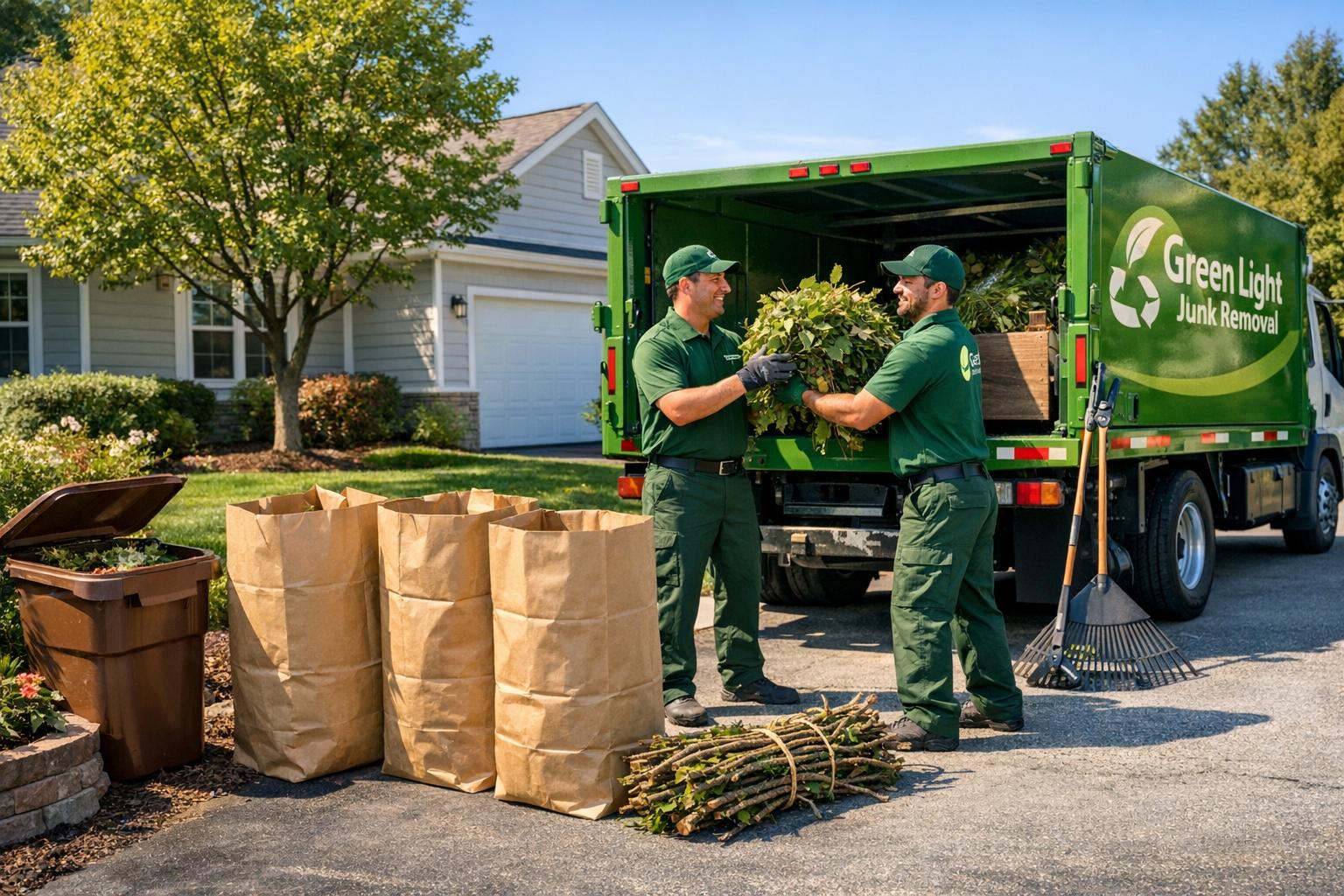
Yard waste can quickly pile up, creating problems for your lawn, property, and local environment. From fallen leaves to dead branches, managing this debris effectively is key to keeping your outdoor space clean and safe. Here’s a quick rundown of eight ways to handle yard waste efficiently:
- Sort by Type: Separate green waste, woody materials, and heavy debris to streamline composting or disposal.
- Mulching Mower: Use for light leaf coverage to recycle nutrients back into your lawn.
- Rake and Bag: Ideal for dense leaves and bulky debris; opt for biodegradable paper bags.
- Leaf Blowers: Best for large properties; choose the right CFM and MPH for your needs.
- Composting: Turn organic waste into nutrient-rich soil while reducing landfill contributions.
- DIY Mulch: Shred leaves or wood chips for garden beds to save on store-bought mulch.
- Municipal Pickup: Convenient for routine waste removal; follow local guidelines.
- Hire Professionals: For large-scale cleanups or when time and effort are a concern.
Each method offers a practical way to manage yard waste while saving time, reducing costs, and protecting your community. Whether you’re maintaining a small yard or tackling a big cleanup, these tips can help you keep your property neat and functional.
Yard Waste 101 – Tips and Tricks with Lee
sbb-itb-096ce5b
1. Sort Your Yard Waste by Type
Start by categorizing your yard waste. This straightforward step saves you time, avoids extra fees, and ensures proper processing. Separate waste into three main groups: green materials (like grass clippings, leaves, and weeds), woody materials (such as branches, twigs, and logs), and heavy materials (including dirt, rocks, and gravel). Green waste breaks down quickly for composting, while woody waste requires chipping to turn into mulch. Mixing these types can result in rejected loads or additional charges [3]. For the best composting results, keep leaves and grass clippings separate – they can enrich your garden soil effectively [1].
Be cautious with contaminated or invasive plants. Diseased or invasive plants should never go into your compost or mulch piles, as they can spread pathogens or seeds to healthy plants. Instead, bag these materials separately and dispose of them through your regular trash or a local program designed to handle such waste [1]. This includes plants like poison ivy or weeds that have already gone to seed.
For municipal pickup, use biodegradable paper bags, as many programs won’t accept plastic bags since they don’t decompose during processing [4]. Bundle branches with twine, ensuring each bundle is under 4 feet in length [1]. If you’re composting at home, aim for a balanced mix of green and brown materials to speed up the decomposition process [5].
Sorting yard waste properly isn’t just convenient – it’s also better for the environment. Loose leaves can clog storm drains, causing flooding and harmful nutrient runoff that damages aquatic ecosystems [4]. By organizing your waste, you save time, reduce costs, and help protect your community.
2. Use a Mulching Mower for Light Leaf Fall
Once you’ve sorted your yard waste, the next step is choosing the right tools to make cleanup easier. For lawns with less than 50% leaf coverage, a mulching mower is a great option. These mowers work by recirculating leaf clippings under the deck, chopping them into tiny pieces before evenly spreading them across your lawn. This approach eliminates the need for raking, bagging, or hauling, saving you time while also giving your lawn a natural nutrient boost [7].
Shredded leaves can supply up to 25% of your lawn’s yearly nutrient requirements, including nitrogen, phosphorus, and potassium. Plus, they decompose three to five times faster than whole leaves, so they don’t create thick mats that can harm your grass [7][13].
"Running your mower over the lawn when it’s covered with leaves helps break the leaves down so they can decompose into the soil, adding critical nutrients and organic matter."
– Teddy Rutberg, Founder, Rutheo Designs [12]
Make sure to mulch only when the leaves are dry – wet leaves can clump together and may even stall your mower’s engine. For the first pass, set your mower to its highest setting to avoid any issues, and then lower it for a second pass if needed [10]. If your lawn has moderate leaf coverage, running the mower twice at 90-degree angles can ensure the leaf pieces are small enough to settle between the grass blades. After mowing, you should still see grass through the shredded material. If the layer is thicker than 1 inch, lightly rake it to spread it out or bag the excess [10].
For heavier leaf cover – more than 6 inches or over 50% of your lawn – consider removing some leaves first or switching to raking and bagging. Mulching mowers typically cost between $200 and $400, but you can also upgrade your current mower with a mulching kit. This small investment can quickly pay for itself by reducing fertilizer costs, avoiding disposal fees, and saving you the effort of manual leaf removal [9].
3. Rake and Bag Yard Waste Properly
Mulching might handle a light leaf fall, but when your yard is buried under heavy layers of leaves or bulky debris like twigs, raking and bagging become essential. This method is the go-to solution when mulching isn’t practical – especially for dense leaf coverage or larger yard waste. The right tools can make all the difference. A leaf rake with flexible plastic tines works great for dry leaves, while metal tines handle damp leaves and pine needles more effectively [14][15]. For heavier debris like twigs or branches, a garden (bow) rake with sturdy, 90°-angled metal tines is your best bet [14][11]. This approach not only clears your yard but also makes composting or disposal easier and more efficient.
Timing is everything when it comes to raking. Wet leaves can weigh two to five times more than dry ones, so aim to rake on dry, calm days [8]. Plus, raking in the same direction as the wind can speed up the process [8][16]. Instead of creating one giant pile, focus on making several smaller piles. Keeping them a few feet across will make bagging easier and reduce strain on your back [17].
When it’s time to bag, opt for paper lawn bags instead of plastic. Not only are they biodegradable, but they also stand upright thanks to their flat bottoms, making them easier to fill. Many local composting programs even require paper bags [17][2]. Keep each bag under 50 pounds to prevent tearing and make collection simpler [2]. For faster bagging, try using a mini-rake or scooper to gather large amounts of leaves at once – it’s a real time-saver [17].
"When raking leaves, just think of it as a workout – good form will make the job easier and almost pain-free."
– Melanie Joseph, Writer, LawnStarter [15]
To avoid unnecessary strain, adjust your rake handle to keep your back straight, and use short, controlled strokes while moving your feet to gather leaves. For bigger yards, consider raking leaves onto a heavy-duty tarp (16 mil or thicker) and dragging it to your bagging area. This trick can save you from making multiple trips across your yard [8][11]. A basic leaf rake costs around $15–$30, and a pack of paper lawn bags is usually under $10 – making this a budget-friendly alternative to professional services, which can average about $158 per visit [8].
4. Use Leaf Blowers for Large Properties
If your property covers half an acre or more, raking can feel like an endless chore. That’s where leaf blowers come in. These tools can save you hours by quickly moving large amounts of leaves across grass and pavement, while also reducing the physical effort required [18][21].
To pick the right blower, focus on two key metrics: CFM (Cubic Feet per Minute) and MPH (Miles Per Hour). CFM determines how much air the blower moves, which impacts how many leaves you can clear at once. MPH, on the other hand, measures the airspeed needed to shift heavier or wet debris [24][25]. For properties larger than half an acre, a blower with 400–600 CFM will handle the job well [23][25]. Walk-behind models can deliver even more power – up to 1,270 CFM – but backpack blowers are often more practical for large spaces, as they’re easier to carry and distribute weight evenly [23][26].
"Work with the wind at your back so it won’t undo your hard work."
– Romel de Castro, Landscaper [20]
To make the job manageable, divide your yard into smaller sections and always position yourself with the wind at your back. Start at the edges and guide the leaves toward a central pile using a steady, side-to-side motion with the nozzle angled toward the ground [28]. For even quicker cleanup, blow leaves directly onto tarps, which you can then drag to your compost pile or the curb [19][22]. Adjust the blower’s power settings when working near fragile areas like flower beds [26][27].
Standard leaf blowers generally cost between $90 and $390 [20][21]. Gas-powered models are great for handling wet leaves and extended use, while battery-powered options – operating at 60–75 decibels – are ideal for noise-sensitive neighborhoods [20][27].
Finally, don’t forget about safety. Leaf blowers can produce air speeds exceeding 150 mph, so always wear safety goggles, earplugs, a dust mask, work gloves, and closed-toe boots to protect yourself during use [20][29].
5. Compost Yard Waste at Home
Composting is a simple way to turn yard waste into nutrient-packed soil while cutting down the amount of organic material by 50% to 75% [31][33]. Instead of sending leaves, grass clippings, and plant trimmings to the landfill – where they release methane, a greenhouse gas far more potent than carbon dioxide – you can create free, natural fertilizer for your garden [32].
To get started, pick a flat, well-drained spot with partial sun or shade, away from your home. Begin by laying down 3–4 inches of small branches or twigs to help with airflow. Then, alternate layers of browns (like dry leaves, straw, or wood chips) and greens (such as fresh clippings, plant trimmings, and spent flowers) in a 2–3:1 ratio [30][33]. For better results, chop woody materials into pieces between 1/2 inch and 1 1/2 inches.
"Greens provide moisture and nutrients, while browns help with aeration and moisture retention. Two-to-three parts brown to one-part green is a recommended ratio."
– Eliza Hensel, Extension Agent, Michigan State University [30]
Keep the pile as moist as a wrung-out sponge and turn it with a pitchfork every one to two weeks to boost oxygen flow. If maintained properly, the compost will heat up to 130°F–160°F, which helps eliminate most weed seeds and pathogens [33][35]. Avoid adding certain materials, like diseased plants, weeds with seeds, treated wood, pet waste, or grass clippings recently exposed to herbicides, as they can harm your garden later on.
In 3 to 6 months, your compost will be ready when it turns dark, crumbly, and smells earthy [33][34]. Whether you build a freestanding pile or invest less than $100 in a composting setup, this eco-friendly approach reduces landfill waste and gives your garden a natural boost.
6. Turn Yard Waste into Mulch for Garden Beds
Turning yard waste into mulch is a smart way to boost your garden’s health while cutting costs. Instead of buying mulch – which typically costs $3–$6 per bag or $22–$30 per cubic yard – you can create your own from materials already in your yard [37][38].
Start by shredding leaves into dime-sized pieces to use as mulch. For larger branches or woody debris, consider renting a wood chipper (around $75 per day) to produce small chips. These chips decompose slowly, offering long-lasting coverage. Grass clippings can also be used – just let them dry out before spreading them thinly to ensure proper water absorption.
Before applying mulch, clear out any weeds and water the garden bed to help retain moisture. Spread the mulch evenly, aiming for a depth of 2–4 inches. Be mindful of spacing: keep mulch 1–2 inches away from flower stems, 3–5 inches from shrubs, and at least 6 inches from tree trunks to prevent issues like bark rot or pests [36]. For added weed control, place a layer of damp newspaper or cardboard under the mulch.
Not all yard waste is suitable for mulch. Avoid using diseased plants, seeded weeds, herbicide-treated materials, black walnut, or resinous woods like juniper and spruce. These can either harm plant growth or take too long to break down [31][32]. For a balanced mulch, mix shredded leaves with wood chips – this combination provides both quick nutrient release and long-term protection for your soil.
"When organic waste decomposes it creates methane, which is a climate super pollutant 84 times more potent than carbon dioxide. By simply composting yard waste, we can divert organic material from landfills to help reduce greenhouse gas emissions."
– Jeremy Walters, Sustainability Ambassador, Republic Services [32]
Incorporating this method into your yard care routine not only supports your garden but also aligns with environmentally conscious practices. It’s a win for your plants and the planet.
7. Schedule Municipal Yard Waste Pickup
When handling yard waste feels overwhelming or impractical, municipal pickup can be a hassle-free solution. Many cities and towns provide curbside yard waste collection, often at no charge or for a small fee, especially during busy seasons. To see if your area offers this service, check your city or county website under sections like "Services", "Recycling", or "Sanitation." Alternatively, reach out to your local Public Works or Refuse Division for details on schedules and requirements.
Know what’s accepted: Most programs take items like leaves, grass clippings, small branches (commonly under 3–4 feet long and 2–3 inches thick), garden plants, brush, and twigs [41][43]. Some areas may also accept pine cones, pine needles, hay, and wood ash. However, items like soil, rocks, sod, treated wood, plastic flower pots, and pet waste are typically not allowed [40][41][43]. For instance, Germantown, TN, permits up to 10 cubic yards of yard debris weekly – equivalent to about 50 thirty-gallon bags [39]. In Memphis, TN, the limit is 0.5 cubic yards of bagged yard waste per week [42].
Prepare your waste properly: Use kraft paper bags, reusable containers, or city-issued carts for your yard debris. If you’re bundling branches, use twine (not wire or plastic tape) and keep bundles under 40 pounds. In Louisville, KY, containers must hold between 20–40 gallons and weigh no more than 60 pounds [41]. For Germantown residents, there’s an option to lease a 96-gallon yard debris cart for a one-time $75 fee [39].
Placement matters: To ensure your waste gets picked up, place it at the grass edge near the street, not in the road or gutters, as that can block storm drains. Keep your piles at least 4 feet away from obstacles like mailboxes, fire hydrants, utility poles, and parked cars to allow collection trucks easy access [44][45]. If your waste isn’t collected, look for a warning tag explaining why it didn’t meet the guidelines [42][43].
Keep in mind that many municipal programs pause during winter. For example, Louisville resumes service in late March, while St. Louis halts pickups from early December to mid-March. Check your local calendar for seasonal schedules and any make-up dates [41][46].
8. Hire Professional Yard Waste Removal Services
Sometimes, tackling yard waste on your own or relying on municipal pickups just isn’t enough. That’s when bringing in professional help can be a game-changer. Whether it’s heavy lifting, specialized equipment, or just the sheer volume of debris, hiring professionals ensures the job gets done quickly and safely. They take care of tasks like raking, shoveling, and hauling, all while minimizing the risk of injury. Plus, they come equipped with tools like wood chippers, excavators for stump removal, and large trucks, and they handle recycling or composting in line with local regulations. This approach pairs well with the eco-friendly methods mentioned earlier, especially for more demanding projects.
The cost for professional yard waste removal generally falls between $200 and $600 per visit, with most bulk jobs averaging around $300. Whether you’re dismantling an old deck, clearing out a shed, or disposing of lawn equipment that contains oil or gas, these experts know how to handle everything safely and in compliance with local laws.
Before hiring a service, it’s a good idea to:
- Get at least three quotes to compare pricing and services.
- Verify they have liability insurance and proper disposal permits.
- Ask about their disposal methods – do they compost or send waste to a landfill?
Most companies accept organic materials like leaves, grass clippings, hedge trimmings, brush, and garden plants. However, they usually require the waste to be free of contaminants such as metal, plastic, or food scraps. Many services also handle hardscape removal, including old fencing, pavers, or even larger structures like hot tubs and gazebos. If you have branches thicker than one inch in diameter, make sure to mention it when requesting a quote, as specialized equipment might be needed.
For regular upkeep, consider signing a maintenance contract. Weekly visits cost about $55, while annual packages average around $360. Beyond keeping your yard tidy, well-maintained landscaping can increase your home’s value by as much as 20%, making professional yard waste removal a smart investment in the long run.
Comparison Table
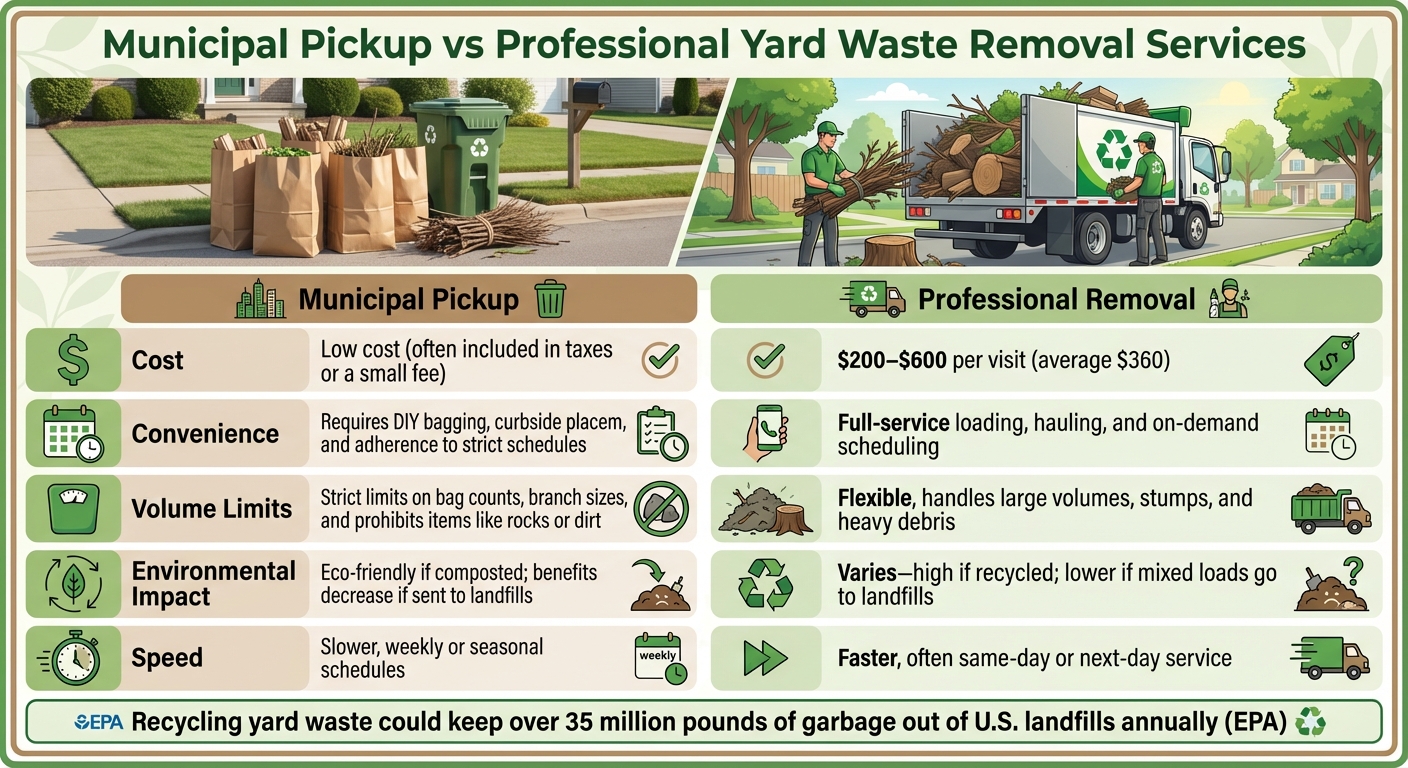
Municipal Pickup vs Professional Yard Waste Removal Services Comparison
Choosing between municipal pickup and professional removal services depends on factors like cost, time, and the size of your project. Municipal services are great for routine yard maintenance – think weekly grass clippings or seasonal leaf piles – but they come with strict rules about bag types, branch sizes, and weight limits. On the other hand, professional services take care of everything, from loading to disposal, making them a better option for larger projects or major cleanouts.
Both approaches can be eco-friendly if they ensure yard waste is sent to composting facilities. However, when yard waste ends up in landfills, it releases methane – a greenhouse gas that’s 25 times more potent than carbon dioxide [6]. According to the EPA, recycling yard waste across the U.S. could keep over 35 million pounds of garbage out of landfills every year [6]. If you’re hiring a professional service, it’s worth asking if they compost or recycle the waste. Be cautious with rental dumpsters, as mixed loads often head straight to landfills [2].
Here’s a side-by-side comparison to help you decide:
| Feature | Municipal Pickup | Professional Removal Services |
|---|---|---|
| Cost | Low cost (often included in taxes or a small fee) | Typically $200–$600 per visit (average $360) [6] |
| Convenience | Requires DIY bagging, curbside placement, and adherence to strict schedules | Offers full-service loading, hauling, and on-demand scheduling |
| Volume Limits | Enforces strict limits on bag counts, branch sizes, and prohibits items like rocks or dirt | More flexible and capable of handling large volumes, stumps, and heavy debris |
| Environmental Impact | Can be eco-friendly if waste is composted, but benefits decrease if waste ends up in landfills | Varies: high if waste is recycled; lower if mixed loads go to landfills [2] |
| Speed | Slower, generally following weekly or seasonal collection schedules | Faster service, often available on the same day or next day |
For big projects, like clearing fallen trees or handling significant debris, professional services are a time-saver and reduce physical effort. Municipal pickup remains a budget-conscious choice if you’re able to meet their bagging and scheduling requirements.
Wrapping It Up
Managing yard waste doesn’t have to feel overwhelming. The key is choosing a method that matches your property size, cleanup timeline, and personal goals. For smaller yards with regular upkeep, options like grasscycling or municipal curbside pickup work well. On the other hand, larger properties with significant debris – think fallen branches from mature trees – might benefit more from tools like leaf vacuums or hiring professional services. If you’re working against the clock, such as after a storm or before an event, professional services can provide same-day solutions. Meanwhile, methods like composting or mulching take longer but reward your patience with nutrient-rich soil enhancements.
Eco-conscious practices, like composting and mulching, also help reduce emissions. Yard waste, when left to decompose in landfills, releases methane – a greenhouse gas far more effective at trapping heat than carbon dioxide. By opting for sustainable disposal, you’re actively contributing to minimizing environmental harm.
Of course, budget plays a role too. Municipal services, often covered by local taxes, are a cost-effective option for routine waste removal. For larger-scale cleanups, professional services may require a bigger investment but save you time and effort.
Ultimately, the best choice depends on your yard’s specific needs, your schedule, and your commitment to sustainability. These approaches give you the flexibility to adapt as the seasons change and your yard’s demands evolve.
FAQs
What’s the fastest way to clear a yard after a storm?
After a storm, cleaning up your yard can feel overwhelming, but a step-by-step approach can make it manageable and safe. Start by inspecting your property for hazards like downed power lines or leaning trees that could pose a danger. Safety should always come first.
Next, tackle the large debris. Use tools like chainsaws or pruning shears to remove fallen branches or broken limbs. Prioritize clearing pathways and driveways to restore access and reduce tripping hazards.
Once the big stuff is out of the way, focus on the smaller debris. Tools like lawn sweepers or rakes make it easier to gather leaves, twigs, and other scattered materials. This method ensures a thorough and efficient cleanup, leaving your yard safe and tidy.
How do I know if my yard waste should be composted or trashed?
When dealing with yard waste, the choice between composting and trashing depends on what you’re handling and your area’s rules. Leaves, grass clippings, and small branches are perfect for composting, as they can break down and improve soil quality. On the other hand, larger branches, storm debris, or materials restricted by local regulations need proper disposal, often through services like curbside collection.
To stay on the right side of the rules and protect the environment, always check your local guidelines for waste disposal. This ensures you’re managing yard waste responsibly while minimizing harm to your surroundings.
When is it worth hiring Green Light Junk Removal for yard waste?
Hiring Green Light Junk Removal is a smart choice when you’re dealing with a large or tricky amount of yard debris. Their quick and eco-conscious service takes the hassle out of cleanup, especially for big projects or when navigating local disposal rules feels daunting. From pickup to proper disposal, they handle it all, giving you an easy, stress-free solution for managing yard waste.