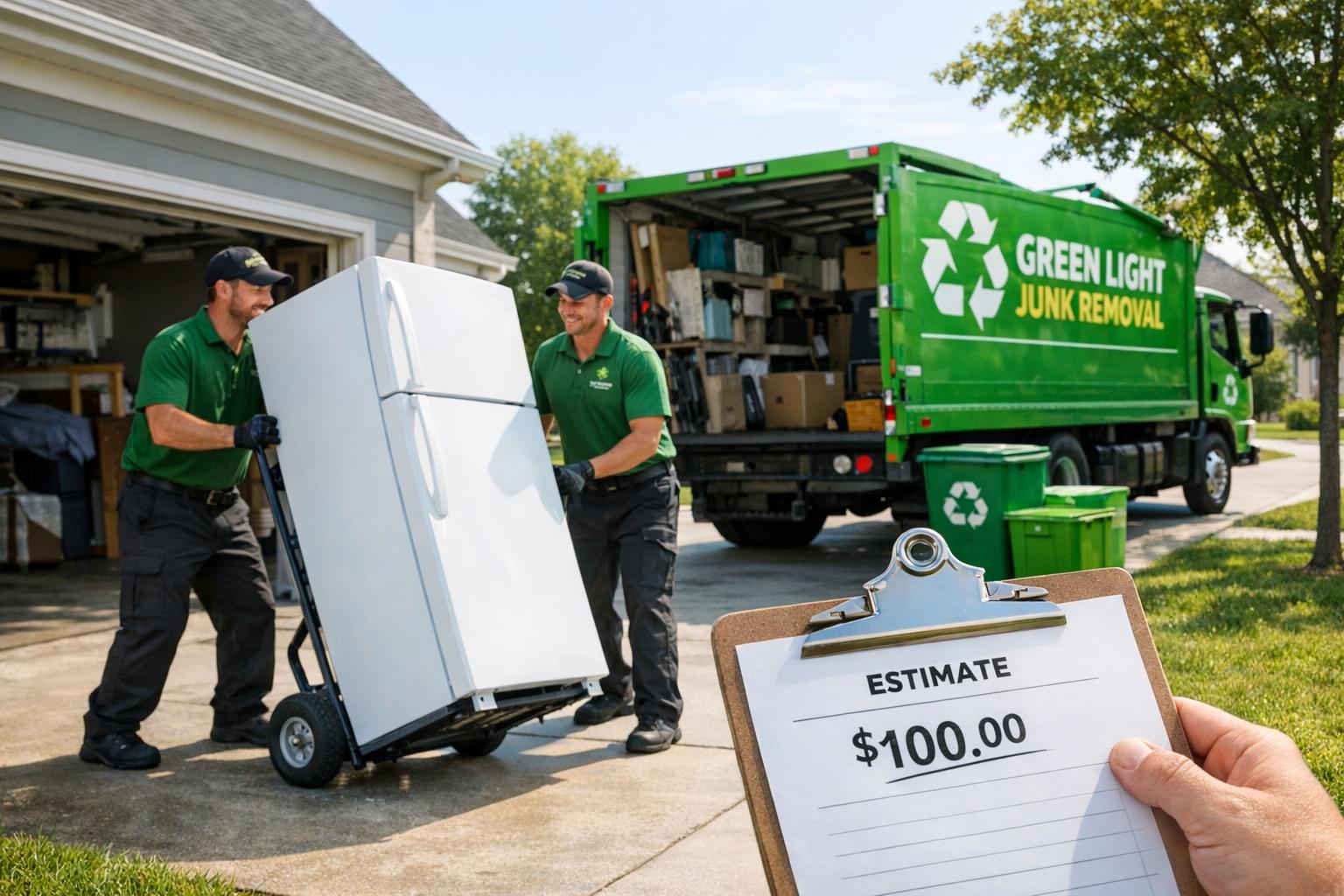
Appliance removal typically costs $75–$130 per item, with a national average of $100. The final price depends on factors like the type of appliance, its location in your home, and how it’s disposed of. For example:
- Refrigerators/Freezers: $50–$400 (includes $20–$50 refrigerant removal fees).
- Washers/Dryers: $75–$250 per unit.
- Ovens/Dishwashers: $75–$200.
Key Cost Factors:
- Size/Weight: Larger appliances cost more due to truck space and labor.
- Location: Accessibility impacts costs – stairs or tight spaces may add $25–$75 per flight.
- Disposal Method: EPA fees apply for refrigerants, while recycling or donating can reduce fees.
Money-Saving Tips:
- Bundle multiple items for discounts.
- Opt for curbside pickup to cut labor costs.
- Check for rebates or scrap metal credits.
Urban areas usually have higher fees due to labor and disposal costs, while rural areas may charge more for travel. Booking online with upfront pricing can help avoid surprises.
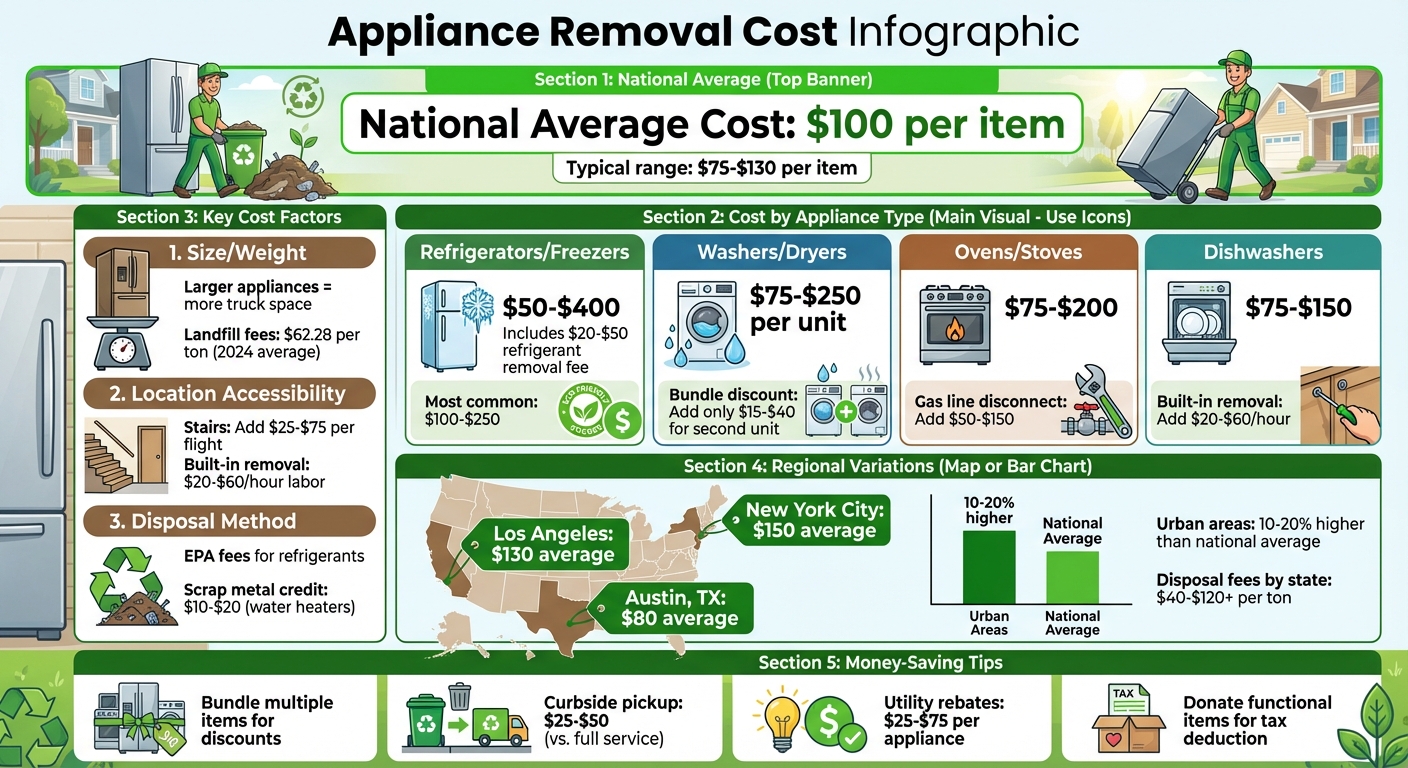
Appliance Removal Cost Breakdown by Type and Factors
How To Price In Junk Removal. My Pricing Sheet, Extra Fees, And Sales Tips.
sbb-itb-096ce5b
What Affects Appliance Removal Costs
Knowing what factors influence appliance removal costs can make budgeting much easier. Generally, three things determine how much you’ll pay: the size and weight of the appliance, how accessible it is, and the disposal or recycling method used.
Appliance Size and Weight
Most junk removal companies base their charges on the amount of truck space your appliance takes up, rather than just its weight. For example, a refrigerator might fill up about a quarter of a truck bed, while a microwave takes up much less space. On average, removing larger appliances like refrigerators or washing machines costs between $70 and $150, while smaller items like microwaves can cost $30 to $60 [5].
Weight, however, still plays a role – especially when it comes to landfill fees. In 2024, the national average tipping fee for landfills hit $62.28 per ton, a 10% increase from the previous year [6]. These costs are often passed on to customers. Heavier appliances also require more labor and equipment, which can bump up the price. For instance, some refrigerators can weigh over 700 pounds, requiring extra care and coordination to avoid property damage [5].
The next cost factor to consider is where the appliance is located in your home.
Location Accessibility
The location of your appliance can significantly influence removal costs. If it’s in an easily accessible spot, like your garage, removal is straightforward. But if it’s in a basement, requiring the crew to navigate stairs, you might face an additional charge of $25 to $75 per flight [2]. Similarly, built-in appliances often come with labor surcharges ranging from $20 to $60 per hour because they require careful removal [1].
Living in a rural area can also mean higher fees due to increased travel time and fuel costs. To save money, prep your space by clearing hallways and doorways so the crew has a direct path to the appliance. If possible, opt for curbside pickup, which is the least expensive option since it eliminates the need for professionals to move the item from inside your home.
"If more time is needed to remove an appliance from your home, expect a typical add-on rate of $20–60 per hour." – Yelp [1]
Finally, the disposal or recycling method plays a big role in determining your final bill.
Disposal and Recycling Methods
Once the appliance is removed, the way it’s disposed of or recycled affects the total cost. Items like refrigerators, freezers, and air conditioners contain refrigerants that require proper handling according to EPA regulations [2][5].
Some appliances, like water heaters, contain scrap metal that can offset removal costs. For instance, the metal in a water heater might be worth $10 to $20, lowering your fee. You can also save money by bundling multiple appliances into one pickup. If the appliance is still in good working condition, donating it could reduce your costs and even provide a potential tax deduction [3].
Average Costs for Common Appliances
The cost of removing household appliances can vary quite a bit, depending on factors like the size of the item, your location, and how the disposal is handled. On average, removing a single appliance costs around $100 nationwide [2]. Below is a closer look at what you might expect for different types of appliances.
Refrigerators and Freezers
Getting rid of a refrigerator or freezer typically costs between $50 and $400, with most jobs landing in the $100 to $250 range [2]. The price depends on the size of the unit and whether it contains refrigerants like freon. Since federal law requires EPA-certified technicians to safely recover refrigerants, some companies may tack on an additional environmental fee of $20 to $50 for this service [2].
"Refrigerators, freezers, window air conditioners, and other cooling equipment contain refrigerants such as freon… as well as hazardous materials like mercury, which require safe, eco-friendly disposal." – Yelp [1]
Washers and Dryers
For washing machines and dryers, removal costs typically range from $75 to $250 per unit [2]. These appliances are heavy – usually weighing between 150 and 200 pounds – so professional removal often requires at least two people and the right tools [9]. If you’re removing both a washer and dryer at the same time, many companies offer a discounted bundle price, adding only $15 to $40 to the cost instead of charging the full rate for each item [9].
Ovens, Stoves, and Dishwashers
The cost to remove ovens and stoves usually falls between $75 and $200, while dishwashers are slightly less expensive at $75 to $150 [2]. If you have a built-in dishwasher, you may face an extra charge of $20 to $60 per hour for the labor required to extract it from cabinetry [2]. Additionally, if your oven or stove is connected to a gas line, you might need a licensed plumber or electrician to disconnect it safely, which could add $50 to $150 to the total cost [2].
Regional Cost Variations Across the US
Local market conditions play a big role in shaping appliance removal costs. While factors like appliance size and accessibility are important, location is another key driver. For instance, in areas with a high cost of living, labor costs can run 10%–20% higher than the national average [7]. Disposal fees also vary widely, depending on weight. Some states charge as little as $40 per ton, while more regulated regions like California, Massachusetts, and Washington see fees climb to over $120 per ton [10]. These regional differences layer on top of previously discussed factors like accessibility and disposal logistics.
Urban vs. Rural Areas
Urban environments tend to have higher appliance removal costs due to unique logistical challenges. Think about navigating through heavy traffic, finding parking for removal trucks, or dealing with elevators and narrow stairwells in high-rise buildings. For example, in New York City, the average cost per appliance is $150, while in Los Angeles, it’s slightly lower at $130 [2]. Compare that to Austin, Texas, where the average is closer to $80 per appliance [2].
Rural areas, on the other hand, often benefit from lower labor costs. However, the distances to disposal or recycling facilities can add travel fees or fuel surcharges. Suburban areas usually fall somewhere in the middle, with prices influenced by local demand and the ease of access. Specific markets, like Sacramento, add another layer of complexity with their unique disposal fee structures.
Costs in Sacramento, CA
Sacramento residents face removal costs shaped by California’s higher labor and disposal fees. For instance, at Sacramento’s Kiefer Landfill (effective January 1, 2026), basic pickup costs $35. Bulky materials are billed at $144.90 per ton, while items requiring special handling can cost as much as $347.80 per ton [7]. These fees directly impact what professional removal companies charge. However, bundling multiple appliances or booking services online can sometimes help reduce overall costs.
Eco-Friendly Disposal and Recycling Options
Choosing eco-friendly disposal helps protect the environment while cutting down on costs. Professional haulers are trained to safely remove refrigerants and hazardous materials from cooling appliances, following EPA guidelines. This step is crucial since these substances can harm the ozone layer if not handled properly [1].
Recycling and Donation Services
If your appliance is still functional, donating it can be both environmentally and financially smart. Many local charities offer free pickup services, which can help you avoid the typical minimum removal fees [1]. Plus, you might even receive a tax receipt for your donation. If you’re hiring a removal service, ask them to prioritize donating usable items – this can help reduce fees tied to waste volume [3].
Eco-friendly disposal services also help cut landfill waste, which can save you money. Dumping fees can range from $50 to $100 per ton, but recycling or donating items often eliminates these costs [4]. These approaches not only lighten your environmental footprint but also trim down your removal expenses.
Another way to save? Take advantage of the scrap metal value in your old appliances.
Scrap Metal Recovery
Many appliances contain scrap metal that can offset removal costs. For instance, water heaters often have a scrap value of $10–$20, which some professional haulers use to reduce their labor and transportation fees [1]. In some cases, the scrap value might even cover the entire removal cost [1]. Be sure to check if your appliance – especially if it contains copper – qualifies for a scrap credit.
For those in the Sacramento area, Green Light Junk Removal offers safe appliance removal, ensuring proper disconnection from utilities [11][12]. Their transparent online pricing allows you to see costs upfront, making the process straightforward and hassle-free.
How to Save Money on Appliance Removal
The average cost for appliance removal in the U.S. is about $100, with most people spending between $60 and $180 [2]. If you’re looking to keep your expenses low, here are some practical tips to help you save.
Bundle Services for Discounts
Scheduling the removal of multiple appliances at once can save you a lot compared to booking separate pickups. For example, removing a single appliance typically costs between $75 and $130, but adding a second appliance often increases the price to only $90–$140 total [1]. Many companies even offer flat rates under $300 for multiple items [2]. This strategy helps reduce labor and transportation fees, which are key factors in removal costs.
"If a junk removal crew is already on-site, adding extra items costs far less than scheduling separate visits." – Haley Nothstein, Contributing Writer, Angi [2]
You can also combine appliance removal with other services, like furniture disposal or yard cleanups, to maximize your savings [2].
Choose Curbside Pickup
Cutting labor costs is another smart way to save. By moving appliances to the curb yourself, you eliminate the need for extra manpower. Many cities offer free or low-cost bulk item pickups as part of their regular trash services [4][13]. Additionally, some retailers will haul away old appliances for a fee of $25–$50 when they deliver new ones [1][8].
Keep in mind, though, that curbside pickup requires you to handle the heavy lifting. Make sure appliances are safely disconnected from gas, water, or electrical lines before moving them [2][1].
Book Online for Upfront Pricing
Booking online with companies that offer transparent pricing can help you avoid surprise charges. For instance, Green Light Junk Removal provides clear, upfront pricing so you know exactly what to expect – no hidden fees or unexpected costs.
Conclusion
The cost of appliance removal depends on factors like size, ease of access, and whether the item contains hazardous materials. On average, removal costs around $100 nationwide [2], though prices can vary depending on the type of appliance, as discussed earlier.
Location plays a big role too. Urban areas often have higher fees due to increased disposal costs and logistical challenges [2][10].
Eco-friendly disposal methods can also impact costs. Services that adhere to EPA guidelines aim to recover as much material as possible, which can help reduce fees. Additionally, utility companies sometimes offer rebates – ranging from $25 to $75 per appliance – to offset removal expenses [9]. These factors combined influence the final cost, making it important to weigh both practical and environmental considerations.
To simplify the process, Green Light Junk Removal offers clear, upfront pricing with no hidden fees. Their team takes care of everything, from safely disconnecting appliances to ensuring they’re responsibly recycled or donated. With online booking and professional service, they make appliance removal stress-free.
FAQs
What’s included in an appliance removal quote?
An estimate for appliance removal typically accounts for labor, transportation, and disposal fees. Some companies might also include services like recycling in an environmentally conscious manner or ensuring the safe handling of hazardous materials. It’s always a good idea to double-check what’s covered with the service provider you choose.
How can I avoid extra fees for stairs or tight spaces?
To steer clear of extra charges for stairs or tight spaces during appliance removal, make sure to share all relevant details with your service provider ahead of time. Some companies might add fees for handling these challenges, so being upfront allows them to give you an accurate quote. Clear communication not only helps them plan properly but can also save you from surprise costs or even open the door to negotiating terms before the job begins.
Do I need to disconnect gas, water, or power before pickup?
Before pickup, it’s crucial to disconnect appliances from gas, water, and power. This step ensures they’re safe and ready for removal. Double-check that all connections are securely turned off and detached to prevent any complications during the process.