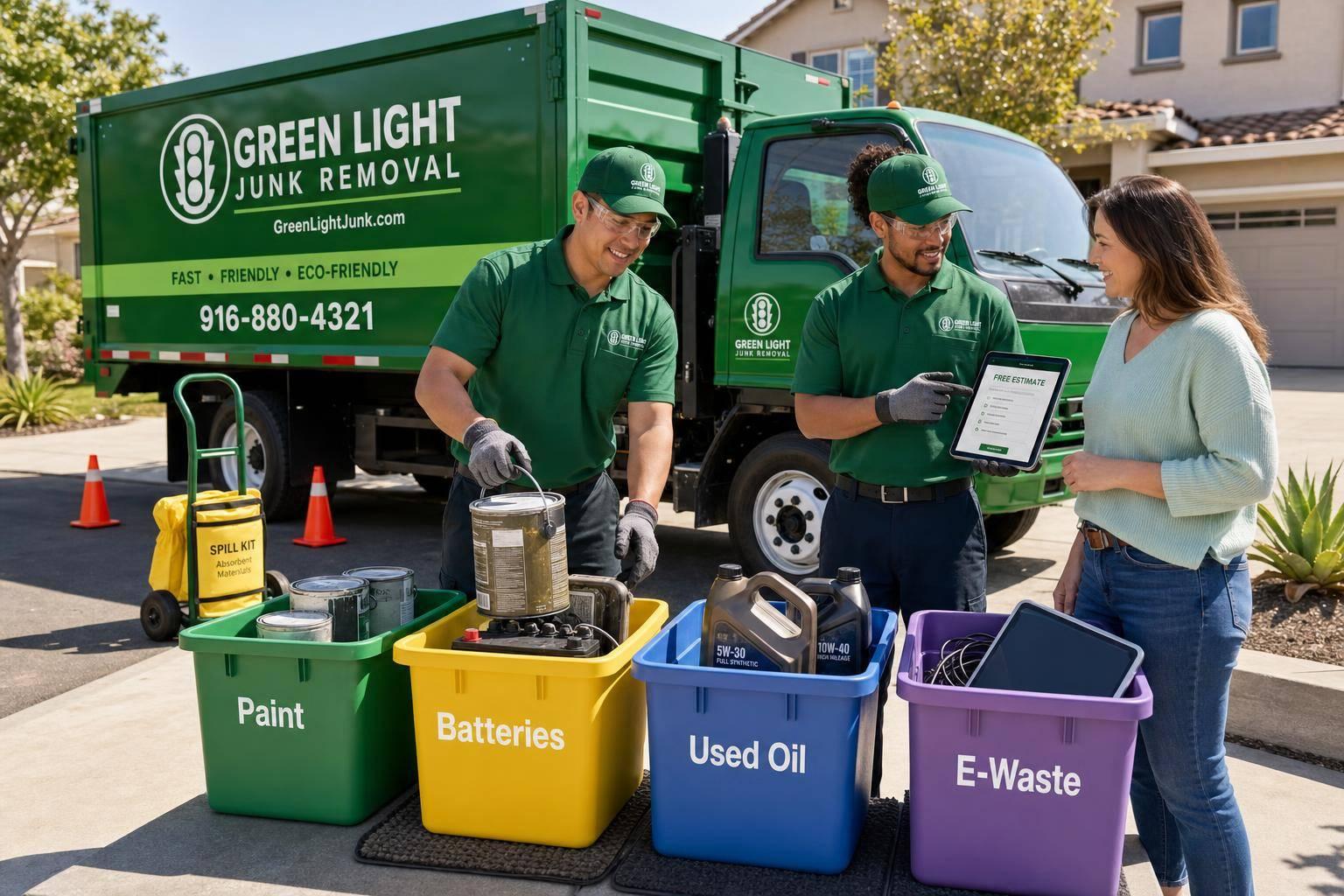
In California, you can’t put many household chemicals, batteries, bulbs, paint, or e-waste in the trash. If you find them during a cleanout, keep them sealed, leave labels on, and take them to an approved Sacramento-area drop-off site.
We see this during garage cleanouts, rental turnovers, estate cleanouts, and move-outs across Sacramento, Elk Grove, Roseville, Folsom, Rancho Cordova, Citrus Heights, Rocklin, West Sacramento, Davis, Carmichael, Fair Oaks, Natomas, Antelope, Galt, and nearby areas. The main steps are simple: identify the item, store it safely, transport it the right way, and use the right local facility.
Quick takeaways:
- Illegal in California: Hazardous waste should not go in the trash, storm drain, or on the ground.
- Watch for label words: DANGER, WARNING, CAUTION, FLAMMABLE, and POISON.
- Common items: paint, solvents, motor oil, antifreeze, pesticides, pool chemicals, batteries, fluorescent bulbs, propane tanks, and electronics.
- Trip limit: Many California HHW programs limit loads to 15 gallons or 125 pounds per trip.
- Local option: Sacramento Recycling & Transfer Station at 8491 Fruitridge Road is one key drop-off site for residents.
- Before you drive: Keep containers upright, closed, leak-free, and labeled. Tape battery terminals and keep bulbs unbroken.
At Green Light Junk Removal, we help sort bulky junk from items that need special disposal so your cleanout stays safe and on track. If you need help with a property cleanup, we’re here to help with a free estimate.
Hazardous Waste at Home: Paint, Cleaners, Oil & More | Season 1, Episode 5 | What Do I Do with This?
sbb-itb-096ce5b
How to Identify Hazardous Waste in Your Home, Garage, or Rental Property
Most people don’t notice how much hazardous waste they have until they start cleaning out a garage, shed, closet, or rental unit. We see this all the time in Sacramento, Folsom, Rancho Cordova, and nearby areas. A single shelf in the garage or a small utility closet can hold products that need special disposal.
The first place to look is the product label. Check for hazard words, then inspect the garage, utility room, laundry area, and storage spaces for old chemicals, worn containers, or mystery bottles. Once you spot warning labels, you can start sorting out which items need extra care.
Warning Labels and Red Flags to Look For
If a product is marked DANGER, WARNING, CAUTION, FLAMMABLE, or POISON, it needs special handling[2][3]. Labels that say TOXIC, CORROSIVE, REACTIVE, or OXIDIZER are red flags too[4].
Never peel off, hide, or cover the original label on a container. Disposal sites and recycling programs use those labels to figure out what’s inside and how to handle it safely[2].
A few other signs should make you slow down:
- Leaking containers
- Rusted cans
- Strong chemical odors
- Cracked lids
- Unmarked bottles or jars
- Old products you can’t identify
If you find any of these during a cleanout in Elk Grove, Roseville, Carmichael, or Fair Oaks, it’s smart to keep the item separate until you know what it is.
Common Hazardous Items Sacramento Residents Often Find
During garage cleanouts, estate cleanouts, and rental turnovers across Sacramento, Elk Grove, Citrus Heights, and Fair Oaks, the same types of hazardous items show up again and again. Our team often finds them tucked into cabinets, workbenches, backyard sheds, and side-yard storage bins.
Here are the items Sacramento homeowners and property managers find most often.
| Category | Common Items Found |
|---|---|
| Automotive | Used motor oil, antifreeze, brake fluid, car batteries |
| Garden & Pest Control | Pesticides, herbicides, pool chemicals |
| Home Improvement | Oil-based paint, paint cans with wet residue, paint thinner, solvents, adhesives |
| Household Cleaners | Drain cleaner, oven cleaner, bleach, aerosol spray cans |
| Lighting & Power | Fluorescent tubes, CFLs, batteries, including rechargeable and button-cell batteries |
| Electronics (E-Waste) | TVs, laptops, cell phones, printers, tablets |
| Pressurized Containers | Propane tanks, non-empty aerosol cans |
| Mercury-Containing Items | Glass thermometers, older thermostats |
Non-empty aerosol cans, including old spray paint and cleaners, are hazardous because their propellants can be flammable or toxic[4][1]. If you’re handling a move-out in West Sacramento or Davis and come across a box of half-used spray cans, don’t toss them in the trash.
We also see these items during rental property cleanouts in Natomas, Antelope, Galt, Rocklin, and surrounding communities, especially when tenants leave behind garage supplies, paint, batteries, or old electronics.
Items That Are Illegal to Throw Away in California
Some of these items cannot go in regular trash at all. In California, it is illegal to dispose of hazardous waste in the regular garbage, down storm drains, or onto the ground[1][4]. Batteries, fluorescent bulbs, electronics, and mercury-containing items must be handled separately and taken to approved drop-off, recycling, or hazardous waste programs[4][1].
That matters for homeowners, landlords, property managers, and contractors alike. Tossing the wrong item into a trash bin can create safety problems for trash workers, damage property, and lead to disposal issues later. If you’re not sure what you’ve found, our team at Green Light Junk Removal can help you sort through the load and point you in the right direction before pickup. If you need help with a cleanout in Sacramento, Elk Grove, Folsom, Rancho Cordova, or nearby, request a free estimate from us.
Safe Handling, Storage, and Transport Before Disposal
Once you spot hazardous items, the next job is to secure them before drop-off. The biggest risks at this stage are leaks and exposure. We see this all the time during garage cleanouts, rental turnovers, and move-outs across Sacramento, Elk Grove, Roseville, Folsom, and nearby areas. A few simple steps can help you avoid a mess in your home, car, or truck.
After you sort everything, handle each item the right way before loading it for drop-off.
How to Store Hazardous Products Safely at Home
Keep hazardous products in their original containers. That way, the label stays attached and the safety directions are still easy to read.
Store chemicals in a cool, dry place away from heat, direct sunlight, food, children, and pets. A shelf in a hot garage next to pet food or pantry items is not a good spot.
Never mix chemicals together. Even if two products seem similar, mixing them can lead to dangerous fumes, fires, or explosions. It’s just not worth the risk.
How to Prepare Hazardous Items for a Drop-Off Trip
California limits residents to 15 gallons or 125 pounds of hazardous waste per trip to a collection site [2][3][7]. If you have more than that, plan more than one trip or set up disposal in smaller loads.
Before transport, make sure every container is:
- Tightly sealed
- Leak-proof
- Clearly labeled
Place containers upright in sturdy cardboard boxes. Add padding around breakable items, especially fluorescent tubes, so they don’t crack on the drive. Keep all hazardous materials in the trunk or truck bed, not inside the passenger area.
That one step matters more than people think. If a container tips over or starts leaking, you do not want fumes or chemicals inside the cab.
Safety Tips for Specific Hazardous Materials
Some items need a little extra prep before transport:
| Material | Key Precaution |
|---|---|
| Batteries | Tape battery terminals with clear tape to help prevent short circuits and fires [6][4] |
| Fluorescent Tubes & CFLs | Keep them intact; never break them [6][4] |
| Propane Tanks | Transport upright in an open truck bed or other well-ventilated space |
| Motor Oil | Keep it in a sealed, clearly labeled container |
| Sharps (needles, lancets) | Store sharps in a sealed sharps container or rigid plastic bottle [1] |
If you’re cleaning out a property in Rancho Cordova, Citrus Heights, Rocklin, West Sacramento, Davis, Carmichael, Fair Oaks, Natomas, Antelope, Galt, or nearby communities, our team at Green Light Junk Removal can help you sort what belongs in junk hauling and what needs special disposal. If you’re unsure about an item, request a free estimate and we’ll help point you in the right direction before you load anything up.
How to Dispose of Common Hazardous Household Waste the Right Way
For garage cleanouts, rental turnovers, and move-outs, we always tell customers the same thing: match each item to the right disposal path. After items are sealed and labeled, take time to sort them the right way before loading your vehicle. The wrong drop-off method can still lead to contamination, fines, or even fires.
Paint, Solvents, Motor Oil, and Automotive Fluids
Paint disposal trips people up all the time. Latex paint and oil-based paint do not follow the same rules, but in California, neither one can go in the regular trash [4].
Paint thinner, solvents, used motor oil, oil filters, antifreeze, and brake or transmission fluid should go to an approved household hazardous waste, or HHW, drop-off site [3]. Never pour any of these down a sink, toilet, driveway drain, or storm drain. That can damage plumbing, pollute waterways, and create a mess that costs far more to fix.
Sacramento residents can drop off these materials for free at the Sacramento Recycling & Transfer Station (SRTS), 8491 Fruitridge Road. The site is open Tuesday through Saturday, 8:00 a.m. to 5:00 p.m. [2]. If you’re in Roseville, there is also free residential HHW pickup, which includes up to 5 gallons of paint per appointment [6].
A simple tip from our team at Green Light Junk Removal: keep liquids upright in a box or bin during transport, and don’t mix products together. That makes drop-off safer and helps staff handle everything the right way.
Next, separate chemical cleaners, pesticides, batteries, and bulbs from liquids and auto fluids.
Pesticides, Cleaning Chemicals, Batteries, and Bulbs
Pesticides, herbicides, pool chemicals, drain cleaners, oven cleaners, and disinfectants all need hazardous waste drop-off [3][1]. These products may look harmless sitting on a shelf, but if they leak in the trash or back of a truck, they can cause serious cleanup problems.
If a container is mostly full and still has its label, the SRTS Reuse Store may accept it and offer it to other residents at no charge [2]. That can be a good option for usable products you don’t want to keep.
Batteries and fluorescent bulbs count as universal waste, so they must stay out of the trash. That includes:
- AA, AAA, C, D, 9-volt, and button batteries
- Fluorescent tubes, CFLs, and LED bulbs [4]
Residential customers can drop these off at Sacramento-area HHW facilities at no charge [2]. If you live in Sacramento, Elk Grove, Folsom, Rancho Cordova, Citrus Heights, Rocklin, West Sacramento, Davis, Carmichael, Fair Oaks, Natomas, Antelope, Galt, or nearby areas, it’s smart to check the site rules before heading out. Some locations have packing, quantity, or ID rules.
Propane Tanks and E-Waste
Propane tanks can’t just be tossed in the trash pile. Sacramento-area HHW facilities accept standard BBQ grill tanks and small camping cylinders, but industrial gas cylinders are usually not accepted [3][2]. Keep tanks upright and secured while driving so they don’t roll around.
For e-waste, accepted items include televisions, computer monitors, laptops, printers, cell phones, tablets, and microwave ovens [4][1]. These items should not go into the trash or curbside recycling.
Before you head to SRTS, check current pricing for small and medium e-waste items. Some products, such as printers and cell phones, may have fees there [2]. A quick look before you leave can save you time at the gate.
When we help with cleanouts across Sacramento and nearby communities, we often see hazardous items mixed in with old furniture, boxes, or garage clutter. That’s where people get stuck. If you want help sorting junk from HHW before a move-out, estate cleanout, or rental turnover, request a free estimate for our junk removal services from Green Light Junk Removal. Our team can help you clear the space and point you toward the right local disposal options.
Where to Take Hazardous Waste in the Sacramento Area
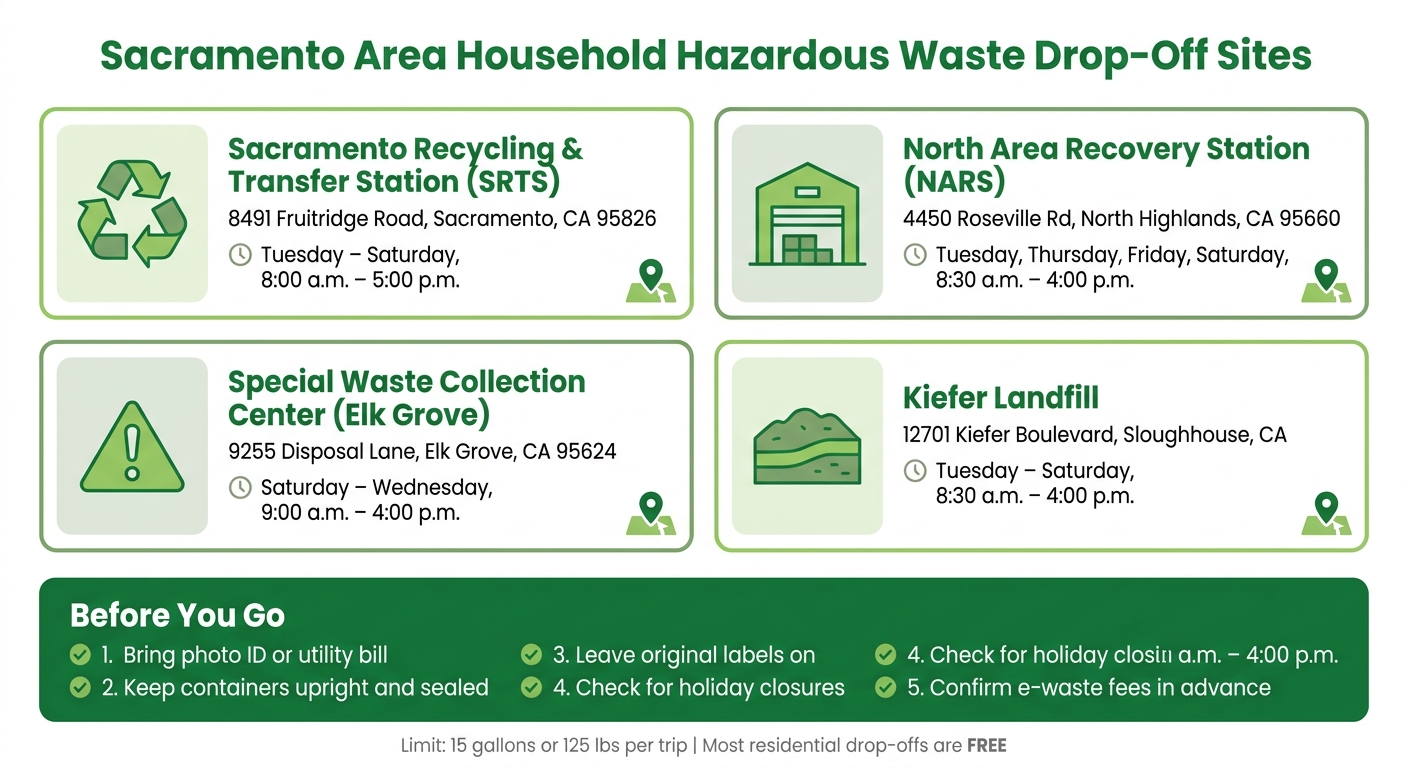
Sacramento Area HHW Drop-Off Sites: Hours, Locations & Accepted Items
Once you’ve sorted and sealed hazardous items, the next step is simple: take them to the right drop-off site. A lot of Sacramento-area residents know what counts as hazardous waste, but they’re not always sure where it should go. The good news is that there are several free household hazardous waste drop-off options in and around Sacramento for residential customers [2][5].
Local Household Hazardous Waste Drop-Off Options
Sacramento County and the City of Sacramento run several permanent household hazardous waste facilities. These sites take many common hazardous materials at no charge for residents. Our team always tells customers to use the location that fits both their item type and residency.
| Facility | Address | Hours |
|---|---|---|
| Sacramento Recycling & Transfer Station (SRTS) | 8491 Fruitridge Road, Sacramento, CA 95826 | Tue – Sat: 8:00 a.m. – 5:00 p.m. [2] |
| North Area Recovery Station (NARS) | 4450 Roseville Rd, North Highlands, CA 95660 | Tue, Thu, Fri, Sat: 8:30 a.m. – 4:00 p.m. [5] |
| Special Waste Collection Center (Elk Grove) | 9255 Disposal Lane, Elk Grove, CA 95624 | Sat – Wed: 9:00 a.m. – 4:00 p.m. [5] |
| Kiefer Landfill | 12701 Kiefer Boulevard, Sloughhouse, CA | Tue – Sat: 8:30 a.m. – 4:00 p.m. [5] |
If you live in Elk Grove, pay close attention to the schedule at the Special Waste Collection Center. It operates Saturday through Wednesday, which can catch people off guard if they show up on a Thursday or Friday. If you have sealed products that are still usable, it’s also smart to ask if they can go to the Reuse Store.
Whether you’re in Sacramento, Elk Grove, Rancho Cordova, Carmichael, Fair Oaks, Natomas, Antelope, Galt, or nearby areas, checking the site details before you leave can save time and frustration.
What to Check Before You Go
Before heading out, confirm the site hours, accepted items, and residency rules. We’ve seen plenty of people make the trip only to find out a site is closed or won’t take what they brought. A little prep goes a long way.
Keep your load safe during transport:
- Pack only what your vehicle can carry safely
- Keep containers upright and secured
- Make sure every container is leak-proof
- Leave labels in place so staff can identify the contents
Bring a photo ID or a utility bill to show residency. It’s also smart to check for holiday closures before you go, especially around Veterans Day and Thanksgiving [5].
You should also verify a few item-specific details before loading up. Some facilities may charge e-waste fees for items like printers or stereos [2]. If you want to use the Reuse Store, check whether it’s open that day. Businesses and contractors need to call ahead for drop-off scheduling, and fees may apply [2][5]. Most sites do not accept asbestos, explosives, ammunition, or radioactive materials, so always confirm first if you have restricted items [2][3].
If you’d rather not sort through all of that on your own, our team at Green Light Junk Removal can help you figure out what belongs at a hazardous waste facility and what we can haul from your property in Sacramento, Roseville, Folsom, Citrus Heights, Rocklin, West Sacramento, Davis, and surrounding communities. If you need help clearing out a garage, shed, rental, or job site, request a free estimate from our team.
When to Call Green Light Junk Removal for Help
Once you’ve sorted out the hazardous items, the rest of the cleanup is often the toughest part. Big cleanouts can turn into a mess fast, especially when bulky junk is mixed with items that can’t go in the regular load.
We see this all the time in estate cleanouts, foreclosures, evictions, rental turnovers, and office cleanouts across Sacramento and nearby areas. A single property may have old furniture, broken appliances, leftover cleaning supplies, car fluids, and batteries all piled together. That means someone has to sort everything the right way before anything leaves the site.
Cleanout Jobs Where Professional Help Makes Sense
Our team at Green Light Junk Removal handles estate cleanouts, eviction cleanouts, office cleanouts, and renovation cleanup jobs throughout Sacramento, Folsom, Elk Grove, Citrus Heights, Rocklin, and surrounding communities. We also help customers in Roseville, Rancho Cordova, West Sacramento, Davis, Carmichael, Fair Oaks, Natomas, Antelope, Galt, and nearby neighborhoods.
These jobs often include a mix of junk that can be hauled away and items that need to be set aside first. That’s where things can slow down for property owners, landlords, contractors, and managers. If the load is large, heavy, or mixed with household hazardous waste, it helps to have our team on site to keep the cleanup organized and moving.
How Our Team Makes the Process Easier
Once the hazardous items are separated, we remove the non-hazardous debris and keep the rest isolated for proper disposal. When our crew arrives, we sort through what’s on the property, remove the bulky items, and help speed up the cleanup.
We also help spot items that should be pulled out for approved HHW drop-off. Products labeled DANGER, CAUTION, WARNING, FLAMMABLE, or POISON should be separated before transport [2][3].
Here’s how we help make large cleanouts easier:
- Remove furniture, appliances, trash, and other non-hazardous debris
- Keep hazardous items separate so they don’t get mixed into the junk load
- Help identify items that need approved HHW drop-off
- Clear out the property fast so owners and managers can move to the next step
If you’re dealing with a large cleanout in Sacramento, Elk Grove, Folsom, Roseville, or a nearby community, request a free estimate from Green Light Junk Removal.
Conclusion: Protect Your Property and the Sacramento Environment
Once you pull hazardous items out from the rest of the cleanout, stick to three simple steps: keep them sealed, label them clearly, and take them to an approved drop-off site. When you need to dispose of hazardous household waste, find it early, keep containers closed and marked, and bring everything to an approved Sacramento-area HHW site. In California, the limit is 15 gallons or 125 pounds per trip, and many residential HHW facilities offer free drop-off when you follow site rules [2][3].
Skipping those steps is illegal in California and can put your property at risk. Hazardous waste should never go in the trash, down storm drains, or on the ground. Doing that can lead to fires and contamination [4].
When a cleanout includes both hazardous waste and bulky junk, it helps to have our team handle the heavy lifting so the job stays on track. At Green Light Junk Removal, we help homeowners, landlords, property managers, and contractors across Sacramento, Elk Grove, Roseville, Folsom, Rancho Cordova, Citrus Heights, Rocklin, West Sacramento, Davis, Carmichael, Fair Oaks, Natomas, Antelope, Galt, and nearby areas with mixed cleanouts.
If you’re planning a property cleanout and need dependable help, request your free estimate from Green Light Junk Removal today.
FAQs
What if a container has no label?
If a container has no label, our team recommends labeling it before transport. Household hazardous waste needs a clear label so it can be handled safely.
If you don’t know what’s inside, do not mix it with other products or toss it in the regular trash. That’s illegal and dangerous. If you’re not sure what to do next, contact your local Sacramento-area hazardous waste facility before moving it.
Can I combine small amounts of chemicals?
No. Never mix different chemicals. That’s one of the biggest safety mistakes people make with household hazardous waste. Mixing cleaners, solvents, paint products, or other chemicals can lead to toxic fumes, fire, or even an explosion.
We always tell customers across Sacramento, Elk Grove, Roseville, Folsom, Rancho Cordova, and nearby areas to leave each product separate and handle it with care.
Keep every item in its original labeled container whenever possible. That label matters. It helps identify what’s inside and allows the drop-off staff at a Sacramento-area facility to handle it the right way.
If a container is damaged, don’t pour the contents into something else unless you have no safe option. Instead:
- Put the damaged container inside a larger leak-proof container
- Label it clearly
- Make sure it is tightly sealed before transport
That simple step can help prevent spills in your car and make drop-off safer for everyone involved.
Will I need proof of residency?
In the Sacramento area, most household hazardous waste drop-off sites don’t clearly ask for proof of residency for residential customers. What they usually care about is whether the waste came from a household and not from a contractor, business, or job site.
That said, some sites have their own local rules. For example, the Special Waste Collection Center in Elk Grove may limit certain days or services to Elk Grove residents. Rules can also change based on staffing, site capacity, or the type of material you’re bringing in.
Before you load up your vehicle, it helps to:
- Sort items by type so drop-off goes smoother
- Label containers clearly if the original label is missing
- Make sure the waste is from your home, not from commercial work
- Check the site’s current rules for Sacramento, Elk Grove, Roseville, Folsom, Rancho Cordova, Citrus Heights, Rocklin, West Sacramento, Davis, Carmichael, Fair Oaks, Natomas, Antelope, Galt, or nearby areas
If items look commercial, mixed, or not allowed, the facility may turn them away. We often tell customers that a little prep goes a long way. Safe packing, clear labels, and a quick rules check can save you a wasted trip.
If you’re not sure what counts as household waste or you need help clearing out a garage, shed, or rental property, our team at Green Light Junk Removal can help you figure out the next step and provide a free estimate.