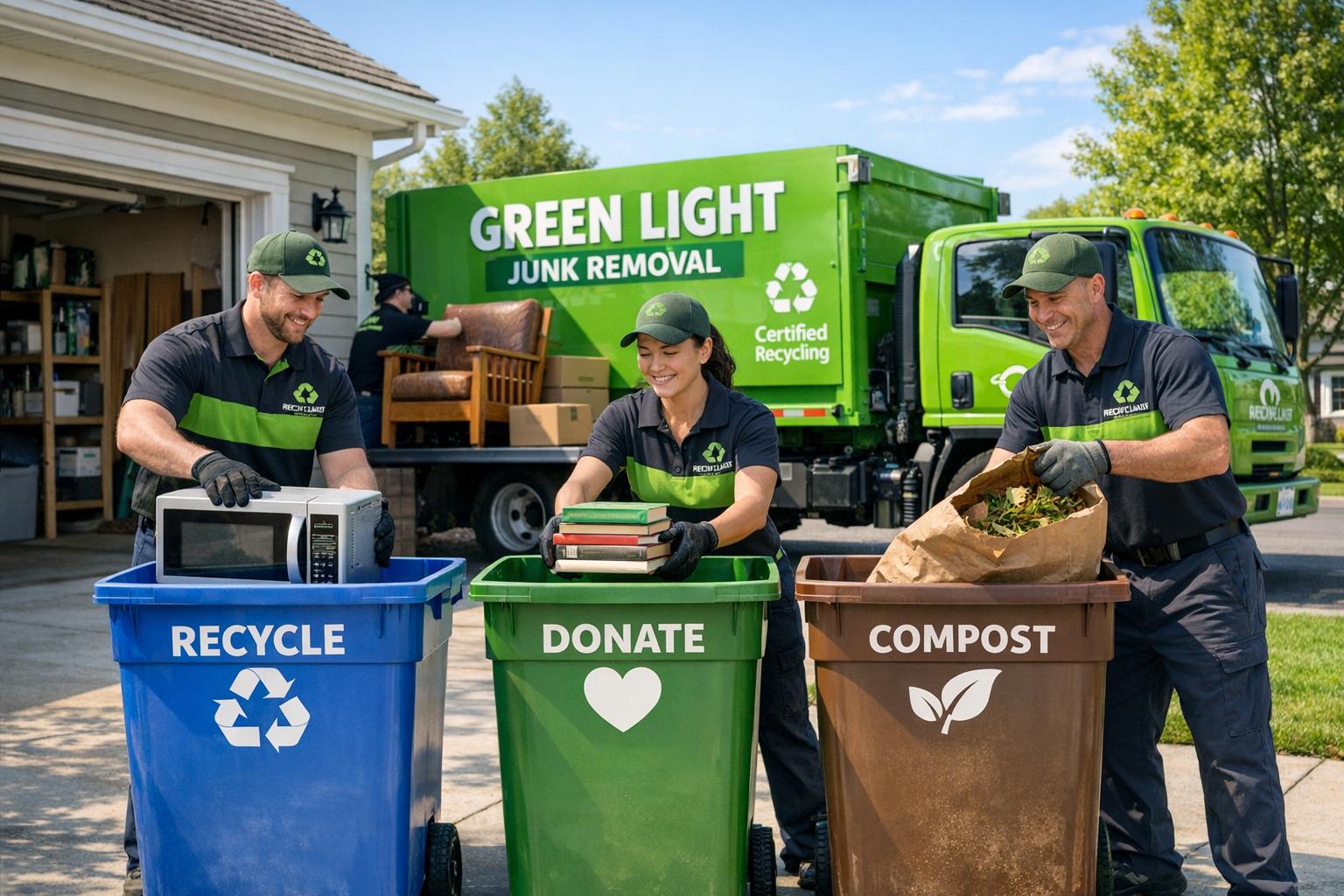
Did you know that over half of the 292 million tons of waste generated annually in the U.S. ends up in landfills? This contributes to methane emissions and toxic pollution. Yet, 75% of this waste could be recycled, but only 32% actually is. Recycling saves resources, energy, and reduces environmental harm – like saving 17 trees and 7,000 gallons of water for every ton of paper recycled.
Here’s how to make a difference:
- Sort your junk: Identify recyclable items like paper, metals, and plastics, and handle hazardous waste like batteries separately.
- Donate usable items: Organizations like Habitat for Humanity ReStore accept furniture and appliances.
- Recycle responsibly: Use services like Green Light Junk Removal to ensure proper sorting and recycling.
- Compost organic waste: Turn food scraps into nutrient-rich compost at home.
Professional services like Green Light Junk Removal simplify the process by sorting, donating, and recycling your junk efficiently. They also handle electronics and appliances responsibly, ensuring hazardous materials don’t harm the planet. Small changes like these can significantly reduce landfill waste and conserve resources.
Recycling isn’t just about disposal – it’s about giving items a second life.
How to Sort Your Junk for Recycling
Identifying Recyclable Materials
The first step in recycling is recognizing what materials can actually be recycled. Did you know paper and cardboard account for 23% of municipal solid waste? Most community recycling programs accept items like newspapers, magazines, mail, and flattened cardboard boxes. Even pizza boxes can be recycled, as long as any food residue is removed [5].
Plastics require a closer look. Check for the resin identification code (numbers 1–7) on containers, as recycling capabilities vary by location. In 2018, only 8.7% of the 35 million tons of plastic generated in the U.S. was recycled [5].
Glass containers, such as jars and bottles, are recyclable – though you should avoid including broken pieces for safety reasons. Metals like aluminum, foil, and steel are also widely accepted. For instance, aluminum was recycled at a rate of 34.9% in 2018 [5].
Household Hazardous Waste (HHW) items require extra care. These include items like pesticides, paints, solvents, and certain light bulbs. Lead-acid batteries, for example, are recycled at an impressive rate of 99%, but lithium-ion batteries – which are often found in toys and tools – need to be taken to specific collection points due to fire risks. Never mix these items with regular recyclables [5].
Preparing Items for Safe Disposal
Once you’ve identified recyclable materials, it’s time to prep them for proper disposal. This step not only improves recycling efficiency but also ensures worker safety. For food containers and aluminum foil, rinse or scrape off any food residue – aim for "spatula-clean" [5]. Flatten cardboard boxes to save space and make processing easier. If you’re recycling glass bottles, remove metal caps to ensure they’re handled correctly.
For electronics, always delete personal data before recycling or donating. In 2018, about 38.5% of the 2.7 million tons of consumer electronics generated were recycled [5]. Hardcover books are a bit tricky – remove the covers before recycling the pages.
Here’s a tip for aluminum cans: don’t crush them if you’re using single-stream recycling. Automated systems work better with unflattened cans [5]. As for plastic bags, wraps, and films, avoid tossing them into curbside bins. Instead, take them to designated drop-off points, often found at grocery or retail stores.
Used motor oil is another item that needs special attention. Recycling just one gallon of used oil can yield 2.5 quarts of new oil, compared to the 42 gallons of crude oil needed to produce the same amount [5]. Many auto-supply stores accept used oil for recycling, and online tools like Earth911 and RecycleNation can help you find drop-off points for specialty items like batteries, oil, and electronics [5].
Next, we’ll explore how donating and upcycling can help you cut down on waste even further.
sbb-itb-096ce5b
Donating and Reusing Household Items
Where to Donate Usable Items
Before scheduling junk removal, take a moment to assess your items. Donating usable goods is a smart way to reduce landfill waste and support your community. What may seem like junk to you could be exactly what someone else needs. For example, Habitat for Humanity ReStore accepts furniture, appliances, housewares, and building materials. With locations across the country, their ZIP code search tool makes it easy to find a nearby store. These outlets help keep hundreds of tons of materials out of landfills every year [10].
Organizations like Fresh Start Furniture Bank focus on helping families transitioning out of homelessness, as well as veterans, refugees, and disaster survivors. Since its inception, Fresh Start has supported over 4,500 families and kept more than 200,000 items from being discarded [8]. If your furniture doesn’t meet their criteria, large thrift chains like Savers are another excellent option [9].
Keep in mind that most donation centers have specific requirements. Furniture should be free of damage like rips, tears, or broken parts, and appliances must be in working condition. Make sure everything is clean before donating, as charities typically reject items that are visibly dirty [8,9].
"Working with [ReStore] is a lot easier because they have the manpower and logistics to support large donations." – Raj Jain, Vice President of India Handicrafts, Inc. [6]
If you donate to a qualified 501(c)(3) organization, you may also be eligible for a tax deduction [6]. Always check donation hours in advance, as they can differ from regular retail schedules [10]. Some charities offer free pickup for large items, while others may charge a fee (around $50) to cover operational expenses [11,12].
When donation isn’t possible, consider giving your items a second life through upcycling.
Simple Upcycling Ideas for Common Items
Upcycling is a creative way to turn old items into something new and useful, while also keeping them out of landfills [11]. Even small updates can make a big difference. For instance, replacing old drawer pulls or hinges on a dresser or desk can give it a whole new look [7].
If you’re into DIY fabric projects, try reupholstering dining chair seats or headboards with fresh fabric. Got an old dining table? Repurpose it as a workbench in the garage or a folding station in the laundry room. Other ideas include mounting wooden crates on walls for shelving, turning vintage trunks into coffee tables or storage benches, or using old wooden ladders as towel racks or plant stands [7].
For textiles that are beyond repair, natural fabrics like cotton, wool, and linen can even be composted [7]. Before starting any upcycling project, sand down old finishes to ensure new paint or stain adheres properly, and always work in a well-ventilated area. These projects not only refresh your home but also fit perfectly into an eco-conscious junk removal plan.
Working with Professional Recycling Services
How Appliances and Electronics Get Recycled
When you schedule a pickup with Green Light Junk Removal, the process ensures your old appliances and electronics are kept out of landfills. The company collaborates with certified facilities that hold R2 (Responsible Recycling) or R2v3 certifications, ensuring proper handling and environmentally responsible management of electronics [12][13]. Did you know the U.S. generates around 6.9 million tons of e-waste annually, but only 22.3% of it gets recycled? [13]
Here’s how it works: electronics are broken down into their base components, such as plastics, wires, circuit boards, metals, and glass [12][14]. Hazardous parts, like those found in old CRT TVs, are carefully handled to manage toxic materials like lead and cadmium. Capacitors containing PCBs or DEHP are sent to EPA-approved incineration facilities for safe disposal [12][14]. Generally, if an item is over 70% metal or has a cord, it’s likely recyclable [14].
"Reuse is our #1 goal! Our rule of thumb: if it’s over 70% metal and/or has a cord attached, we can recycle it!" – 1 Green Planet [14]
Green Light Junk Removal doesn’t stop at electronics. They handle everything from refrigerators and washing machines to construction debris and yard waste [4]. To make the process smooth, gather your items in an easy-to-reach spot before pickup. If you have particularly heavy items like hot tubs or pianos, let the team know ahead of time so they can bring the right equipment [4]. With upfront pricing available through online booking and a 9.1/10 customer satisfaction rating from 200 reviews, their service is both efficient and reliable [4].
In addition to recycling electronics, reducing organic waste at home is another impactful way to minimize landfill contributions.
Setting Up Home Composting for Organic Waste
While professional services take care of the big stuff, composting at home is a simple way to reduce waste every day. Pick a spot in your yard that’s convenient but not too close to your house – somewhere with good drainage and partial shade works best. You’ll need a bin or a designated area about 3 feet by 3 feet to ensure good airflow.
Start by creating a base layer with twigs or straw for drainage. Then, alternate between "green" materials (like fruit peels, vegetable scraps, and coffee grounds) and "brown" materials (such as dry leaves, cardboard, and newspaper). Keep the pile moist – think the texture of a wrung-out sponge – and turn it every few weeks using a pitchfork or shovel. Avoid adding meat, dairy, or oily foods, as these can attract pests and slow down decomposition. In three to six months, you’ll have nutrient-rich compost ready for your garden. This small effort at home complements broader recycling initiatives by turning organic waste into something useful for your plants.
If you find yourself with more yard debris or organic waste than you can handle, Green Light Junk Removal’s yard cleanup service is a great option. They’ll manage the heavy lifting and ensure the materials are processed according to environmental standards [4].
Benefits of Eco-Friendly Junk Removal
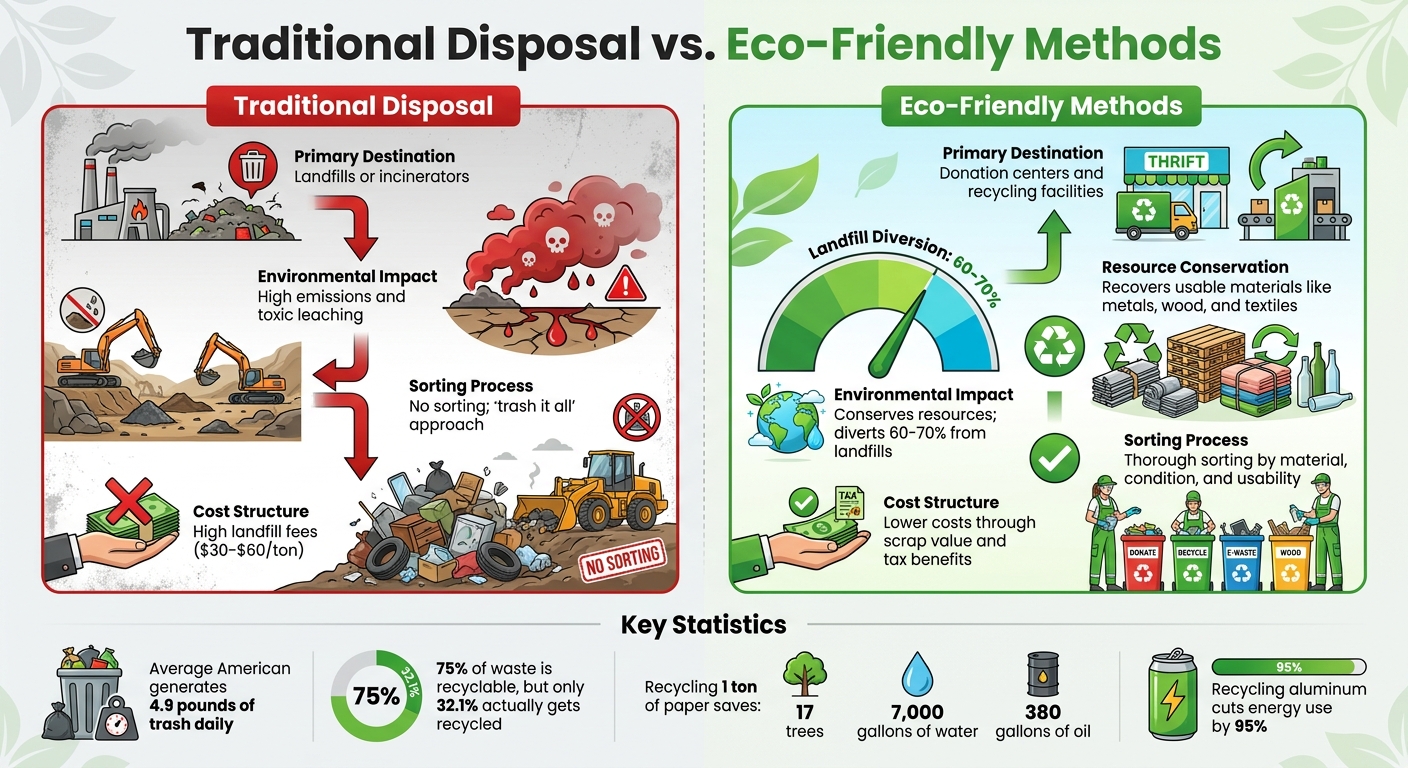
Traditional vs Eco-Friendly Junk Removal: Environmental Impact and Cost Comparison
Traditional Disposal vs. Eco-Friendly Methods
The contrast between traditional junk disposal and eco-friendly methods goes beyond just where your waste ends up. Opting for sustainable practices helps conserve resources and can even save money. Did you know the average American generates 4.9 pounds of trash every day? That adds up to a massive annual waste load. Yet, while 75% of this waste is recyclable, the national recycling rate is only 32.1% [1][3].
Here’s a quick comparison of the two approaches:
| Feature | Traditional Disposal | Eco-Friendly Methods |
|---|---|---|
| Primary Destination | Landfills or incinerators [3] | Donation centers and recycling facilities [2] |
| Environmental Impact | High emissions and toxic leaching [2][1] | Conserves resources; diverts 60-70% from landfills [2][3] |
| Resource Conservation | Depends on new material extraction [2] | Recovers usable materials like metals, wood, and textiles [3][1] |
| Cost Structure | High landfill fees ($30–$60/ton) [3] | Lower costs through scrap value and tax benefits [2][3] |
| Sorting Process | No sorting; "trash it all" approach [2] | Thorough sorting by material, condition, and usability [1] |
The benefits of eco-friendly junk removal are clear when you look at the numbers. For instance, recycling just one ton of paper saves 17 trees, 7,000 gallons of water, and 380 gallons of oil. Recycling aluminum is even more impactful, cutting energy use by up to 95% [2].
Green Light Junk Removal takes this approach seriously. They sort items into four categories – donatable, recyclable, hazardous, and true waste – ensuring only the last category ends up in landfills [2][1].
By understanding these differences, you can see how eco-friendly practices directly conserve resources and reduce environmental harm. Plus, tracking these efforts makes the impact even more tangible.
How to Track Your Recycling Impact
Transparency is a cornerstone of eco-friendly junk removal. Knowing exactly where your discarded items go – along with their weight and destination – proves that most of your waste is being reused or recycled [2][3]. This ensures your junk gets a second life instead of sitting in a landfill for decades.
When arranging a pickup, ask your service provider about their local partnerships. Reputable companies often work with organizations like Goodwill or Habitat for Humanity for donations [3][2]. For recyclables, they collaborate with certified facilities that process materials like metals, plastics, and wood. As an added bonus, you can request tax-deductible donation receipts, and some services even provide detailed reports showing how much waste they diverted from landfills [3].
"By sorting and tracking every piece, it helps us minimize local landfill waste and support eco-conscious lifestyles." – Gary Bostick, Heart and Soul, Junked: Powered by Vets [1]
This level of tracking reassures you that your junk is being handled responsibly. Green Light Junk Removal combines environmental care with dependable service. Whether you’re decluttering your attic or managing a larger cleanout, knowing your items are being processed thoughtfully makes the whole experience more rewarding.
Conclusion
Eco-friendly junk removal is about making smarter choices that protect the planet while improving your living or working space. By properly sorting through your junk, you help divert a significant amount of waste from overcrowded landfills [2][3]. This practice not only reduces environmental harm but also supports organizations like Goodwill and Habitat for Humanity. Plus, recycling conserves energy and saves natural resources, making it a win-win all around.
Professional services take these efforts a step further by ensuring nothing goes to waste. For example, Green Light Junk Removal handles everything – from sorting and transporting to delivering items to certified recycling facilities or donation centers. They give your unwanted items a second chance at life instead of letting them end up in a landfill. Whether you’re cleaning out your garage, managing an estate, or renovating an office, these services save you time while maximizing environmental benefits.
"Eco-friendly junk removal isn’t simply a business practice. It’s a foundation for environmental responsibility." – Gary Bostick, Heart and Soul, Junked: Powered by Vets [1]
This combination of individual action and professional expertise creates a full-circle approach to sustainable junk removal. Every step – sorting, donating, recycling – contributes to a cleaner, greener future. Whether it’s upcycling old furniture or working with services that track recycling data, your choices can make a difference. With the right approach, your junk won’t just be discarded – it’ll be repurposed responsibly.
FAQs
What items can’t go in my curbside recycling bin?
Not everything belongs in your curbside recycling bin. Items you should keep out include non-recyclable plastics, partially full aerosol cans, asbestos, ammunition, and hazardous waste like batteries or chemicals. Additionally, avoid placing broken or non-recyclable appliances and items needing special handling, such as broken wooden furniture or anything containing refrigerants. Always check your local guidelines to ensure proper disposal of these materials.
How do I recycle batteries and other hazardous waste safely?
To recycle batteries and hazardous waste safely, it’s essential to handle them correctly. For lithium-ion batteries, tape the terminals and place each battery in a separate plastic bag before disposal. Never throw them into household garbage or standard recycling bins. Instead, drop them off at designated collection points or hazardous waste facilities. Similarly, items like chemicals or paint should be taken to your local household hazardous waste site to guarantee safe and environmentally responsible disposal.
Can I get a receipt showing what was donated or recycled?
Receipts are often available for items you donate or recycle, and they can be quite handy for tax purposes. Donations, in particular, might qualify for deductions. Many environmentally conscious junk removal services focus on recycling and donating items, making sure you get the necessary documentation for your records.