When deciding what to do with old furniture, donating and recycling are two primary options. Here’s what you need to know:
- Donation is ideal for furniture in good condition. It helps families in need, reduces landfill waste, and may offer tax deductions if donated to qualified charities.
- Recycling works best for damaged furniture. It salvages materials like metal, wood, and foam but requires more effort due to limited facilities and the need for disassembly.
Quick Comparison
| Method | Best For | Cost | Effort | Condition | Tax Benefits |
|---|---|---|---|---|---|
| Donation | Usable furniture | Free or minimal fees | Moderate (transport) | Good condition required | Yes |
| Recycling | Damaged or unusable items | $79–$400+ (removal) | High (disassembly) | Any condition accepted | No |
Choose donation for functional furniture to support local causes and reduce waste. Opt for recycling if the furniture is broken or unsuitable for reuse. For convenience, professional removal services can handle both options efficiently.
Donation vs Recycling for Old Furniture: Complete Comparison Guide
DONATE vs. TRASH vs. RECYCLE| What to Actually DO with Your Clutter
sbb-itb-096ce5b
Benefits of Donating Old Furniture
Giving away furniture you no longer need can make a big difference – not just for people in your community but for the planet as well.
Helping Local Communities and Charities
When you donate furniture, you’re directly helping families facing tough times. Organizations like the National Furniture Bank Association assist more than 100,000 families each year, providing essential household items to those transitioning from homelessness, escaping domestic violence, or starting over as refugees [1]. As the Dallas Furniture Bank describes their mission:
Furnishing hope and dignity for families transitioning from crisis to stability [3].
These groups rely on donations to meet urgent needs. A donated couch, dining table, or bed in good condition can go to someone who otherwise couldn’t afford such basics. This helps families redirect their limited funds toward other essentials like food, medical bills, or education. Plus, donating doesn’t just help people – it also reduces waste by keeping usable furniture out of landfills.
Reducing Landfill Waste
Every time you donate furniture, you’re helping to cut down on landfill waste. Each year, 9.7 million tons of furniture end up in landfills, with only 0.3% being recovered for reuse [1]. By donating, you’re giving furniture a second life and keeping large, bulky items out of the trash. If you have items that aren’t suitable for donation, professional junk removal services can ensure they are disposed of responsibly.
Donating also avoids the environmental impact of incineration. Around 2.36 million tons of furniture are burned annually for energy recovery [1], releasing harmful pollutants from treated wood, foam, and synthetic materials. Choosing to donate instead means fewer emissions and a cleaner environment.
Potential Tax Deductions
Donating to qualified charities like Habitat for Humanity ReStore or The Salvation Army can also offer you a financial benefit. If you itemize your deductions, you may be able to reduce your federal income tax based on the furniture’s Fair Market Value (FMV) – essentially, what it would sell for in its current condition [4][5].
For example, a sofa in good shape might have an FMV of $35–$200, while a dining room set could be valued at $150–$900 [5]. To claim these deductions, keep written receipts for all donations. If any single item is valued over $250, you’ll need a formal acknowledgment from the charity [5]. For the 2026 tax year, the standard deduction is $16,100 for single filers and $32,200 for married couples filing jointly [5]. Donating furniture could help you save money if your total deductions exceed these amounts.
Drawbacks of Donating Old Furniture
Donating furniture might seem straightforward, but it often comes with unexpected challenges.
Condition Requirements for Donations
Charities aren’t able to accept every piece of furniture – they typically require items to be in "good to excellent" or "resaleable" condition. This means furniture with rips, stains, smoke odors, pet damage, or structural issues (like broken frames or missing parts) often gets turned away [1][7]. Before scheduling a donation pickup, ask yourself: Would I buy this item in its current state from a thrift store?
In fact, up to 40% of furniture donations are rejected because they either fail to meet quality standards or because donation centers don’t have enough storage space [7]. As Dropcurb puts it:
Charities are not dumpsters with tax receipts – they have strict standards because they need to resell or redistribute your furniture. [7]
Furniture made from particleboard, such as pieces from IKEA or Wayfair, is especially prone to rejection. These "fast furniture" items typically last only 5–7 years and aren’t sturdy enough to handle multiple moves, making them unsuitable for resale [1][7]. Additionally, many organizations won’t accept mattresses or sleeper sofas due to health regulations and sanitization concerns [1][7].
Transportation and Logistics Challenges
Even if your furniture meets the strict condition requirements, getting it to a donation center can be a logistical headache. While some charities offer free pickup services, you might have to wait 1–3 weeks – and during busy periods, up to 6 weeks [7]. Pickup windows can range from 4 to 8 hours, which is inconvenient if you have a packed schedule [7].
Accessibility issues can also complicate the process. Many pickup crews are unable to navigate stairs or tight spaces, meaning you might need to move heavy items to the ground floor or driveway yourself [7]. If you’re dealing with a charity like Goodwill, which primarily operates as drop-off only, you’ll need access to a large vehicle to transport your furniture [7]. And even if everything seems perfect, crews may still decline oversized or extremely heavy items, like 400-pound sleeper sofas, due to safety concerns [7].
Here’s a breakdown of the restrictions and wait times for some popular charities:
| Charity | Free Pickup? | Typical Wait Time | Key Restrictions |
|---|---|---|---|
| Salvation Army | Yes | 1–2 weeks | No stains or structural damage; may decline at door [7][1] |
| Goodwill | Select areas only | 1–3 weeks | No rips, stains, or disassembled items [7][1] |
| Habitat ReStore | Yes (most locations) | 3–10 days | No mattresses or entertainment centers [1][6] |
| Furniture Banks | Varies by location | 1–4 weeks | Must be functional and clean [1][7] |
Benefits of Recycling Old Furniture
Donating old furniture often gets the spotlight, but recycling offers another impactful option – especially for pieces that don’t meet donation standards. The environmental benefits are undeniable, even though recycling infrastructure for furniture is still catching up.
Eco-Friendly Disposal
Recycling transforms old furniture into reusable raw materials, keeping waste out of landfills. For instance:
- Metal components like steel, aluminum, brass, and copper can be melted down and used in industrial projects, from rebar for highways to parts for electric vehicles [10][2].
- Solid wood can be repurposed into new furniture, turned into compost, or even used as kindling [8][2].
- Textiles and foam are often reused in carpet padding, insulation, or acoustic panels [9].
The energy savings from recycling are impressive. For example, recycling copper uses 85% less energy than mining new copper, and aluminum recycling saves a staggering 95% of the energy compared to producing it from raw bauxite [10]. Advanced mattress recycling programs can recover up to 98.5% of materials, including springs, foam, and fabric [9].
Here’s a closer look at how different furniture materials are repurposed:
| Furniture Material | Typical Repurposed Use |
|---|---|
| Solid Wood | New furniture, patio seating, kindling, compost [8][2] |
| Steel/Aluminum | Rebar, structural beams, vehicle parts [10][2] |
| Copper/Brass | Electrical wiring, plumbing valves, EV components [10] |
| Foam/Textiles | Carpet padding, home insulation, acoustic panels [9] |
| Plastic Waste | Chopping boards, rugs, plinths, plant stakes [8] |
This process not only reduces landfill waste but also conserves energy and lowers emissions.
Reducing Carbon Footprint
Recycling furniture doesn’t just recover materials – it also significantly cuts greenhouse gas emissions and energy use. By diverting waste from landfills and incinerators, recycling helps minimize pollutants. Currently, about 19.5% of furniture waste (roughly 2.36 million tons) is incinerated for energy recovery, which releases harmful chemicals from treated wood, foam, and synthetic materials [1].
Americans generate a staggering 12.1 million tons of furniture waste annually – a 450% increase since 1960 [1]. Yet, furniture remains the least-recycled category of household waste in the U.S., with a recycling rate of just 0.4%, far behind paper (68.2%) and metals (34.9%) [1]. As Reuters highlighted:
"Americans generated 12.1 million tons of furniture and furnishings waste – up 450% from 2.2 million tons in 1960. That makes furniture the single least-recycled category of household waste in the United States." [1]
Recycling furniture offers a chance to reverse this trend by turning waste into energy-efficient resources. If you have items that are beyond repair, contact us to discuss responsible disposal options.
Drawbacks of Recycling Old Furniture
Recycling old furniture might sound like a great idea, but in the U.S., the lack of a solid recycling infrastructure for furniture creates major hurdles. Items like couches or dining tables often end up in landfills instead of being repurposed or recycled [12].
Limited Availability of Recycling Centers
One of the biggest obstacles is simply finding a place to recycle furniture. Despite furniture making up about 4–5% of all landfill waste, its recycling rate is shockingly low – only around 0.3% to 0.4%. To put that in perspective, paper is recycled at 68.2%, metals at 34.1%, and even plastics manage 8.7% [12]. Why so low? Most furniture is made from a mix of materials – wood, metal, foam, fabric, and adhesives – that are tightly bonded together. Separating these components is labor-intensive and often not cost-effective [12]. Additionally, many specialized recycling services cater primarily to businesses, leaving households with few options [12].
This problem is compounded by the fact that at least seven U.S. states are expected to run out of landfill space within the next five years. Bulky furniture continues to take up valuable landfill capacity because recycling options remain so limited [12].
"Fast furniture" only makes things worse. Pieces made from materials like particleboard and MDF are essentially impossible to recycle because they’re held together with synthetic glues. As furniture expert Mary Meade explains:
The mixed materials [in particle board] make it impossible to recycle [11].
Even if you do find a recycling center, the process is far from simple.
Time and Effort Required
Recycling furniture isn’t just about finding a center – it also demands a lot of personal effort. Once you locate a facility, you’re responsible for separating the materials yourself. That means taking apart wood, metal, foam, and textiles, which can take hours for a single piece [13]. On top of that, you’ll need to handle heavy lifting and arrange transportation for large items [1].
If your furniture doesn’t fit standard bulk pickup requirements, you might have to disassemble it into smaller pieces just to get rid of it. Municipal bulk pickup fees vary, ranging from free to $75 per item. If you turn to professional removal services, expect to pay a minimum of $79, with full-service options often exceeding $400 [1].
All of this makes recycling furniture a daunting task for the average household.
Donation vs Recycling: Side-by-Side Comparison
Choosing between donation and recycling can feel like a tough call. Both options reduce landfill waste, but they take completely different approaches. Donation gives furniture a second chance by passing it on to someone else, while recycling breaks it down into raw materials for reuse [1].
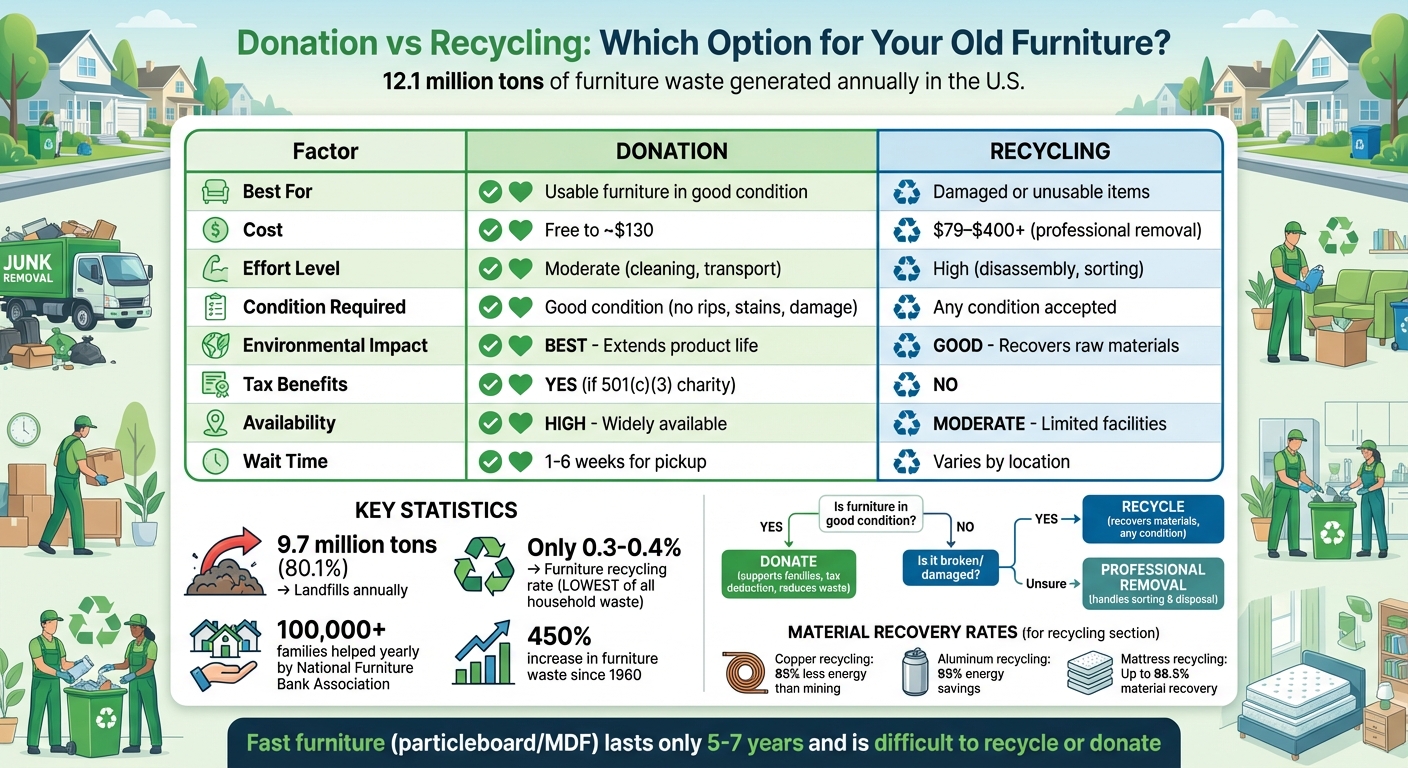
Here’s a staggering fact: every year, 12.1 million tons of furniture waste are produced, and about 80.1% of that (9.7 million tons) ends up in landfills [1]. Donation is often seen as the more eco-friendly choice since it avoids the need for new production. On the other hand, only 0.4% of furniture waste is recycled, making it one of the least-recycled household items [1].
To help you decide, here’s a breakdown of the key differences between these two options.
Comparison Table
This table highlights how donation and recycling stack up against each other:
| Method | Environmental Impact | Cost to You | Time/Effort Required | Condition Requirements | Tax Benefits | Local Availability |
|---|---|---|---|---|---|---|
| Donation | Best (extends product life) [1] | Free to around $130 [14] | Moderate (cleaning, inspection, transport) [14] | Must be in good condition (no rips, stains, or damage) [1] | Yes (if donated to a 501(c)(3) charity) [2] | High (widely available via charities and furniture banks) [1] |
| Recycling | Good (recovers raw materials) [1] | $79–$400+ for professional removal [1] | High (disassembly, sorting, transport) [2] | Accepts items in any condition [1] | No | Moderate (limited facilities) [12] |
The biggest distinction lies in the condition of the furniture. Donations typically require items to be gently used and in good shape, while recycling is a solution for damaged or heavily worn pieces [1]. If your furniture doesn’t meet donation standards or if convenience is a priority, professional removal services can handle the heavy lifting and ensure eco-friendly disposal. For more tips on sustainable waste management, check out our junk removal blog.
When to Choose Donation Over Recycling
Sometimes, donating furniture makes a bigger impact than recycling. If your furniture is in good shape and can be reused, donating it can benefit your local community while keeping it out of landfills.
Furniture in Good Condition
Donation is the way to go if your furniture is in solid, resaleable condition – meaning no rips, stains, pet damage, smoke odors, or structural problems [1]. As Dropcurb puts it:
"If you wouldn’t buy it in a thrift store, they won’t sell it either" [1].
Furniture made from solid wood, especially pieces from the 1980s, often retains its value and sells quickly at donation centers. On the other hand, particleboard furniture tends to have a shorter lifespan and may not hold up well after multiple moves, especially if it’s 5–7 years old [1]. Before donating, make sure all parts are intact and safe. It’s also a good idea to call donation centers ahead of time to confirm they can accept your items – what they need can change from month to month [1]. By donating furniture that meets these criteria, you give it a second life and help others in your community.
Desire to Support Local Causes
Donating furniture goes beyond decluttering your home; it directly supports local families and programs. Furniture banks, for instance, provide essential items to individuals transitioning out of homelessness, escaping domestic violence, or resettling as refugees. The National Furniture Bank Association alone helps over 100,000 families each year [1]. By donating, you’re not just passing along furniture – you’re contributing to meaningful change in people’s lives.
When to Choose Recycling Over Donation
Sometimes, recycling is the better option when furniture is too damaged to donate. It helps recover materials and saves charities from spending money on disposal. While donation is ideal for items in good condition, recycling steps in when furniture is no longer usable or when donation options are limited.
Broken or Damaged Furniture
Donation centers have strict standards for what they accept. Organizations like Goodwill, Salvation Army, and Habitat ReStore typically won’t take furniture with rips, stains, missing parts, or structural issues since these items can’t be resold [1]. Donating unusable furniture – a practice often called "wish-cycling" by NPR – can actually harm charities by forcing them to pay for trash disposal. For example, Goodwill of Greater Washington, D.C. reported spending $1.2 million in a single year to get rid of unusable donations [1].
Furniture with severe issues like water damage, pest infestations, broken frames, permanent stains, or strong odors usually doesn’t meet donation standards. Recycling, however, can recover materials like metal frames or untreated wood [1][17]. Items made from particleboard or MDF, often referred to as "fast furniture", typically last only 5–7 years and are also better suited for recycling [1]. If you’re dealing with bulky pieces, disassembling them to separate recyclable parts can make transportation to recycling centers easier [17].
Lack of Local Donation Options
Even if furniture is in decent shape, local donation options might be limited. Some centers may have long wait times or may not accept specific items, like mattresses. In these cases, recycling becomes a quicker and more practical solution [1]. Many communities offer specialized programs for items that are hard to donate, and professional junk removal services can help with sorting and proper disposal, especially if transportation is a challenge [17].
Professional Furniture Removal with Green Light Junk Removal
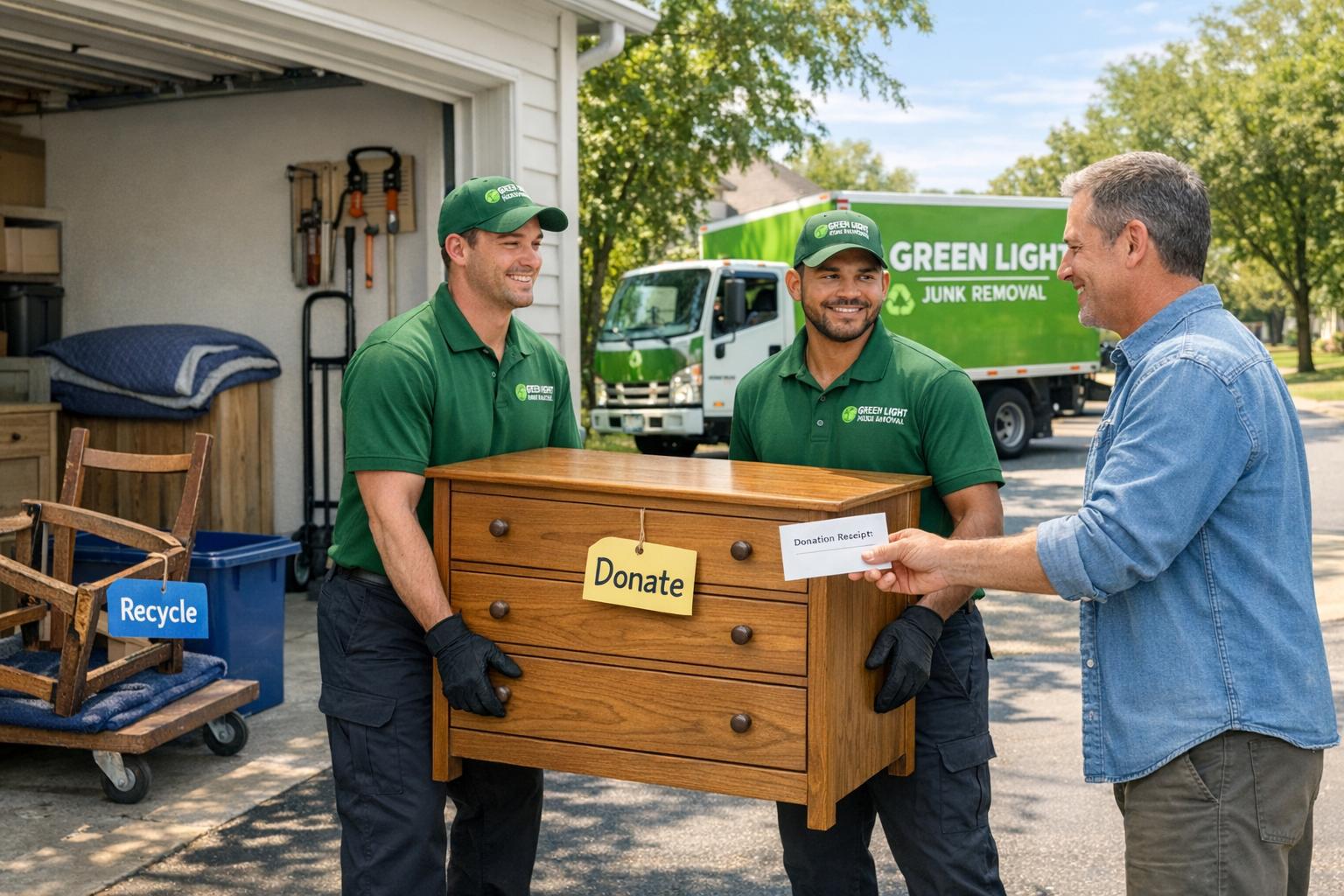
When donation or recycling isn’t an option, professional furniture removal can simplify the process. Green Light Junk Removal takes care of everything – from lifting heavy items to sorting them for donation, recycling, or proper disposal. They eliminate the hassle of waiting on charities or finding specialized recycling facilities.
Convenient and Professional Services
Green Light Junk Removal handles furniture removal from any part of your home or business, saving you from the physical effort and logistical headaches. Their team of background-checked professionals can manage anything from a single oversized couch to clearing out an entire estate. With thousands of satisfied customers nationwide [18], their service is often described as “courteous,” “efficient,” and “organized.”
Unlike charity pickups that might take weeks, Green Light Junk Removal typically offers service within 24–48 hours [1]. If you have particularly heavy items, letting the team know in advance ensures they bring the right equipment [18]. For an even faster pickup, you can gather items in one designated area ahead of time. This service provides a practical solution, balancing convenience with environmental responsibility.
Commitment to Eco-Friendly Practices
Sustainability is a priority for Green Light Junk Removal. They work with local charities and recycling facilities to divert as much waste as possible from landfills, addressing the challenges of furniture’s low recycling rates.
"Our eco-friendly junk removal practices ensure that as much waste as possible is recycled or donated, reducing the impact on landfills and promoting responsible disposal. We partner with local charities and recycling facilities to guarantee that usable items find a new home, while hazardous materials are disposed of in compliance with environmental regulations." – Green Light Junk Removal [18]
Transparent Pricing and Easy Booking
Green Light Junk Removal offers upfront online pricing and simple scheduling, cutting out guesswork and saving you money compared to municipal fees, which often range from $25 to $75 per item [1][18]. You’ll receive a guaranteed price quote before the team arrives, and you can track your order online – no hidden fees, no surprises [18].
Conclusion: Choosing the Best Option for Your Furniture
Key Factors to Consider
When deciding what to do with your furniture, it’s important to weigh its condition, how quickly you need to remove it, and your personal priorities. If the furniture is in great shape, donating it is a fantastic way to extend its life while keeping it out of landfills. Organizations like Habitat ReStore and the Salvation Army accept gently used pieces, and you might even qualify for a tax deduction if you itemize your taxes [15][16].
For furniture that’s broken or damaged, recycling may be the better route. Unfortunately, in the U.S., only 0.4% of furniture waste gets recycled, making it one of the least-recycled household items [1]. While metal parts are often salvaged by scrap dealers, materials like particleboard and foam are usually rejected by municipal recycling programs [2][19]. If you’re in a hurry, professional removal services can pick up your furniture within 24–48 hours and ensure it’s either donated or recycled [1]. These considerations can guide you in choosing the best disposal method based on your furniture’s condition and how quickly you need it gone.
Making an Eco-Friendly Choice
If sustainability is your goal, focusing on reuse is one of the best strategies. Peer-to-peer platforms, such as "Buy Nothing" groups, often have higher success rates for reuse because recipients tend to be more accepting of items in less-than-perfect condition compared to traditional charities [1]. However, it’s essential to avoid "wish-cycling" – donating items that can’t realistically be resold. This practice actually raises disposal costs for charities, as seen with Goodwill of Greater Washington, D.C., which spends $1.2 million annually on disposal fees [1].
Carefully assessing your furniture’s condition helps you decide whether to donate, recycle, or use a professional service. Companies like Green Light Junk Removal simplify this process by sorting items for donation, recycling, or responsible disposal. This way, you can reduce waste and give back to your community at the same time.
FAQs
How do I know if my furniture is donate-worthy?
To figure out if your furniture is ready for donation, start by assessing its condition and functionality. It should be in gently used or like-new shape, without major issues like scratches, stains, tears, or missing pieces. Steer clear of donating anything that’s broken, rotted, or splintered. Items such as sofas, dining tables, or bed frames that are still in good shape and practical for everyday use are typically great candidates for donation.
What furniture parts can actually be recycled?
Recyclable parts of furniture often include metal frames, hardware, and glass components since these materials tend to have higher recycling rates. On the other hand, materials like particleboard or composite wood are rarely recycled due to their complex makeup and the lack of widespread recycling facilities for them. While metals and glass are easier to process, the reality is that furniture recycling as a whole remains minimal. Most furniture still ends up in landfills or is incinerated.
Can Green Light Junk Removal pick up furniture for donation or recycling?
Green Light Junk Removal offers furniture pickup services tailored to both donation and recycling needs. They handle furniture disposal, assist with donations, and provide eco-friendly removal options. This makes it simple to either repurpose your items or dispose of them responsibly.