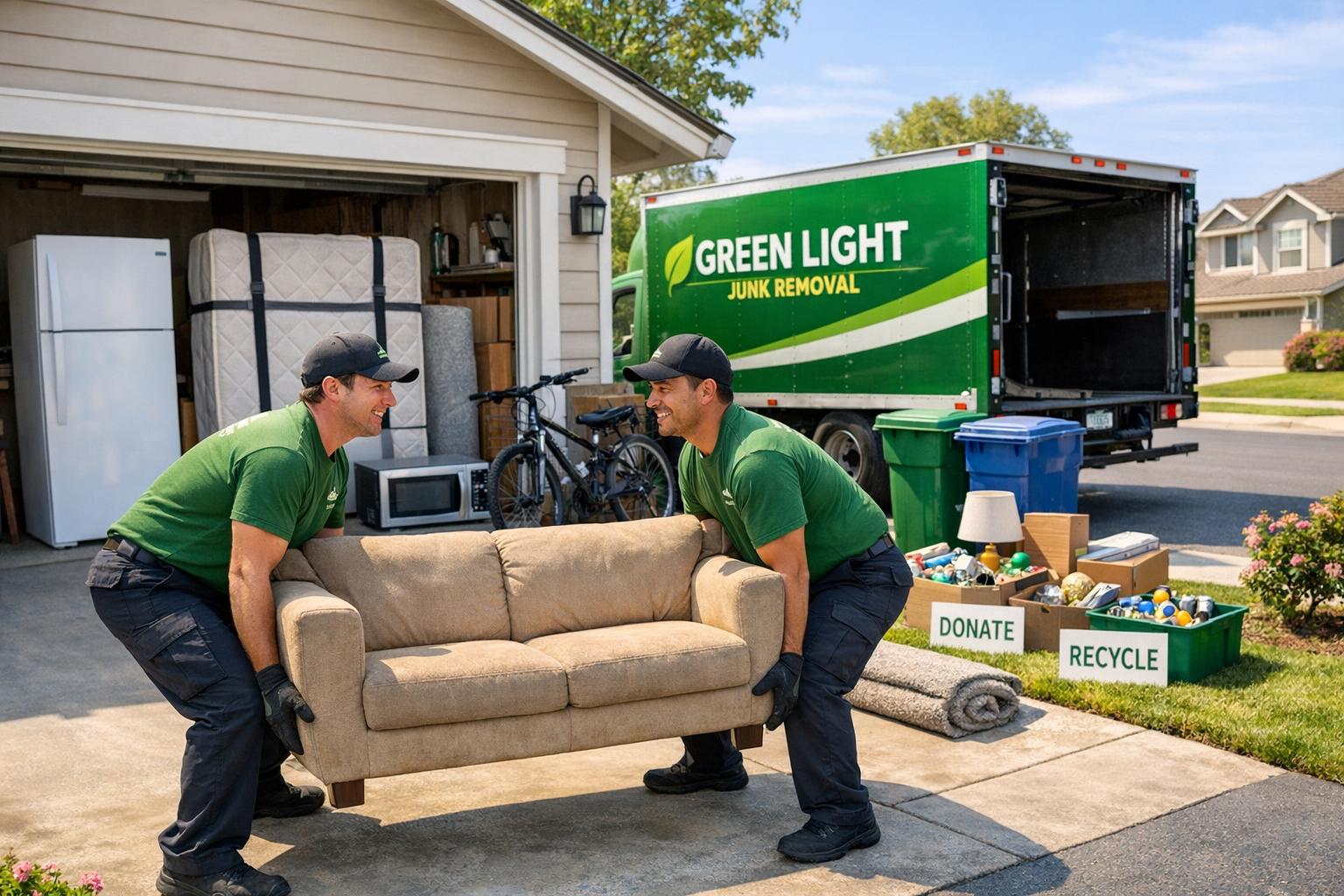
Getting rid of large household items can be a challenge, but junk removal services make it simple. They handle heavy lifting, proper disposal, and even prioritize recycling or donation. From old couches to broken appliances, these services save time and effort while ensuring responsible waste management.
Here’s a quick list of 10 items they commonly remove:
- Old Furniture: Couches, sectionals, and mattresses.
- Large Appliances: Refrigerators, freezers, washing machines, and dryers.
- Electronics: TVs, computers, and other e-waste.
- Hot Tubs: Disassembled and hauled away.
- Exercise Equipment: Treadmills, ellipticals, and more.
- Pianos: Heavy and intricate, requiring professional handling.
- Patio Furniture and Grills: Including BBQs and outdoor sets.
- Yard Waste: Branches, leaves, and outdoor debris.
Junk removal companies offer convenience with same-day appointments, volume-based pricing, and eco-conscious practices. Whether you’re decluttering or replacing old items, they make the process hassle-free.
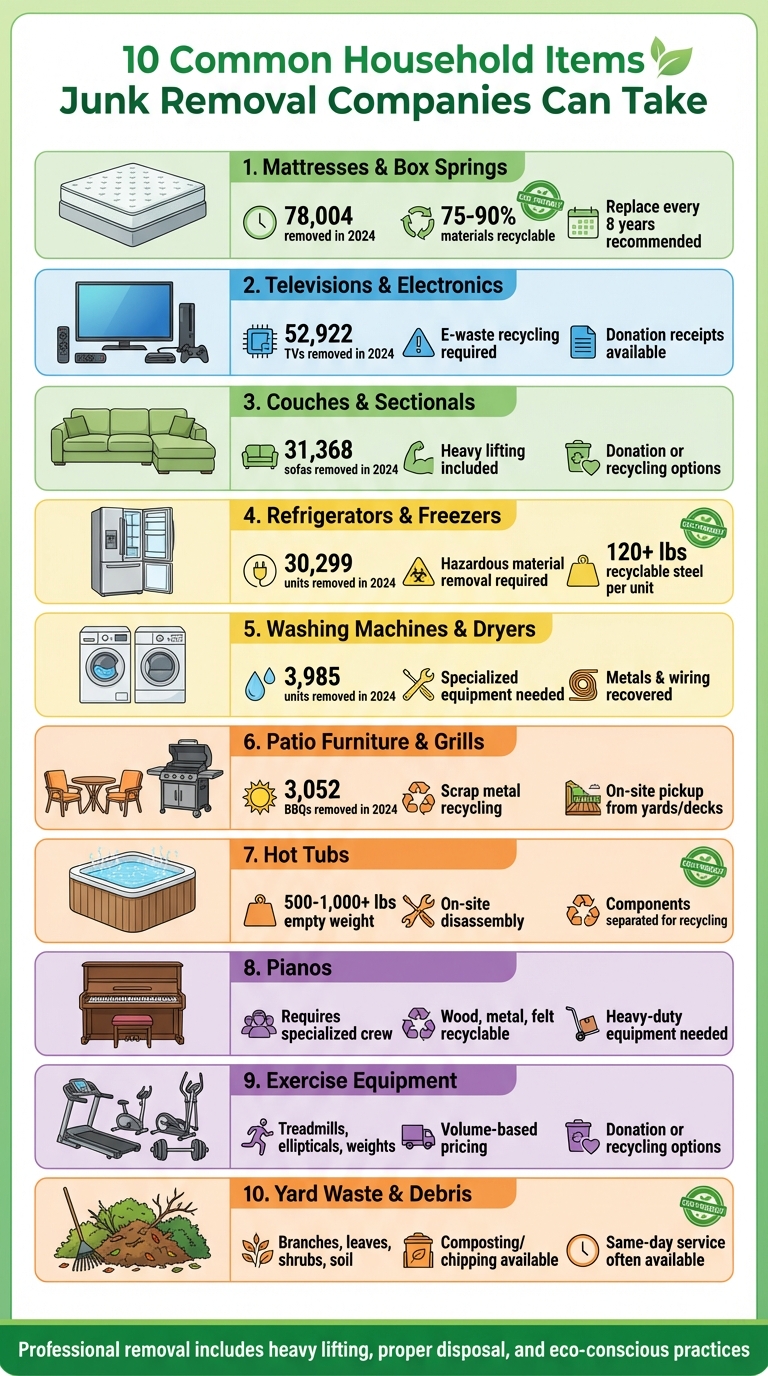
10 Common Items Junk Removal Companies Accept with Removal Statistics
1. Old Couches and Sectionals
Size and Bulkiness of the Item
Couches and sectionals are notoriously heavy and awkward to move, especially in tight spaces like staircases or narrow basements. Without professional help, maneuvering these large pieces can quickly turn into a frustrating and even hazardous task [4][6]. Their design often demands multiple people and specific techniques to navigate tricky areas safely.
Professional junk removal teams are well-equipped for this challenge. With trained crews, they handle the heavy lifting and ensure safe removal from any location, whether it’s a basement, attic, or spare room. As one company explains:
"Our luggers will do all the heavy lifting! … We do all the labor and loading, no matter where your items are located." [2]
This expertise is a key reason why removal services for couches and sectionals are so frequently requested.
Frequency of Removal Requests for the Item
The demand for couch removal is steady and substantial. In 2024, one major junk removal company collected 31,368 sofas across North America and Australia [3]. The previous year saw over 30,200 removals of couches, sectionals, and futons [7]. These numbers highlight how common it is for homeowners to seek professional help with furniture disposal.
Why do people need this service so often? Many are replacing their old furniture with something new and need the space cleared before delivery. Others are dealing with worn-out or damaged couches that have simply reached the end of their lifespan [3][7]. Since these bulky items don’t fit into standard trash pickup systems, professional removal becomes the most practical option [6][5].
But there’s more to this process than just convenience – it also opens the door to eco-conscious disposal.
Potential for Eco-Friendly Recycling or Disposal
Many junk removal companies go beyond simple disposal by prioritizing donation and recycling efforts. If a couch is still in usable condition, it’s often donated to a local charity or community center instead of being sent to a landfill. Some companies even provide a tax-deductible donation receipt within 14 business days [2].
For furniture that’s beyond saving, recycling is the next step. Components like wood, metal, and fabric are separated and sent to specialized facilities [4][5]. This approach not only reduces landfill waste but also gives materials a chance to be repurposed. By focusing on sustainability, these services ensure that old furniture can find a second life or be responsibly recycled.
sbb-itb-096ce5b
2. Refrigerators and Freezers
Size and Bulkiness of the Item
Refrigerators and freezers are some of the heaviest and most cumbersome appliances found in homes, making their removal a real challenge without professional assistance. Their size and weight demand specialized equipment and skilled handling. Professional junk removal teams typically assess the situation on-site, then use tools like dollies and straps to safely disconnect, lift, and transport these bulky items. As Dirty Deeds Junk Removal puts it:
"Our highly trained team specializes in the safe and careful removal of large, bulky appliances. We use the proper equipment and follow safe techniques to ensure your property and our crew are protected." [9]
To prepare for removal, it’s essential to unplug the appliance, disconnect any water or electrical lines, and clear a pathway. This level of care highlights the increasing need for professional and safe appliance disposal.
Frequency of Removal Requests for the Item
The demand for refrigerator and freezer removal has been on the rise. In 2024 alone, one prominent junk removal company handled 30,299 units, making these appliances the fourth most commonly removed items [3]. This marked an increase from over 22,500 units removed the previous year, which itself was nearly 4,000 more than in 2022 [7]. With a standard junk removal truck capable of fitting about eight full-sized refrigerators, companies are well-prepared to manage these frequent and high-volume requests.
Specialized Handling or Equipment Required for Removal
Refrigerators and freezers require careful handling because of the hazardous materials they contain. Federal regulations mandate the removal and safe recovery of refrigerants, oils, and other chemicals before these appliances can be scrapped [10]. This not only ensures compliance with the law but also helps protect the environment from substances like Freon, mercury, and PCBs.
Professional junk removal companies often work with licensed facilities that participate in initiatives like the EPA’s Responsible Appliance Disposal (RAD) Program. These partnerships ensure the proper recovery of ozone-depleting chemicals and the recycling of materials such as glass, plastic, and metal. Tom from 1-800-GOT-JUNK? emphasizes the importance of this process:
"Fridges and freezers contain hazardous materials, so proper disposal is key. We… [ensure] they were responsibly recycled whenever possible." [3]
However, this specialized handling often comes with additional fees for tasks like Freon and hazardous material removal [8]. Despite the extra costs, these efforts significantly reduce environmental harm and recover valuable materials, such as over 120 pounds of recyclable steel from older units [10].
3. Mattresses and Box Springs
Size and Bulkiness of the Item
Mattresses and box springs are notorious for being some of the toughest household items to move. Their large size, considerable weight, and awkward flexibility make navigating them through doorways and staircases a real challenge. To simplify the process, professional removal teams often disassemble mattresses right on-site. They break them down into components like foam, steel springs, cotton, and felt, which are then compressed using specialized equipment. This method not only makes transportation easier but also sets the stage for recycling.
Frequency of Removal Requests for the Item
Mattresses and box springs consistently top the list of the most commonly removed junk items. In 2024, for instance, 1-800-GOT-JUNK? reported hauling away an impressive 78,004 mattresses across North America and Australia. This was a significant increase from the 53,463 units removed in 2023 [1][7].
This rising demand aligns with health and comfort recommendations, which suggest replacing a mattress every eight years [1][7]. Another factor driving these numbers is the limited options for disposal. Many municipal waste services either refuse to accept mattresses or enforce strict rules, particularly for infested ones. For homeowners without the means to transport these bulky items, professional junk removal becomes the go-to solution.
Potential for Eco-Friendly Recycling or Disposal
Tackling the logistical difficulties of mattress removal also opens the door to more sustainable disposal practices. In the United States alone, around 20 to 25 million mattresses and box springs are discarded each year. Each one takes up between 23 and 40 cubic feet of landfill space [11]. Luckily, specialized recycling processes can recover and reuse 75% to 90% of the materials [11][12].
Many professional junk removal services emphasize recycling and donation to minimize landfill waste. As 1-800-GOT-JUNK? explains:
"We work to donate the donateables and recycle the recyclables, as a way to give back and divert as much as possible from the landfill" [1].
Steel springs, for example, have a recovery rate of over 95% and can be turned into products like construction rebar or automotive parts. Polyurethane foam, which makes up 40% to 50% of most mattresses, has an 80% to 90% recovery rate and is often repurposed into carpet padding or insulation. Recycling just one ton of steel from mattresses reduces CO2 emissions by an impressive 4,000 pounds [11].
For mattresses in good condition, donation and recycling are prioritized. However, if a mattress is infested with bedbugs, it must be sealed in a specialized disposal bag and clearly labeled before pickup [12]. Residents in states like California, Connecticut, and Rhode Island may also benefit from "Bye Bye Mattress" drop-off locations, where recycling can be free due to fees paid at the time of purchase [11].
4. Hot Tubs
Size and Bulkiness of the Item
Hot tubs are notoriously difficult to remove, mainly because of their size and weight. An empty hot tub typically weighs anywhere from 500 to 1,000 pounds or more [15]. Their bulky shape makes it tough to maneuver them through standard gates or doorways. The materials used – like treated wood, fiberglass or acrylic shells, dense foam insulation, and metal components – add to the complexity. These factors often place hot tubs beyond the limits of standard disposal methods.
To manage their removal, professionals often need to break them down into smaller pieces using reciprocating saws. This helps navigate tight spaces and allows the pieces to fit onto removal trucks. As TWO MEN AND A JUNK TRUCK® puts it:
"We primarily price by volume, based on how much space your junk occupies in our truck. We also consider the type of items and any special handling requirements" [13].
In short, hot tubs require careful planning and specialized techniques for proper removal.
Specialized Handling or Equipment Required for Removal
Removing a hot tub isn’t just about muscle – it demands preparation and the right tools. Before professionals arrive, homeowners need to disconnect the tub from all electrical and plumbing systems. This often calls for a licensed electrician or plumber. Additionally, the tub must be fully drained to avoid leaks and make it lighter for transport.
Professional crews come equipped with tools like reciprocating saws for cutting through the frame and shell, along with basic disassembly tools for smaller parts. Safety gear, including heavy-duty gloves and goggles, is a must to protect workers from sharp edges and fiberglass fragments. If access is particularly tight, teams are ready to dismantle the tub on-site. Once disassembled, the components are prepared for transport, often with an eye toward recycling.
Potential for Eco-Friendly Recycling or Disposal
Hot tubs are packed with materials that can be recycled. During the removal process, professionals separate components like the wooden or plastic cabinet, plumbing, and metal parts. Pumps, heaters, and copper wiring are collected as scrap metal, while electronic control boards and other electrical elements are treated as e-waste to prevent hazardous materials from ending up in landfills. Even the acrylic or fiberglass shell can be broken down and sent to specialized recycling facilities. Many junk removal services collaborate with local recycling centers to ensure as much of the hot tub as possible is repurposed, reducing the environmental impact of disposal.
5. Washing Machines and Dryers
Size and Bulkiness of the Item
Washing machines and dryers are among the heaviest and most cumbersome household appliances to move [6]. Their size and weight often make them unsuitable for curbside trash pickup programs [5]. To safely navigate doorways, stairs, and tight spaces, professional removal services rely on specialized tools and techniques [6][2].
Frequency of Removal Requests for the Item
Because of their size and the effort required to remove them, washing machines and dryers are frequently hauled away by professionals. Many homeowners replace older models with newer, energy-efficient options. For instance, in 2024, a national hauling service removed an impressive 3,985 washer and dryer units [3].
Specialized Handling or Equipment Required for Removal
To manage these bulky appliances without causing damage to property, professional teams use tools like dollies and straps [16]. They take care of the heavy lifting and ensure the appliances are removed safely and efficiently [2][16]. Once removed, the focus shifts to proper disposal or recovery processes.
Potential for Eco-Friendly Recycling or Disposal
After removal, these appliances are sorted for recycling or donation to keep them out of landfills [2]. Functional units might be donated to local organizations, while non-working ones are dismantled to recover valuable materials like metals and wiring. Some companies even provide donation receipts within 14 business days if your appliance qualifies for charitable contributions [2].
Declutter & Demolish: Everything You Need to Know About Professional Junk Removal
6. Televisions and Electronics
Green Light Junk Removal approaches the removal of televisions and electronics with a focus on safety and care for the environment.
Frequency of Removal Requests for the Item
Televisions are among the most frequently requested items for removal. In 2024, one major service provider reported removing a staggering 52,922 televisions across North America and Australia. This surge is largely fueled by homeowners upgrading to newer flat-screen models with enhanced resolution and smart features [1]. The sheer volume of these requests highlights the importance of properly managing both modern devices and older, bulkier electronics.
Size and Bulkiness of the Item
Older CRT televisions and large office electronics can be tricky to handle due to their size and weight. Maneuvering these items through tight spaces, like narrow doorways or staircases, requires skill to avoid damaging walls or floors during removal.
Potential for Eco-Friendly Recycling or Disposal
Electronics fall under the category of e-waste, meaning they need to be recycled through specific processes to safely extract components [1][2]. Professional services ensure that electronics are sorted for donation or recycling in compliance with environmental guidelines. Devices that are still functional can often be donated to local charities, and some companies even provide donation receipts within 14 business days if the items qualify [2][17]. However, most municipalities do not include e-waste in their curbside pickup services [14][17].
Specialized Handling or Equipment Required for Removal
To ensure safe and efficient removal, professionals use equipment designed specifically for handling electronics. From computers and laptops to game consoles and stereos, these teams manage the heavy lifting and careful transportation of items from basements, attics, or spare rooms. Homeowners don’t need to lift a finger, as trained "luggers" handle every step. The process also involves sorting items for donation and identifying recyclable components to minimize waste [2][3][17].
7. Patio Furniture and Grills
Green Light Junk Removal extends its services to outdoor spaces, efficiently tackling bulky patio furniture and grills while prioritizing convenience and responsible disposal practices.
Frequency of Removal Requests for the Item
Grills and patio furniture are among the most commonly removed outdoor items. In 2024, one major removal service reported taking away 3,052 BBQs, ranking grills as the eighth most removed item [18]. Patio furniture also sees frequent removal requests, particularly during home renovations, outdoor upgrades, or when preparing for a move.
Size and Bulkiness of the Item
Outdoor furniture and grills can be awkward and heavy to handle. Items like metal patio sets or large grills require careful maneuvering to prevent damage to lawns, decks, or doorways. Professional teams manage the heavy lifting directly on-site, whether the items are in a backyard, on a deck, or stored in a garage [17]. Plus, there’s no need for homeowners to dismantle items beforehand.
Potential for Eco-Friendly Recycling or Disposal
Junk removal teams aim to minimize landfill contributions by sorting items for donation or recycling on-site [17]. Metal grills and patio furniture frames are particularly suitable for scrap metal recycling. If your furniture is still in good condition, you can even request a donation receipt, which is typically issued within 14 business days [17].
Specialized Handling or Equipment Required for Removal
Rusted grills and heavy patio items require trained professionals and the right tools to ensure safe and efficient removal. Many companies use volume-based pricing, meaning the cost depends on how much space the items take up in the truck [17]. It’s important to note that propane tanks must be handled separately due to safety regulations, as most junk removal services cannot transport hazardous materials [17]. Additionally, some metal items may qualify for free scrap metal pickup [19].
8. Pianos
Moving a piano is no small feat – it’s one of the most demanding items to relocate due to its weight and intricate design.
Size and Bulkiness of the Item
Pianos are incredibly heavy, often requiring a team effort to move them safely [20]. Their large size and the hefty cast iron harp inside make them particularly tricky to handle. Moving one typically calls for specialized tools and a larger crew than what’s needed for most household items. To make the process smoother (and safer), ensure there’s a clear, unobstructed path from where the piano sits to the exit.
Specialized Handling and Equipment Required
The inner workings of a piano make moving it even more complicated. The strings and harp are under significant tension, creating potential safety hazards if mishandled. Professional movers often base their charges on the piano’s type (upright or grand), the crew size needed, and any access challenges like stairs or narrow doorways. It’s a good idea to confirm these services in advance. Careful disassembly not only ensures safety but also helps recover materials for recycling, aligning with environmentally conscious practices.
Eco-Friendly Recycling and Disposal
Once the piano is safely removed, consider recycling its durable materials like wood, metal, and felt [21]. Dismantling the piano allows each part to be repurposed or recycled. For example, the steel wires, screws, and cast iron harp can go to scrap metal facilities, while the wooden casing can be transformed into furniture like bookshelves or garden planters. Even the keys can find new life in crafts, though older ones made of ivory may require special disposal due to legal restrictions. By recycling, you give these parts a second life and reduce waste.
9. Exercise Equipment
Unused exercise equipment often turns into bulky clutter over time, and dealing with heavy fitness machines is a big reason why many homeowners turn to professional removal services.
Size and Bulkiness of the Item
Large fitness machines – like treadmills, ellipticals, and rowing machines – are not only heavy but also awkward to move through tight spaces like narrow doorways, sharp corners, and staircases[22]. Their mechanical parts and odd shapes require careful handling to safely remove them from areas like basements, attics, or spare bedrooms.
Unlike regular furniture, most exercise equipment isn’t eligible for curbside municipal pickup[22]. Professional removal services are equipped to handle everything from small stationary bikes to massive multi-station home gyms. They also deal with outdoor items like trampolines, basketball hoops, and swing sets[23,28]. To get an accurate removal estimate, it’s helpful to identify and detach removable parts, such as weights or consoles[22]. These complexities make exercise equipment one of the most common items requiring expert removal.
Frequency of Removal Requests for the Item
Some of the most frequently removed items include treadmills, ellipticals, stationary bikes, rowing machines, stair-steppers, and ski machines[22]. Smaller fitness gear, like free weights, resistance bands, yoga mats, and punching bags, is also commonly accepted. Many companies determine costs using a price-by-volume approach, factoring in how much space the equipment takes up in the truck rather than just its weight[2]. Pricing usually includes labor for lifting, loading, hauling, and ensuring proper disposal or recycling.
Potential for Eco-Friendly Recycling or Disposal
Many removal services prioritize sustainability by recycling or rehoming usable exercise equipment. If your machine still functions, ask whether the company provides donation receipts – some offer them within 14 business days after successfully donating your gear[2]. For broken or unusable items, crews often separate materials like metals and plastics to ensure they are recycled instead of ending up in landfills[23,4].
10. Yard Waste and Debris
Outdoor cleanups often leave behind bulky waste, from storm-damaged branches to old fencing materials.
Size and Bulkiness of the Item
Yard waste comes in all shapes and weights, from lightweight organic matter to heavy construction leftovers. Professional crews typically manage a variety of items, including branches, leaves, shrubs, lawn clippings, and palm fronds. They also handle heavier or bulkier debris like cement chunks, soil piles, scrap wood, and broken outdoor furniture [23]. For larger items – such as old fencing, sheds, swing sets, and tree stumps – specialized handling is often required, as these items are too cumbersome for standard municipal pickups [23]. Crews not only haul the debris but also take care of the loading and cleanup process.
Frequency of Removal Requests for the Item
Yard waste removal is one of the most frequently requested services, especially after storms that leave properties littered with branches and palm fronds [23]. Homeowners often turn to professional crews to avoid HOA penalties for visible debris or neglected landscaping. Landlords and realtors also rely on these services to tidy up overgrown yards between tenants. Seasonal cleanups, like fall leaf removal or spring landscaping prep, further drive demand [23]. This consistent need highlights the importance of efficient yard waste management.
Potential for Eco-Friendly Recycling or Disposal
A large portion of yard waste can be recycled through composting or chipping. Professional crews sort through the debris to ensure that organic materials are sent to composting or recycling facilities, rather than being dumped in landfills [25]. This process not only minimizes landfill waste but also contributes to the local ecosystem by removing decomposing vegetation.
"We recycle or compost green waste whenever possible. Items that can’t be recycled are disposed of responsibly at licensed facilities." – Pit Stop Junk Removal [23]
Crews also handle overflow items that municipal services may not accept. Some companies even offer same-day service for appointments made before 2:00 PM, which can be a lifesaver if you’re facing an HOA citation or a tight property sale deadline [24]. By managing yard waste responsibly, homeowners can stay on top of their decluttering projects while minimizing their environmental footprint.
Conclusion
Clearing out your home doesn’t have to involve endless trips to the dump or the headache of moving heavy items by yourself. Professional junk removal services take care of everything – from the heavy lifting to responsible disposal – so you can skip the hassle. Green Light Junk Removal handles it all: bulky furniture, old appliances, electronics, and even tricky items like pianos and hot tubs. Plus, they focus on eco-friendly practices to keep as much waste as possible out of landfills.
With volume-based pricing, insured professionals, and the option for same-day or next-day appointments, the process is simple and stress-free. You’ll even get arrival notifications to make scheduling easier. Their team ensures safe handling of your belongings, reducing the risk of injury or property damage [26].
Beyond decluttering, this service supports sustainable waste management. In 2024 alone, Green Light Junk Removal recycled thousands of appliances and electronics while carefully managing hazardous materials [1]. By partnering with local charities and recycling centers, they make sure your unwanted items are either reused or disposed of responsibly [27].
Every aspect of their service reflects a commitment to sustainability. Whether you’re tackling a small project or a large-scale cleanup, Green Light Junk Removal makes decluttering your home straightforward while promoting environmentally friendly practices. You can even request a donation receipt for tax purposes (typically provided within 14 business days) or send photos of your items for quicker quotes [17][26]. With their upfront pricing and focus on customer satisfaction, reclaiming your space has never been easier [27].
FAQs
How much does junk removal cost?
Junk removal services in the U.S. generally cost anywhere from $60 to $700 or more, with the average price landing around $241. The cost largely depends on factors such as the amount and type of items being hauled away. For instance, larger or heavier items often push the price higher, while smaller loads typically fall toward the lower end of the spectrum.
Do I need to disconnect appliances first?
It’s a good idea to disconnect appliances such as refrigerators, washers, and dishwashers before junk removal. This makes the process smoother and safer while reducing the risk of damage or potential hazards. Unless your junk removal service clearly states they handle disconnections, it’s wise to take care of this step in advance to keep everything running efficiently.
What items can’t be hauled away?
Items that generally can’t be taken by junk removal services include garbage, food waste, items contaminated with food, ceramics, kitchenware, windows, mirrors, plastic wrap, packing peanuts, bubble wrap, and wax-coated boxes. It’s a good idea to confirm any specific restrictions with your junk removal provider.