
Old furniture is easy to get wrong: one bad lift can hurt your back, damage a wall, or leave you stuck with city pickup rules you didn’t check first.
If I want this job to go smoothly, I keep it simple:
- Sort each piece first: keep, donate, sell, recycle, or trash
- Check condition honestly: clean and solid pieces can be reused; stained, broken, moldy, or bug-infested ones should not
- Measure doors, halls, stairs, and elevators before moving anything
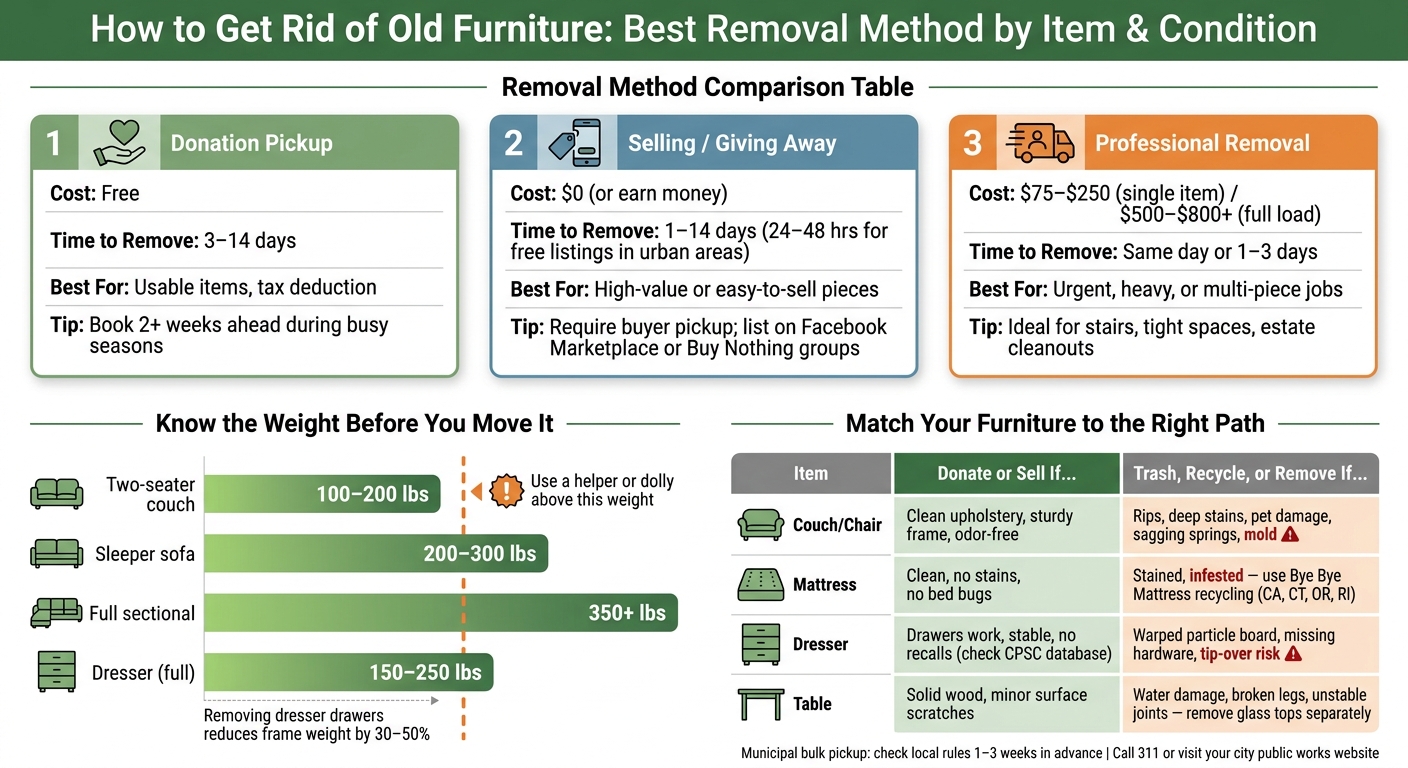
- Know the weight: couches can run 100–350+ lbs, sleeper sofas 200–300 lbs, and dressers 150–250 lbs
- Use the lowest-stress option: donation for usable items, buyer pickup for resale, city bulk pickup for junk, or a removal crew for heavy or unsafe jobs
- Follow local rules: some cities need 1–3 weeks to schedule bulk pickup, and mattresses often need plastic wrapping
- Be extra careful with mattresses, recalled dressers, bed bugs, mold, flood damage, and pre-1978 painted furniture
Here’s the short version: if a piece is clean, sturdy, and safe, I’d try donation, sale, or a free giveaway. If it’s broken, contaminated, water-damaged, or too heavy for a safe DIY move, I’d skip the extra work and move straight to recycling, bulk pickup, or paid removal.
A few numbers help set expectations: donation pickup may take 3–14 days, free listings can move in 24–48 hours in busy areas, and paid removal often runs about $75–$250 for one item or $500–$800+ for a full load.
This article lays out the easiest path for couches, mattresses, tables, chairs, and dressers so I can get them out without extra trips, delays, or strained muscles.
How to Get Rid of Unwanted Furniture Before Moving | Movers.com
sbb-itb-096ce5b
Step 1: Decide what to do with each piece before you move it
Sort each piece before you touch it. That quick check can save you from hauling something twice or taking it to the wrong place.
Check condition before you lift or list it
Every piece of furniture usually fits into one of four buckets: reusable, repairable, disposal-grade, or hazard-grade [1].
Reusable furniture is sound, clean, and free of odors. Repairable furniture has small issues, like a slight wobble or surface scuffs, that a simple fix can handle. These pieces may still be fine for Buy Nothing groups or curb alerts. Disposal-grade furniture includes broken frames, deep stains, missing hardware, or warped particle board. Most charities will turn those items away. Hazard-grade means bed bugs, mold, or flood contamination. If that’s the case, the piece should be destroyed, not passed on [1].
A simple way to check is the wobble test. Grab the legs, joints, and drawers, then give the piece a firm shake. If it’s loose but still stable, you may be dealing with a small repair. If it feels unsafe or starts to give way, it’s disposal-grade [3].
If a piece was made before 1978, look for cracked or peeling paint. Don’t sand it or donate it [1]. You should also check the CPSC recalls database before donating or selling dressers and children’s furniture. Recalled items can create tip-over or entrapment risks [1].
That quick screening helps you pick the right path for each piece.
Match couches, mattresses, dressers, and chairs to the right outcome
Not all furniture should be handled the same way. A clean chair and a stained mattress are two very different stories.
| Item | Keep, Donate, or Sell If… | Trash or Recycle If… |
|---|---|---|
| Couch / Chair | Clean, odor-free upholstery and a sturdy frame | Rips, deep stains, pet damage, sagging springs, mold |
| Mattress | Clean, no stains, no bed bugs | Stained or infested |
| Dresser | Drawers work, stable, no recalls | Warped particle board, missing hardware, tip-over risk |
| Table | Solid wood, minor surface scratches | Water damage, broken legs, or unstable joints |
Solid wood pieces, like a hardwood dining table or a well-built dresser, usually have more resale and donation value. Particle board furniture has much less second-life potential [1][6]. Sofas are also tough to recycle because they combine foam, fabric, wood, and metal. So if a sectional is torn or stained, professional hauling is often the practical move [1].
Mattresses need extra care. Many charities won’t take them because of bed bug risk. Some states, including California, Connecticut, Oregon, and Rhode Island, run mattress recycling programs through Bye Bye Mattress, where fees are paid at purchase [1].
Measure access and decide if DIY removal is realistic
After you know where each piece is headed, make sure you can get it out of the space. Measure the furniture against door frames, hallways, stair turns, and elevator access before moving day starts [6].
Weight matters too. A standard two-seater couch weighs 100–200 lbs, a sleeper sofa with a metal frame weighs 200–300 lbs, and a full sectional can top 350 lbs [8]. Dressers usually weigh 150–250 lbs [4]. If a piece is over 200 lbs, use a helper or a furniture dolly.
A few small steps can make a big difference. Removing dresser drawers can cut the frame’s weight by 30% to 50% [4][8]. Taking off couch legs can help it squeeze through a doorway. If the piece is upstairs, stuck behind a narrow hall, or has to make a tight stair turn, professional pickup is often the easier call – and a lot kinder on your back.
Step 2: Pick the easiest removal option for furniture still in good shape
How to Get Rid of Old Furniture: Best Removal Method by Item & Condition
Once you know a piece can be reused, the next move is simple: pick the option that gets it out of your home with the least hassle. If it’s still in good shape, go with the route that clears the space FAST without making you handle it twice.
Donate usable furniture when speed and reuse matter most
Donation is often the easiest path for clean, reusable furniture. Groups like Habitat for Humanity ReStore, Salvation Army, and local furniture banks may offer free pickup for items in good condition [4][10][5].
Pickup windows often fall 3 to 14 days out, so it helps to book at least two weeks ahead during busy moving seasons [4][1].
Before you call, snap a few photos in natural light and write down the dimensions. Many charities now ask for that up front so they can confirm the item fits their rules [9][4]. That can save you from a wasted trip or a rejected pickup. Donations may also qualify for a tax deduction at fair market value [4].
Sell or give away items that are clean and easy to sell
Selling makes the most sense for solid wood furniture or pieces with clear resale value. The easiest setup is buyer pickup only. List the item on Facebook Marketplace, say the buyer must haul it, and you remove the hardest part of the job [4][2].
Price it a bit below similar local listings. Add exact dimensions and clear photos taken in natural light [2][4]. If your main goal is just to get it gone, a Buy Nothing group or free listing can move a piece within 24 to 48 hours in urban areas [5].
Book professional furniture removal for the most hands-off option
If you’re short on time, dealing with stairs, or staring at a heavy sectional that isn’t moving without help, professional furniture removal is often the cleanest fix. A crew comes to your home, carries items out from wherever they are, loads the truck, and takes care of disposal or donation routing [4][10][7].
This works well for move-outs, rental turnovers, estate cleanouts, or jobs with several heavy pieces at once. A single estate cleanout or living room remodel can produce 500 to 2,000 lbs of old furniture [4]. Pricing for one item usually runs $75–$250, while full truckloads range from $500 to $800+ based on volume and location [4][5].
For furniture in good condition, the best option is usually the one that saves time and keeps extra work off your plate.
| Method | Cost Range | Time to Remove | Best Use Case |
|---|---|---|---|
| Donation Pickup | Free [4][10][5] | 3–14 days [4][10][5] | Usable items, tax deduction |
| Selling/Giving Away | $0 (or earn $) [4][2] | 1–14 days [5][4] | High-value or easy-to-sell pieces |
| Professional Removal | $75–$800+ [4][5] | Same day/1–3 days [4][5] | Urgent, heavy, or multi-piece jobs |
Step 3: Deal with damaged furniture responsibly and with less effort
If a piece is past the point of reuse, go with the fastest responsible way to get rid of it. Broken, water-damaged, heavily stained, or contaminated furniture usually isn’t a fit for donation or resale. In those cases, skip the extra steps and move straight to disposal, recycling, or pickup.
Follow local bulk pickup and disposal rules
Most U.S. cities offer curbside collection for large items, but the rules change a lot from place to place. Some cities have monthly pickup. Others ask you to book it 1–3 weeks in advance [1][7][3]. In many areas, municipal pickup is free or low-cost [1][4][3].
Before you haul anything outside, check your city or county public works website or call 311. Confirm the schedule, size limits, and any prep rules first [2][5].
Bed bugs change the process. If a piece is infested, don’t leave it at the curb without prep. Many cities require mattresses and box springs to be sealed in plastic bags for curbside pickup [1][3]. You should also mark contaminated items with a clear bed-bug label and wrap them in plastic sheeting before moving them [1][4].
If the item still has parts worth saving, remove those before pickup.
Recycle wood, metal, and other parts when possible
Most damaged furniture can’t be recycled as one full piece. But parts of it often can. Metal frames, springs, and hardware may go to scrap metal facilities. Untreated solid wood is sometimes accepted at transfer stations or turned into mulch. Glass tabletops should come off first and be handled on their own for safety [1][3].
It doesn’t take much effort to separate those parts, and it can keep usable material out of the landfill.
| Item Type | Best First Option | Backup Option | Special Handling Needs |
|---|---|---|---|
| Couches | Municipal Bulk Pickup | Professional Removal | Label "Bed Bugs" if infested; discard if waterlogged [1] |
| Mattresses | Specialty Recycling (Bye Bye Mattress) | Municipal Bulk Pickup | Plastic bag required for curbside in many cities [1][2] |
| Dressers | Recycle Wood/Metal Parts | Municipal Bulk Pickup | Check CPSC database for tip-over recalls [1] |
| Tables | Recycle Metal/Wood | Landfill Drop-off | Remove glass tops and dispose of them separately [1][3] |
| Broken Chairs | Recycle Components | Regular Trash (if small) | Remove cushions; recycle metal or untreated wood [3] |
If a piece is too large, contaminated, or risky to take apart, bring in a removal crew.
Use professional removal for bulky, unsafe, or contaminated items
Some furniture just isn’t safe or practical to move on your own. A waterlogged couch, a mold-damaged sectional, or a heavy dresser upstairs can turn into a back injury fast. That’s where DIY starts to fall apart.
Porous, water-damaged furniture should be discarded.
A professional crew can come to your home, do the heavy lifting, and take the item to disposal or recycling when that route is available.
Conclusion: Pick the lowest-stress path and get the furniture out
Once you’ve sorted each piece, the next step is pretty straightforward. Match the item to the right path: donate or list furniture that still has use left, sell clean pieces that have resale value, and use bulk pickup, recycling, or pro removal for anything damaged.
After the reusable stuff is dealt with, move the rest out through the fastest responsible option. If time is tight or the job looks unsafe, don’t force a DIY fix. That’s when professional junk removal usually makes the most sense. A crew can handle the heavy lifting, awkward stairwells, tight corners, and disposal, so the job keeps moving without extra strain or delays.
Assess the item, choose the lowest-stress option, and get it out responsibly.
FAQs
How do I know if furniture is worth donating?
Ask yourself this: would you buy it from a thrift store as is? If the answer is no, it’s probably not ready to donate.
Donated furniture should be clean, structurally sound, and fully functional. That means no stains, tears, pet damage, odors, broken parts, missing hardware, mold, mildew, or signs of pests.
If it needs repairs or heavy cleaning before someone can use it, it’s not fit for donation.
When should I hire a removal crew instead of moving furniture myself?
Hire a professional removal crew when speed, convenience, and physical safety matter more than handling the job yourself.
It’s a smart move for heavy, bulky, or awkward pieces like sleeper sofas and large dressers, especially if they’re on upper floors or tucked behind tight stairwells. It also makes sense for whole-home cleanouts, urgent pickups, or a hands-off experience.
What should I do with a mattress that can’t be donated?
If your mattress can’t be donated due to stains, tears, or heavy wear, the next move is recycling. Many local mattress recycling programs and drop-off centers can take apart the mattress and recycle parts like foam, steel springs, and fabric.
If you want the simplest route, hire a junk removal service. You can also check with your local sanitation department to see if they offer bulk pickup and whether the mattress needs to be wrapped in plastic. Just don’t leave it on the curb until you’ve checked the rules in your area.