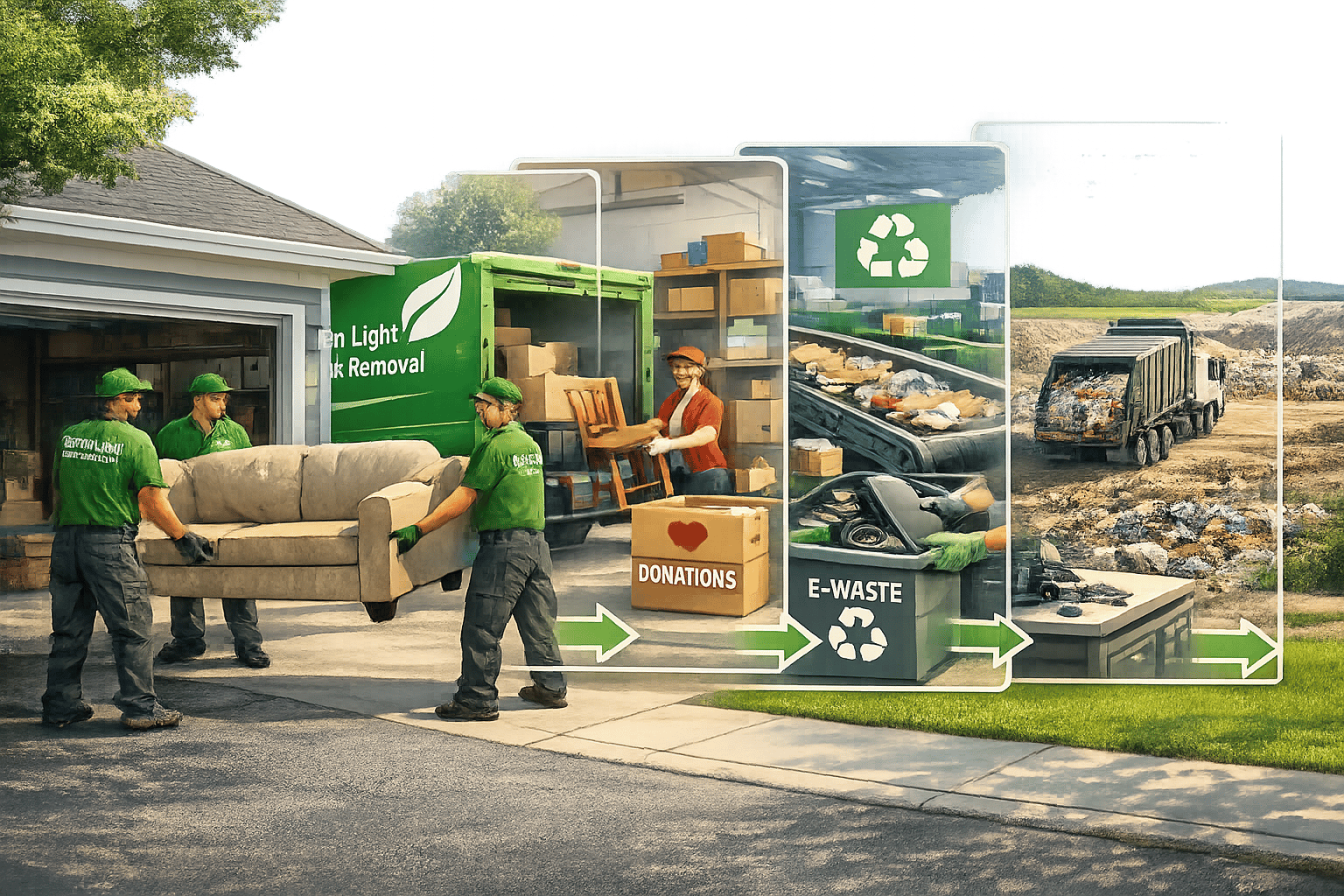
When your junk is hauled away, it doesn’t just vanish into thin air. Here’s what typically happens:
- Sorting On-Site: Items are categorized into three groups: donation, recycling, or waste. Usable items might go to charities, while hazardous materials are set aside for proper disposal.
- Transportation: Junk is taken to transfer stations where further sorting occurs. Materials like metals, wood, and electronics are routed to specialized facilities for processing.
- Donation and Reuse: Usable goods are donated to organizations like Goodwill or Habitat for Humanity. Some items may undergo refurbishment to extend their life.
- Recycling: Non-reusable materials are broken down into raw components (e.g., metals, plastics, paper) and sent for recycling. Electronics are processed at certified facilities to recover valuable materials.
- Disposal: Items that can’t be reused or recycled are sent to landfills or waste-to-energy plants. Advanced facilities reduce waste volume and generate electricity.
Choosing a responsible junk removal service ensures items are handled properly, reducing landfill waste and supporting recycling efforts. Always ask your provider about their sorting and recycling practices.
How Trash Goes From Garbage Cans to Landfills (Every Step Explained) | WIRED

sbb-itb-096ce5b
How Junk Removal Works: From Pickup to Processing
![What Happens to Your Junk After It's Removed? [Step-by-Step]](https://assets.seobotai.com/undefined/6a18d8ee5ded517781cb38b7-1780017906937.jpg)
What Happens to Your Junk After It’s Removed? [Step-by-Step]
Pickup and On-Site Assessment
The process kicks off when the crew arrives to evaluate the items you’re getting rid of. They’ll quickly assess the volume, item types, and any special handling needs. For instance, bulky items like hot tubs, refrigerators, or pianos require extra care during removal.
On-site, the team sorts everything into three categories: donation, recycling, and waste. Decisions are based on factors like the condition and type of item. For example, a gently used couch might be set aside for donation, while a broken appliance could be earmarked for scrap recycling. Hazardous materials, like old paint, are separated for proper disposal through municipal hazardous waste programs, as most junk removal services won’t handle these items directly.
Here’s a handy tip: if you have usable items, flag them early. This helps the team prioritize donations, and you might even get a donation receipt for tax deductions. These quick assessments on-site help make the entire process more efficient, from loading to sorting later on.
Transportation and Transfer Stations
Once the truck is loaded, the next stop is a local transfer station. Here, items undergo further sorting, weighing, and organization. Using a hub-and-spoke model, the crew ensures everything is sent to the right destination – whether that’s a donation center, a recycling facility, or a landfill. For example, scrap metal is sent to recyclers, reusable furniture goes to donation partners, and electronics are routed to certified facilities like R2 or e-Stewards, which handle hazardous components like lead and mercury responsibly [1][6].
Landfill tipping fees, which typically range from $30 to $60 per ton [3], give haulers a financial reason to recycle and donate as much as possible. This not only reduces costs but also minimizes the environmental footprint by focusing on recycling and reuse. With this organized system, every item ends up where it belongs, ensuring nothing goes to waste unnecessarily.
Sorting and Material Separation
Once items arrive at a transfer station or warehouse, they go through a thorough sorting process. This typically involves two steps: sorting by material type and then by condition.
Sorting by Material Type
Materials are first separated based on their type. Metals like steel, aluminum, copper, and iron – often salvaged from appliances and furniture – are sent to scrap processors. Wood is divided into clean, untreated pieces versus treated or painted wood, which can’t be safely chipped or composted. Electronics are sorted into a separate stream and sent to R2 or e-Stewards certified facilities. These facilities recover valuable materials like gold, silver, and copper while safely handling hazardous components such as lead and mercury [1][2].
Cardboard and paper are collected for recycling, where recycling just one ton of cardboard can save 46 gallons of oil and 4,000 kilowatt-hours of electricity [2]. Textiles, glass, and construction debris – like concrete, drywall, and flooring – are also sorted and sent to specialized processors, such as aggregate or biomass facilities. Each material stream is directed to the appropriate processor, ensuring maximum recovery and minimal waste.
Sorting by Item Condition
After materials are sorted, items are further evaluated based on their condition. This step determines how each item will be processed.
For instance, furniture that is clean, structurally intact, and odor-free can often be donated. A broken appliance that can’t be repaired may still have value as scrap metal and will be sent for recycling. On the other hand, a wet or bedbug-infested mattress is typically sent straight to disposal. Certain items, like refrigerators, require special handling regardless of their condition. For example, a certified technician must recover refrigerants (like Freon) before the metal can be recycled [2][3].
Here’s a quick breakdown of how different items are assessed:
| Item | Reusable If… | Recyclable If… | Landfill If… |
|---|---|---|---|
| Furniture | Clean, functional, no odors | Broken down for wood or metal | Severely damaged |
| Appliances | In working condition | Non-working but contains scrap metal | Hazardous or contaminated components |
| Mattresses | Rarely accepted | Dry, no bedbugs; springs and foam intact | Wet, contaminated, or infested |
| Electronics | Fully functional | Contains recoverable metals | Typically not applicable (usually recycled) |
| Wood | Usable lumber or shelving | Clean, can be chipped for mulch | Treated, painted, or rotted |
Identifying reusable items early in the process helps streamline donation efforts and ensures items find their best possible use.
Donation and Reuse: Giving Items a Second Life
Once items are sorted by condition, those still usable are set aside for donation or refurbishment. This approach helps keep functional goods out of landfills. Consider this: Americans produce a staggering 12.1 million tons of furniture waste annually, but only 0.4% of it is recycled [8].
Donating to Local Charities
Junk removal teams often collaborate with organizations like Habitat for Humanity ReStore, The Salvation Army, Goodwill, and Vietnam Veterans of America (VVA), each with its unique mission. For example, Habitat for Humanity ReStore sells donated furniture, appliances, and building materials to support affordable housing projects in local communities. Meanwhile, furniture banks under the National Furniture Bank Association (NFBA) directly furnish homes for families transitioning out of homelessness [8].
However, charities have become more selective about what they accept. For instance, Goodwill of Greater Washington, D.C., spends $1.2 million annually disposing of items dropped off by donors that can’t be sold [8]. Items must be in good, usable condition. Baby car seats, for example, are typically rejected due to changing safety standards [4].
If you’re donating, ask for a receipt to potentially claim a tax deduction under IRS Publication 526 [1][7].
When donations require only minor fixes to be functional again, they are directed to refurbishment.
Refurbishment and Resale
Not every donated item is ready to use as-is. Some need small repairs to regain their practicality.
"A worn dresser may only require a new drawer pull instead of removal." – Jiffy Junk [1]
Items marked for refurbishment are sent to specialized facilities where they’re cleaned, repaired, and tested before being resold or distributed [4]. For example, a working washer could sell for around $50, while a non-functional one might still fetch $12–$25 as scrap metal [3]. This process keeps items out of landfills and gives them a second chance at usefulness.
For items that can’t be fully restored, salvage crews recover usable parts – like metals, hardware, or structural components – before sending the remainder to disposal [6]. This step reduces waste and helps conserve resources, aligning with eco-conscious junk removal efforts.
Recycling: How Junk Gets Turned Into New Materials
When items can’t be donated or refurbished, they enter a recycling process designed to recover raw materials for new products. In the U.S., only about 32% of waste is recycled [5]. Responsible junk removal plays a key role in directing as much material as possible to the appropriate recycling facilities.
Metals, Electronics, and Appliances
At material recovery facilities (MRFs), metals are separated using advanced systems. Magnets extract ferrous metals like steel and iron, while eddy current systems identify non-ferrous metals such as aluminum and copper. These metals are sent to smelters, where they’re melted and reformed into raw materials. This process uses 60% less energy compared to producing steel from iron ore [2].
Recycling appliances requires extra care. Units like refrigerators and air conditioners contain refrigerants such as Freon, which must be safely removed by certified technicians before the appliances are shredded. A single refrigerator can provide $15 to $35 worth of recoverable materials like steel, copper, and aluminum [3].
Electronics are directed to certified facilities (R2 or e-Stewards), where workers disassemble devices to recover batteries, circuit boards, and other components. Precious metals like gold, silver, and palladium are extracted using chemical or thermal methods. Interestingly, one metric ton of circuit boards contains more gold than a metric ton of mined gold ore [10]. This highlights the importance of certified e-waste processing for both resource recovery and the safe handling of hazardous substances like lead and mercury.
These methods pave the way for recycling other large and challenging items.
Furniture, Mattresses, and Construction Debris
Bulky items like mattresses are broken down into their individual components. Springs are melted, foam is turned into carpet padding, and padding is reused as insulation. Specialized facilities can recover up to 90% of a mattress’s materials [9], yet less than 19% of the 18.2 million mattresses discarded annually in the U.S. are recycled [3].
Old wood furniture that’s beyond repair is often chipped or shredded to create mulch, particleboard, or biomass fuel. Meanwhile, construction debris like concrete is crushed and screened into aggregate, which can be reused in road bases or new construction projects. Recycling these materials keeps heavy waste out of landfills and puts them back into the supply chain.
Plastics, Paper, and Cardboard
Plastics are sorted by resin type – such as ABS or polycarbonate – before being shredded, cleaned, and turned into pellets. These pellets are then used to manufacture new products. Paper and cardboard go through a pulping process, where they’re broken down, de-inked, and reformed into new boxes and packaging materials. Recycling just one ton of cardboard saves a considerable amount of energy and oil [2].
To ensure recyclables are processed properly, always keep them clean and dry. Contaminated materials may be rejected by recycling facilities and could end up in landfills instead.
Final Disposal: Landfill and Waste-to-Energy
Even with careful sorting, some waste is simply beyond saving. Contaminated items, products made from mixed materials, and biohazardous waste are among the materials that can’t be reused or recycled. Around 20% to 30% of the average junk removal load falls into this category [12]. Here’s what happens to these materials.
Landfill as a Last Resort
Some items, like moldy drywall, chemically treated wood, or carpets made from mixed materials, are rejected by recycling centers and aren’t suitable for donation. In these cases, landfills become the only realistic option, especially when the cost of processing or transporting the material outweighs its value.
"When processing or transportation costs exceed the material’s value, landfill becomes the practical outcome." – Morse Junk [4]
Modern landfills are designed to minimize environmental damage. They use specialized liners and leachate collection systems to keep toxins from contaminating groundwater. Additionally, waste is compacted and covered daily to control odors and runoff [11]. However, landfills still produce methane – a greenhouse gas that’s over 20 times more potent than CO₂ [13]. Rising landfill tipping fees add another layer of complexity, encouraging recycling and donation efforts as more sustainable and cost-effective solutions [11].
For certain materials that can’t be safely contained in landfills, there’s another option.
Waste-to-Energy Facilities
Waste-to-energy (WTE) facilities provide an alternative that tackles both waste volume and environmental concerns. These facilities burn organic materials that can’t be recycled, such as clean wood and yard waste, under controlled, high-temperature conditions to generate electricity. On average, a WTE plant generates about 550 kilowatt hours (kWh) of electricity per ton of waste, which far exceeds the 65 kWh per ton produced by landfill gas capture systems [14].
One major advantage of WTE is its ability to significantly reduce waste volume. Incineration cuts waste weight by 87% to 90%, shrinking its physical size by up to 90% [13][15]. Additionally, high-temperature combustion destroys over 99% of PFAS – chemicals that would otherwise leach from landfills into the environment [13]. Currently, 75 WTE facilities operate in the U.S., and their role in waste management continues to grow as landfill space becomes more limited and regulations become stricter [14].
| Feature | Waste-to-Energy | Traditional Landfill |
|---|---|---|
| Greenhouse Gas Emissions | 30x fewer per ton [13] | Major methane source [13] |
| Energy Output | ~550 kWh per ton [14] | ~65 kWh per ton [14] |
| Volume Reduction | 87–90% [13][15] | None; requires ongoing land [13] |
| PFAS Destruction | >99% destroyed [13] | Risk of leaching into groundwater [13] |
Conclusion: Why Choosing Responsible Junk Removal Makes a Difference
The path your junk takes after it’s hauled away is more complex than most people think. Items are carefully evaluated, sorted, and directed toward donation, recycling, or, as a last resort, disposal. Each step has a meaningful impact on the environment, local communities, and the individuals who benefit from donated goods.
Here’s a striking fact: the EPA estimates that 75% of the American waste stream is recyclable, but the national recycling rate lags at just 32% [5][3]. Recycling doesn’t just help the planet – it boosts the economy too. For every 1,000 tons of material recycled, it creates 1.17 jobs, generates $65,230 in wages, and contributes $9,420 in tax revenue [1]. This highlights why it’s crucial to choose a junk removal service that prioritizes proper sorting and processing.
To ensure your items are handled responsibly, look for a service that follows certified sorting protocols. Before booking, ask about their donation partners and certified recycling facilities. If a company can’t provide these details, it may be a red flag for less thorough practices.
Green Light Junk Removal is a standout example of responsible junk removal. They focus on careful sorting to maximize reuse and recycling.
"Choosing Green Light Junk Removal means opting for a hassle-free experience… Our eco-friendly junk removal practices ensure that as much waste as possible is recycled or donated, reducing the impact on landfills." – Green Light Junk Removal [16]
With a 9.1/10 rating based on 200 customer reviews [16], Green Light Junk Removal takes care of everything – from sorting to heavy lifting – so you don’t have to. Whether it’s a single appliance or an entire property cleanout, their mission is clear: reduce landfill waste and give items a second life whenever possible.
FAQs
What items can’t be taken in a junk removal pickup?
Junk removal services have strict rules about what they can and cannot take, largely due to safety concerns and legal restrictions. Hazardous materials are at the top of the "do not accept" list. This includes:
- Paints and solvents
- Pesticides and automotive fluids
- Asbestos-containing materials
- Explosives and ammunition
- Propane tanks
- Biohazardous waste (like medical sharps or anything contaminated with bodily fluids)
In addition to hazardous items, some oversized objects that can’t be safely loaded or dismantled may also be off-limits. Always check with your local provider to understand specific regulations and limitations in your area.
How can I make sure my usable items actually get donated?
To make sure your items find a new home through donation, let our team know which ones are in good condition so they can focus on those first. Before we arrive, take a moment to remove any personal belongings from furniture to help things move along smoothly. Not sure if something can be donated? Just ask our team on-site – they’re skilled at spotting reusable items and can confirm if they meet the standards for local charities.
What should I do to prepare electronics and appliances for recycling?
Before recycling electronics or appliances, it’s crucial to protect your personal information and prepare the items properly. Start by removing all personal data from devices like computers and phones – use data-wiping software or perform a factory reset. Next, disconnect any cables, cords, and accessories, and make sure to remove batteries or power supplies. For larger appliances, such as air conditioners, drain any fluids and remove any hazardous materials. These steps not only protect your privacy but also ensure safe handling and a smoother recycling process.