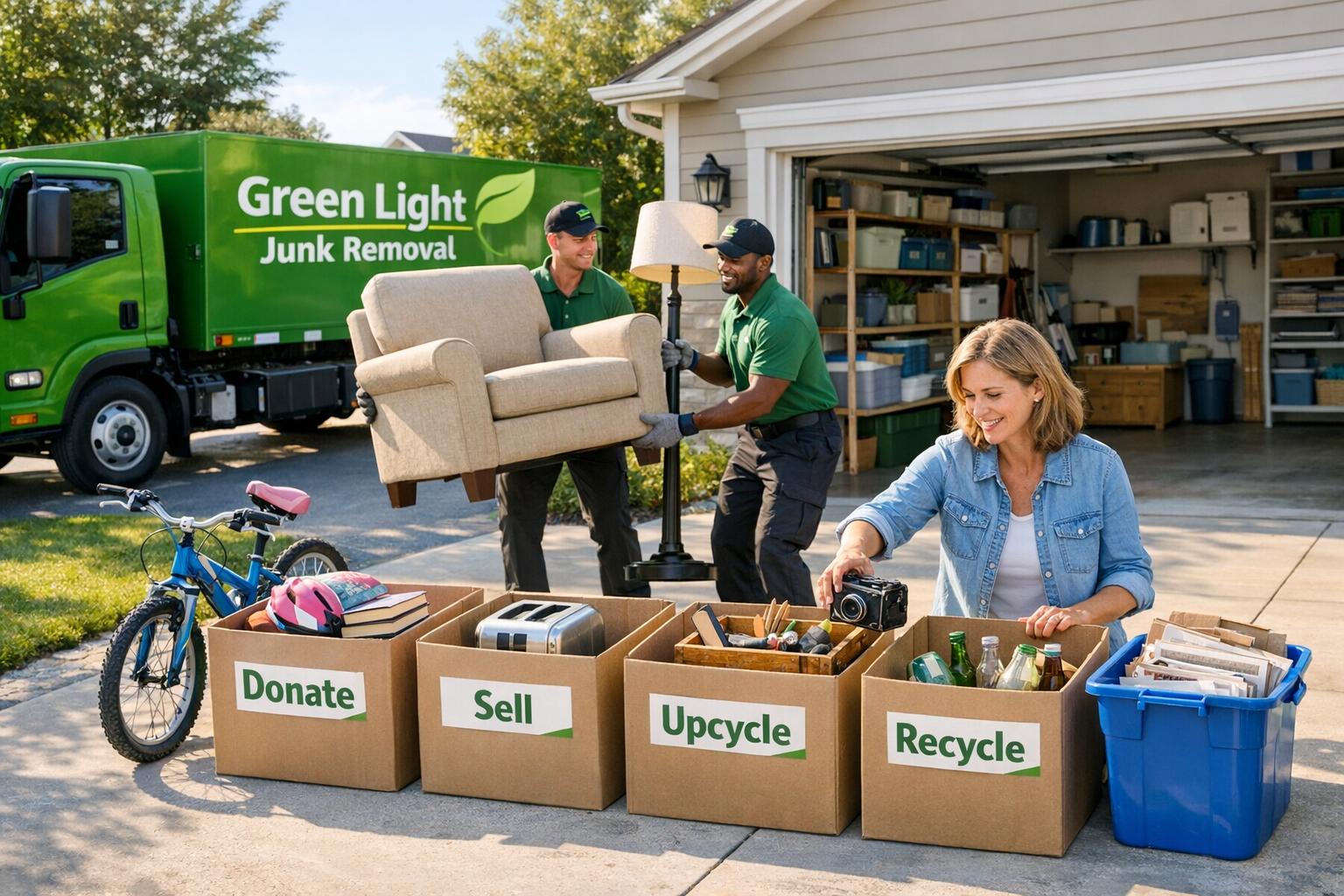
Decluttering your home doesn’t have to mean contributing to landfills. By donating, reusing, and recycling items, you can reduce waste, lower methane emissions, and help others in your community. Here’s how:
- Sort items into categories: Keep, donate, sell, or recycle/upcycle.
- Donate usable goods: Clothing, furniture, and electronics can support local charities and programs.
- Repurpose old items: Turn outdated furniture or textiles into functional decor or tools.
- Recycle responsibly: Use local recycling programs for electronics, batteries, or hazardous materials.
- Hire eco-conscious junk removal services: For large or hard-to-handle items, choose companies that prioritize recycling and donations.
Landfills are a major source of methane gas and waste valuable resources. By decluttering responsibly, you keep items in circulation, reduce pollution, and contribute to a cleaner planet.
Let’s break down how to make responsible decluttering easy and impactful.
7 Decluttering Tips (Without The Dumpster)
sbb-itb-096ce5b
The Landfill Waste Problem
Americans produce an astonishing amount of municipal waste. In 2018 alone, the U.S. generated 292.4 million tons of municipal solid waste – that’s about 4.9 pounds per person, every single day [4]. To put that into perspective, the average American today produces nearly twice as much waste as they did in 1960, when the daily figure was just 2.68 pounds [4].
Out of all this waste, 50% – over 146 million tons – ends up in landfills [4]. While this is a step forward compared to the 94% that was landfilled in 1960, the sheer volume of waste continues to rise with increased consumption. The U.S. currently operates more than 1,250 active municipal solid waste landfills [5][6], but these sites are filling up quickly.
How Landfills Damage the Environment
Landfills are major contributors to environmental pollution. When organic materials like food scraps and yard waste break down in a landfill without oxygen, they release methane – a greenhouse gas that traps heat 28 to 36 times more effectively than carbon dioxide [8]. As of 2022, landfills were the third-largest source of methane emissions in the U.S., responsible for over 17% of the total [6].
Food waste plays a significant role, accounting for an estimated 58% of methane emissions from municipal landfills [7]. Beyond greenhouse gases, landfills also waste valuable resources like water, energy, and land, along with the materials and energy embedded in the discarded items – resources that could have been recovered or reused.
Household Items Commonly Sent to Landfills
So, what are we throwing away? Food waste leads the pack, making up 24% of all landfilled materials, followed by plastics at 18.5% and paper and paperboard at nearly 12% [4]. Other notable contributors include clothing, textiles, rubber, and leather, which together account for 11.4% [4].
Durable goods are another big issue. Items like furniture, appliances, and electronics frequently end up in landfills even when they still have usable life. For example, in 2018, Americans discarded 2.7 million tons of consumer electronics, but only 1 million tons were recycled. The rest ended up in landfills or incinerators [4]. Furniture recycling is particularly dismal, with a rate of just 0.3%. Small appliances fare slightly better at 6%, while carpets are recycled at 9% [6]. These items could often be repaired, donated, or recycled, but instead, they take up limited landfill space and waste resources that could have been put to better use. These numbers highlight the pressing need for waste reduction strategies, which are explored further in the next sections. If you need help clearing out large items responsibly, you can contact our team for professional assistance.
How to Declutter Without Creating Waste
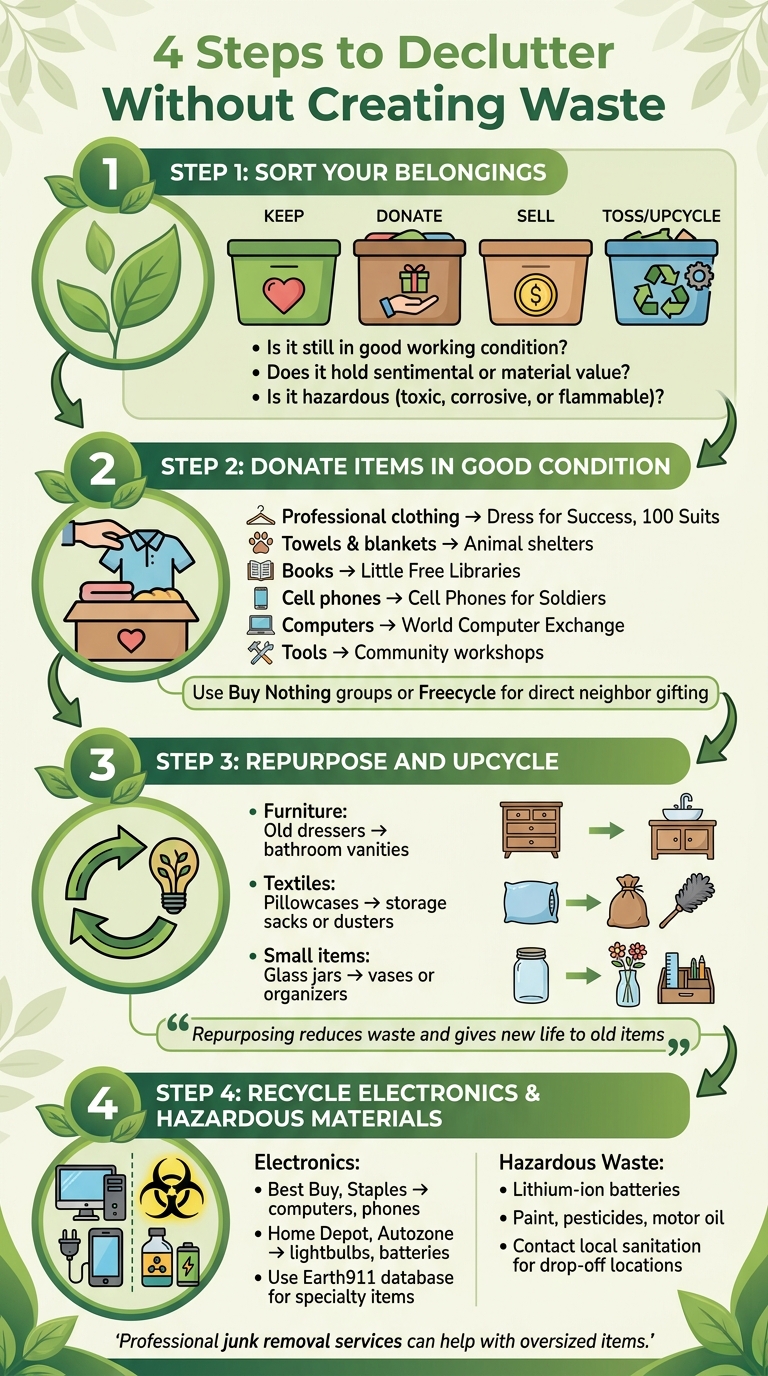
4-Step Guide to Declutter Responsibly Without Creating Waste
With the growing awareness of the landfill crisis, more people are looking for ways to declutter responsibly. Did you know that 80% of Americans participate in spring cleaning [9]? That number has climbed by 10% since 2021 [9]. While tackling clutter is a great habit, doing it thoughtfully can help reduce waste and keep reusable items out of landfills.
The secret to responsible decluttering? Start by sorting your belongings into four categories: keep, donate, sell, and toss/upcycle [10]. This simple step ensures more items are reused or recycled, minimizing what ends up in the trash.
Step 1: Sort Your Belongings
Grab four boxes or bags and label them: keep, donate, sell, and toss/upcycle [10]. As you go through your stuff, be honest with yourself. That bread maker gathering dust? The jeans you haven’t worn in three years? It’s time to let them go.
For items you’re not keeping, ask yourself three key questions:
- Is it still in good working condition?
- Does it hold sentimental or material value?
- Is it hazardous (toxic, corrosive, or flammable)?
These questions help you decide whether to donate, recycle, repurpose, or dispose of items properly. (Hazardous materials, like batteries or paint, require special handling – more on that in Step 4.) Once sorted, focus on donating items in good condition.
Step 2: Donate Items in Good Condition
Donating is one of the most impactful ways to declutter responsibly. Items in good shape can find a second life through charities, thrift stores, and community programs. This not only keeps usable items out of landfills but also helps others in need.
Here are some ideas for donations:
- Professional clothing can support job seekers through organizations like Dress for Success or 100 Suits [1].
- Old towels, blankets, and comforters make great bedding for animal shelters [9].
- Books can go to Little Free Libraries, local library fundraisers, or even programs that send books to prisoners [9].
For specialized items, consider targeted donations:
- Cell phones can go to Cell Phones for Soldiers.
- Refurbished computers can be donated to the World Computer Exchange.
- Tools can benefit community workshops or vocational schools [9].
You can also use gifting networks like Buy Nothing groups or Freecycle to pass items directly to neighbors who might need them. This works especially well for niche items like craft supplies or extra food [1].
Step 3: Repurpose and Upcycle What You Can
Before tossing or donating, think about whether an item could serve a new purpose in your home. Upcycling gives old items a fresh use, reducing waste and adding creativity to your space [11].
"Repurposing pillowcases reduces waste and gives new life to old pillowcases, offering an inexpensive way to create new household items." – Eryn Donaldson, Founder and CEO, The Model Home [11]
Here are some upcycling ideas:
- Furniture: Turn old dressers into bathroom vanities or kitchen islands. Use wooden crates as floating shelves or shoe organizers. Vintage doors and windows can become rustic coffee tables or headboards [11].
- Textiles: Use old pillowcases as storage sacks or dusters. Transform worn sweaters into blankets, pillows, or mittens. Even old leather belts can be woven into chair seats or cabinet handles [11].
- Small items: Glass jars can become vases, tea light holders, or organizers for small items. Silicone baking cups are great for sorting craft supplies or office essentials. Even broken candle wax can be used to lubricate zippers or silence squeaky hinges [11].
"I never feel bad when a good plate or bowl breaks because I love repurposing them into unique mosaic plant pots, adding charm to my garden or home." – Betsy Fein, President, Clutterbusters [11]
Step 4: Recycle Electronics and Hazardous Materials
Electronics and hazardous materials require special recycling methods. Many retailers offer take-back programs for items like electronics, batteries, and lightbulbs. For example:
- Best Buy and Staples accept old computers, phones, and other devices.
- Home Depot and Autozone handle lightbulbs and car batteries [1].
If a retailer doesn’t accept your item, databases like Earth911 can help you find local recycling options for trickier materials like packing peanuts or coffee pods [1]. For electronics, you might also consider upgrading components, like a computer’s hard drive, to extend its life [2].
Hazardous waste – like lithium-ion batteries, paint, pesticides, and motor oil – needs to go to specialized facilities. Contact your local sanitation department for drop-off locations or collection events [1][2].
| Item Category | Recommended Action | Where to Take It |
|---|---|---|
| Professional Clothing | Donate | Dress for Success, 100 Suits |
| Books & Media | Donate | Little Free Library, local libraries |
| Linens & Towels | Donate/Repurpose | Animal shelters, schools |
| Electronics | Recycle/Donate | Best Buy, Staples, local schools |
| Batteries & Lightbulbs | Recycle | Autozone, Home Depot |
| Hazardous Waste | Specialized Disposal | Local sanitation drop-off sites |
| Food Scraps | Compost | Home bins, community gardens |
When to Use Professional Junk Removal
Even with the best self-decluttering efforts, there are times when the job is just too big to handle alone. For oversized or overwhelming waste – think large furniture, broken appliances, or debris from renovations – professional junk removal can be a lifesaver. These services are particularly useful when dealing with items that are tough to move or dispose of properly, like mattresses, refrigerators, or tires, which often require specialized equipment and recycling facilities [2].
Let’s face it – parting with sentimental or outdated belongings can be emotionally taxing. Hiring professionals offers a quick and guilt-free way to clear out your space without the burden of doing it all yourself [3].
What to Look for in a Junk Removal Service
Not all junk removal companies operate with the same level of care for the environment. The best services go beyond simple pickups – they sort through items to separate donations, recyclables, and waste, ensuring that as little as possible ends up in a landfill. In fact, top-tier services can divert more than 60% of collected items from landfills, far surpassing the national recycling rate of 32.1% [12].
When choosing a service, ask detailed questions. Find out which donation partners and recycling facilities they work with. Avoid companies that give vague or noncommittal answers [12]. Reputable providers often collaborate with organizations like Goodwill and Habitat for Humanity ReStore [12][13]. Additionally, inquire about how they manage specialty items like electronics or mattresses, which require more costly and careful processing [12].
"Eco-friendly junk removal is more than just taking your unwanted items to a recycling center. It involves a meticulous process focused on reducing waste, reusing materials, and recycling as much as possible." – JunkDoor Blog [14]
Transparency in pricing is another key factor. On average, junk removal costs range from $133 to $372, with most homeowners spending about $242 [13]. Look for companies that provide clear, itemized quotes to avoid hidden fees. Plus, some donations may qualify for tax deductions, so it’s worth asking about that as well [13].
How Green Light Junk Removal Reduces Waste
Green Light Junk Removal stands out for its commitment to eco-conscious practices. They handle everything from pickup to proper disposal, ensuring items are sorted for maximum recycling and donation. Usable furniture, appliances, and household goods are donated to local charities, while materials like metals, cardboard, and glass are sent to recycling centers [12].
This approach not only benefits the environment but also helps avoid landfill tipping fees, which typically range between $30 and $60 per ton [12]. For example, a single refrigerator can contain $15 to $35 worth of recyclable materials like steel, copper, and aluminum [12].
Green Light Junk Removal also specializes in handling tricky items like electronics and hazardous materials, including batteries and paints [13]. Their team is equipped to manage heavy and cumbersome items – everything from hot tubs and pianos to full-scale property cleanouts. With upfront pricing and easy online booking, they make the process of decluttering both efficient and stress-free.
Keeping Your Home Clutter-Free Long-Term
Tackling clutter is one thing, but keeping it at bay is a whole different challenge. Over the years, consumer habits have shifted dramatically – Americans now purchase 60% more clothing per person than two decades ago, and global clothing production has more than doubled in the past 25 years [16]. With so much new stuff constantly entering our lives, staying clutter-free requires more than a one-time purge. It’s about creating habits that prevent the mess from returning.
The secret? Moving from reactive decluttering to proactive prevention. Instead of waiting until your drawers are bursting, set up systems that limit what comes into your home in the first place. By being intentional about what you acquire and how long you keep it, you can maintain the progress you’ve made.
Buy Less, Choose Better
One of the simplest ways to control clutter is to rethink how and why you shop. Here’s a surprising fact: most people wear just 20% of their wardrobe 80% of the time [16]. Investing in fewer, high-quality items can make a huge difference. A single, well-made coat can last for years, while cheaper alternatives often need replacing again and again.
Before buying something new, try applying the 90/90 Rule: if you haven’t needed something similar in the past 90 days and don’t expect to need it in the next 90, skip it [16].
"The solution to this problem is, first, to buy fewer, better-quality things, and second, to do what you can to keep the clothes you do buy from ending up in the trash once you’re done with them." – Oliver Franklin-Wallis, Author of Wasteland [16]
When you do shop, stick to a consistent style or color palette. This makes it easier to mix and match items you already own, reducing the temptation to buy “just one more thing” to complete an outfit.
Avoid purchases made on a whim or for “someday” scenarios – like clothes for a weight you hope to reach, gadgets for recipes you haven’t tried, or supplies for hobbies you haven’t started. These items often sit unused, eventually turning into clutter.
Set Up a Regular Decluttering Routine
Mindful shopping is a great start, but maintaining a clutter-free home requires regular upkeep. Schedule a review of specific areas of your home every three to six months. This habit keeps clutter from piling up and ensures that items you no longer need are still in good enough condition to donate or sell.
Use the space you already have – like bins, shelves, or drawers – as natural limits. When a container is full, nothing new gets added unless something is removed. This simple one-in, one-out rule keeps things manageable without requiring constant effort.
For items you’re unsure about letting go, try a “holding zone.” Put them in a dated box or bag and revisit them after a season or a year. If you haven’t needed them by then, it’s a sign they can go. This method gives you time to make decisions without cluttering your immediate space.
When it’s time to part with items, consider local solutions like the BuyNothing app, which allows you to give directly to neighbors [16]. This keeps your unwanted goods in use within your community. Keep in mind that only 20% of items donated to thrift stores actually find a second home [16], so targeted gifting or selling is often more effective than anonymous donations.
"Sustainable decluttering isn’t about finishing the house. It’s about maintaining stability with minimal effort." – Declutterish [15]
Conclusion
Decluttering goes beyond simply getting rid of things. By carefully sorting items, donating those in good condition, repurposing where possible, and properly recycling electronics or hazardous materials, you play a part in keeping valuable goods in use and reducing landfill waste. This is critical, as landfills rank as the third-largest source of methane pollution – a greenhouse gas that harms the climate [1]. Every item diverted from a landfill makes a difference.
Adopting a mindset of repair, reuse, and mindful consumption doesn’t just help the planet; it also supports local communities. Responsible actions, like selling, gifting, or recycling, prevent toxic materials from contaminating soil and water. These choices do more than clear your home – they contribute to a healthier environment and a stronger community.
As Liz Galst, author and expert, puts it:
"Decluttering is a cycle, not a chore. By choosing to sell, gift or responsibly recycle, you aren’t just reclaiming your square footage; you’re fueling your local economy and protecting the planet." – Liz Galst [1]
Sustaining this effort requires thoughtful purchasing habits and regular reviews of what you own. When items can’t be reused, services like Green Light Junk Removal provide eco-friendly solutions for recovery and proper disposal.
FAQs
How do I know if something should be donated or recycled?
When deciding what to do with an item, start by checking if it’s still functional and in good shape. You can donate items that are clean, usable, and could help someone else. For things that are damaged, broken, or no longer usable, recycle them to ensure they’re disposed of properly. If something holds sentimental value or inspires you, think about repurposing or upcycling it instead of throwing it away.
Where can I take batteries, paint, and other hazardous items?
You can safely dispose of batteries, paint, and other hazardous materials by taking them to specialized disposal facilities or hazardous waste collection sites. These items need careful handling to prevent harm to the environment. To find the right place, contact your local government or waste management services. Many communities offer designated drop-off locations or specific collection days for hazardous waste.
What should I ask a junk removal company to ensure it’s eco-friendly?
To ensure a junk removal company operates with an eco-friendly approach, start by asking if they sort items for donation, recycling, or specialized processing instead of defaulting to landfills. Specifically, dig into their recycling practices – do they handle metals, electronics, cardboard, and glass responsibly? Also, find out if they donate usable items like furniture and clothing to those in need. Transparency matters here. Don’t hesitate to request details or even proof of their recycling and donation efforts to confirm their dedication to sustainable practices.