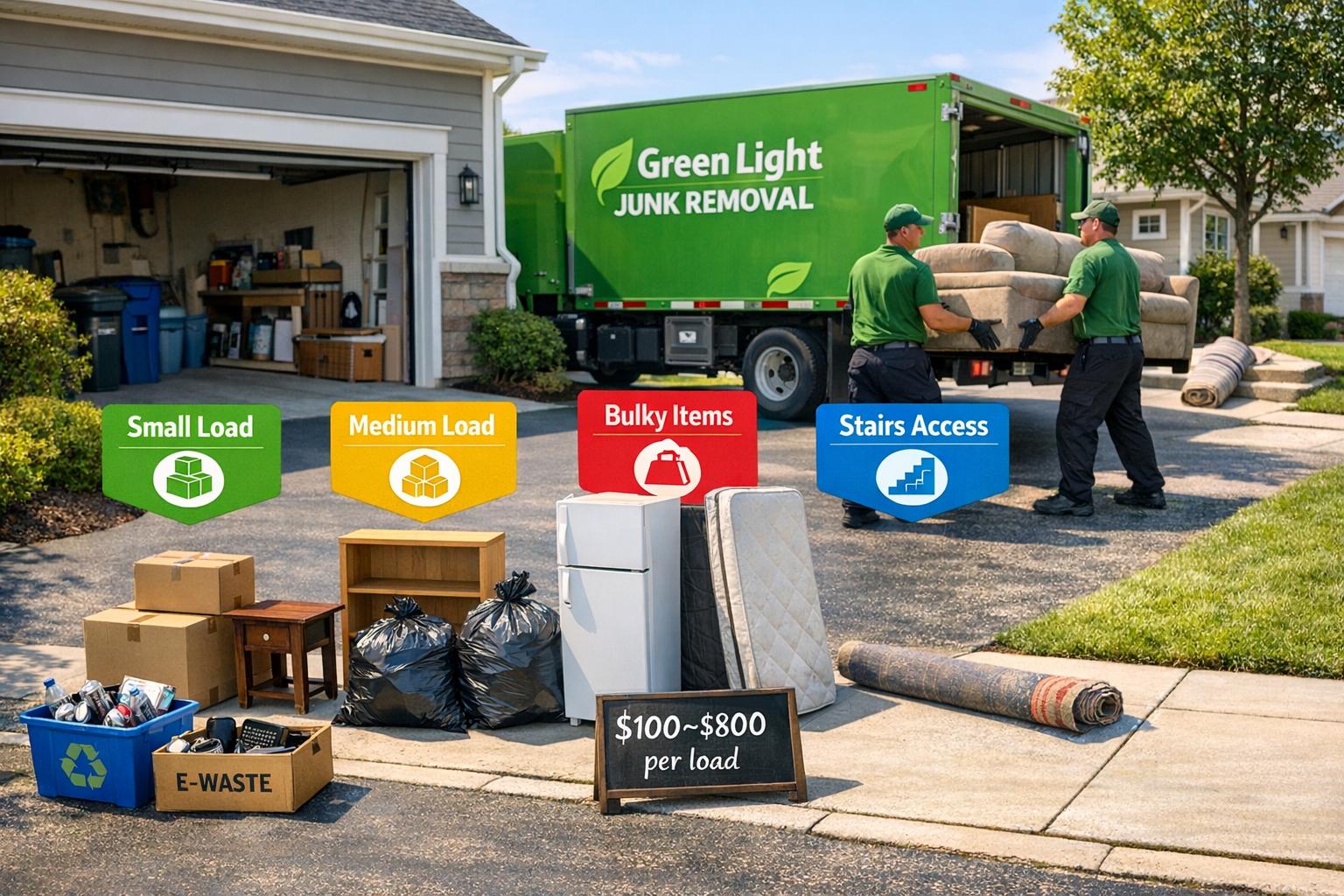
Getting rid of unwanted items can cost anywhere from $100 to $800 per load in 2026, with the national average around $250 per load. The price depends on factors like the amount of junk, type of materials, location, and accessibility. Smaller jobs may cost as little as $70–$150, while large cleanouts can exceed $850. Key cost drivers include:
- Volume of Junk: Prices are based on truckload size (e.g., 1/8 load = $70–$150, full load = $600–$850+).
- Type of Items: Special handling for appliances, e-waste, or hazardous materials adds fees.
- Location: Urban areas and regions with high landfill fees charge more.
- Accessibility: Hard-to-reach areas or stairs can increase labor costs by up to 50%.
For most, hiring professionals simplifies the process, ensures proper disposal, and often includes labor, transportation, and fees in one clear price.
How to Price Junk Removal Jobs
sbb-itb-096ce5b
Average Junk Removal Costs in the United States
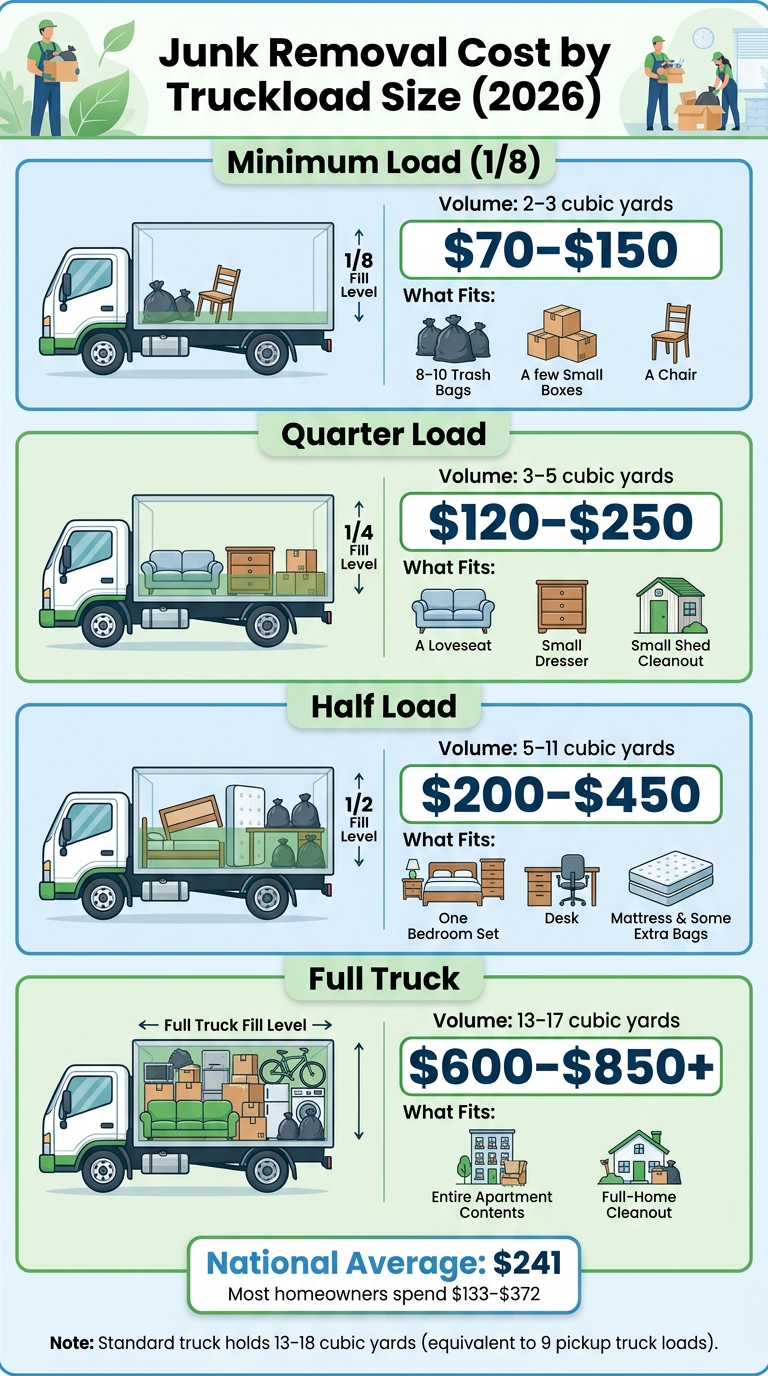
Junk Removal Cost by Truckload Size 2026
Standard Pricing Ranges for Junk Removal
In 2026, the national average for professional junk removal services is $241, with most homeowners spending between $133 and $372, depending on the size and complexity of their project [6]. Melissa Graham, a contributing writer at Angi, explains:
Professional junk removal averages $241, varying by debris volume and waste type [6].
For smaller jobs, minimum service fees typically fall between $70 and $150 [1]. These fees cover essential costs like crew dispatch, fuel, and travel time, even for light loads. On the other hand, larger cleanouts – such as clearing out an entire apartment or home – can range from $600 to $850 or more [1]. Labor charges alone generally run between $100 and $300 per service [6].
Regional pricing differences also come into play. Cities like New York and San Francisco often see rates 30–50% higher than the national average due to higher disposal fees and operating expenses [5]. For example, landfill tipping fees vary significantly: Mississippi has some of the lowest fees at $30 per ton, while Connecticut and Alaska have much higher fees at $131 and $142 per ton, respectively. These disparities directly influence per-truckload costs [7].
Now, let’s explore how the size of the truckload impacts pricing.
How Truckload Size Affects Price
Junk removal companies typically base their pricing on how much space your items take up in their truck, measured in fractions of a truckload or cubic yards [5]. A standard truck used for junk removal holds 13 to 18 cubic yards, which is roughly equivalent to nine pickup truck loads [5]. This volume-based pricing means you only pay for the space you use, offering flexibility compared to flat-rate options.
| Load Size | Volume | 2026 Price Range | What Fits |
|---|---|---|---|
| Minimum (1/8) | 2–3 cu. yd. | $70–$150 | 8–10 trash bags, a few small boxes, or a chair |
| Quarter Load | 3–5 cu. yd. | $120–$250 | A loveseat, small dresser, or a small shed cleanout |
| Half Load | 5–11 cu. yd. | $200–$450 | One bedroom set, desk, mattress, and some extra bags |
| Full Truck | 13–17 cu. yd. | $600–$850+ | Entire apartment contents or a full-home cleanout |
Bundling items into a single large pickup is often more economical than arranging multiple smaller trips, as minimum fees and travel costs are applied only once [1]. However, dense materials like concrete or brick can lead to "weight-full" pricing. In these cases, the truck may reach its payload capacity before it’s physically full, potentially increasing costs even for smaller loads [7].
What Affects Junk Removal Pricing
Breaking down what influences junk removal costs can help you understand the pricing structure and even find ways to save. While the size of the truckload is the primary pricing factor, other elements can significantly affect the final bill.
Volume of Junk and Truckload Size
Pricing for most household junk removal is based on how much space your items take up in the truck. Jessica Gonzalez, Founder of Happen Ventures, explains this straightforward system:
"The fairest model is to charge by volume. The client pays for how much space their junk takes up in the truck: a quarter, half, three-quarters, or a full load." [9]
In other words, you’re only billed for the space your junk occupies. To give you an idea, a full truckload equals about eight standard-sized refrigerators [2]. However, dense materials like concrete, dirt, or brick may lead to weight-based charges since these items can hit the truck’s weight limit before filling its space [8].
You can cut costs by taking a few proactive steps. For instance, disassembling large furniture, like bed frames or shelves, before the crew arrives can reduce the volume your items occupy, potentially lowering your truck space needs [8]. Similarly, gathering all your items in one accessible spot makes it easier for the crew to provide accurate estimates and speeds up the process.
Next, let’s look at how the type of items you’re disposing of can affect pricing.
Type of Items and Materials
The kind of items you’re getting rid of plays a big role in determining the cost. While standard household items like sofas or tables are typically priced by volume, certain items require special handling, which can raise the price.
For example, appliances containing refrigerants – such as air conditioners or refrigerators – must be disposed of following strict environmental regulations, adding $70 to $150 per unit [1]. Electronics like TVs, computers, and monitors, often classified as e-waste, require specialized recycling and can cost anywhere from $25 to $200 per item [10]. Mattresses and tires may also come with recycling fees due to local or state regulations [2].
Keep in mind that hazardous materials like wet paint, certain chemicals, and some types of batteries are often not accepted due to safety and legal concerns [2].
Now, let’s dive into how accessibility and labor impact your overall costs.
Accessibility and Labor Requirements
How easy it is to remove your junk can directly affect labor time and, ultimately, the price. Difficult-to-reach areas can increase costs by 10% to 50%, depending on the added effort required [1].
For example, items located in basements or attics typically require more physical work compared to curbside pickups. If stairs or upper floors are involved, expect to pay an additional $25 to $100 per flight or floor [3]. Other factors, such as narrow doorways, long carries from the back of a property, or even having to remove doors to move large items, can also add to the labor costs.
To save money, you can move your items to a driveway or curb before the crew arrives. This simple step can cut costs by 20% to 40% by eliminating the need for labor-intensive indoor navigation [3].
Location and Disposal Fees
Your location is another major factor in junk removal pricing. Urban areas tend to charge 10% to 20% more than rural areas due to higher operating expenses like wages and permits [3]. On the other hand, rural locations might tack on travel surcharges for long-distance hauling [10].
Local landfill fees, also known as "tipping fees", vary widely depending on the region, ranging from about $40 to over $120 per ton [3]. States with stricter recycling laws, such as California, Massachusetts, and Washington, often have higher disposal costs due to limited landfill space and stringent environmental regulations [3]. These differences are reflected in regional price estimates: a full truckload might cost $450 to $1,000 on the West Coast, $500 to $1,000 in the Northeast, and $300 to $700 in the Midwest [3].
Why Use Professional Junk Removal Services
Hiring professional junk removal services offers more than just cost efficiency – it simplifies the process, ensures safety, and promotes responsible waste management. Green Light Junk Removal, for example, provides a seamless experience with added benefits that make clearing out unwanted items a breeze.
Convenience and Time Savings
One of the biggest perks is the convenience of not having to lift a finger. Professional crews handle everything, whether the items are tucked away in your basement, attic, garage, or even upstairs. All you need to do is point out what needs to go, and the team takes care of the rest, saving you both time and physical effort [2].
Think about it: sorting items for donation, finding recycling centers, renting a truck, making multiple trips to disposal sites, and dealing with landfill rules – it’s a lot to juggle. Professionals streamline all of this, turning a potentially overwhelming task into a straightforward process.
Another major benefit? Protection from liability. Reputable companies carry both general liability and workers’ compensation insurance, so if an accident occurs or property gets damaged during the removal, you’re covered. Always ask for the company’s Certificate of Insurance (COI) to confirm this before hiring [2].
Eco-Friendly Disposal Methods
Professional junk removal services don’t just dump everything at the nearest landfill. Instead, they carefully sort through items to identify what can be donated, recycled, or responsibly discarded. This ensures that waste is minimized and reusable items find a second home [2][4].
Many companies partner with organizations like the Salvation Army and Big Brothers to donate usable furniture, clothing, and appliances [2]. Not only does this reduce landfill waste, but it can also lower your costs – since fees often depend on landfill volume, diverting items for donation may mean a smaller bill [2].
Handling hazardous materials is another area where professionals excel. Items like refrigerators with Freon, electronics, and certain chemicals require special treatment and must be taken to certified facilities to meet environmental regulations [4]. Professionals know exactly where to take these items and handle the logistics for you.
Clear Pricing and Dependable Service
Transparent pricing is another standout feature of professional services. Instead of vague phone quotes, most companies offer free, no-obligation on-site estimates. This approach ensures you know exactly what you’ll pay before any work begins, avoiding surprises [2].
The pricing is straightforward – you’re charged based on the space your items take up in the truck. This flat rate includes labor, transportation, and disposal fees, eliminating hidden costs like truck rentals, fuel, landfill charges, or street permits that often come with DIY junk removal [2].
Professional crews are licensed, insured, and punctual. They work efficiently, handle unexpected challenges with ease, and stick to eco-friendly disposal practices, giving you peace of mind throughout the process [1].
Conclusion
Understanding the key factors behind junk removal costs – volume, weight, accessibility, and location – gives you the power to make smarter decisions. These elements directly influence your final bill, and knowing how they work helps you identify fair pricing while avoiding surprises.
Professional junk removal services, like Green Light Junk Removal, offer more than just clear pricing. They provide convenience, safety, and eco-friendly disposal in a single package. Their team takes care of heavy lifting and ensures items are sorted for donation or recycling, reducing landfill waste and sparing you from potential injuries or liabilities.
With their upfront pricing model, you’ll know exactly what you’re paying before work begins. Labor, transportation, and disposal fees are included, sparing you additional costs like truck rentals, fuel, or landfill fees often associated with DIY junk removal.
Choosing a licensed, insured service that prioritizes responsible waste management is not only a smart financial move but also a step toward reducing environmental impact. Green Light Junk Removal delivers dependable service and transparent pricing, making it easier to clear out a single room or an entire property.
FAQs
How can I estimate my junk removal price before booking?
To figure out your junk removal cost, think about the amount and type of items you want to get rid of. Prices usually fall between $70 and $850, with most services costing $150 to $450. Many companies provide instant online estimates based on the size and materials of your load, making it easier to plan and budget.
What items cost extra to remove or may not be accepted?
Certain items can come with extra charges or might not be accepted by junk removal services. These often include hazardous materials, oversized or extremely heavy items like hot tubs, and certain appliances. It’s always a good idea to confirm the specific rules and restrictions with your service provider beforehand to steer clear of unexpected issues.
How can I lower my junk removal cost on pickup day?
If you’re looking to save money on junk removal, start by reducing the amount of stuff you need hauled away. Take some time to sort through your belongings and get rid of anything unnecessary beforehand. The less you have, the lower the cost.
Keep in mind that smaller, simpler loads – like household clutter or yard waste – are usually less expensive to remove than heavier or more specialized items. Also, consider scheduling your pickup during off-peak times, as some companies may charge extra during busy periods. Always check the company’s pricing policies to see where you can cut costs.