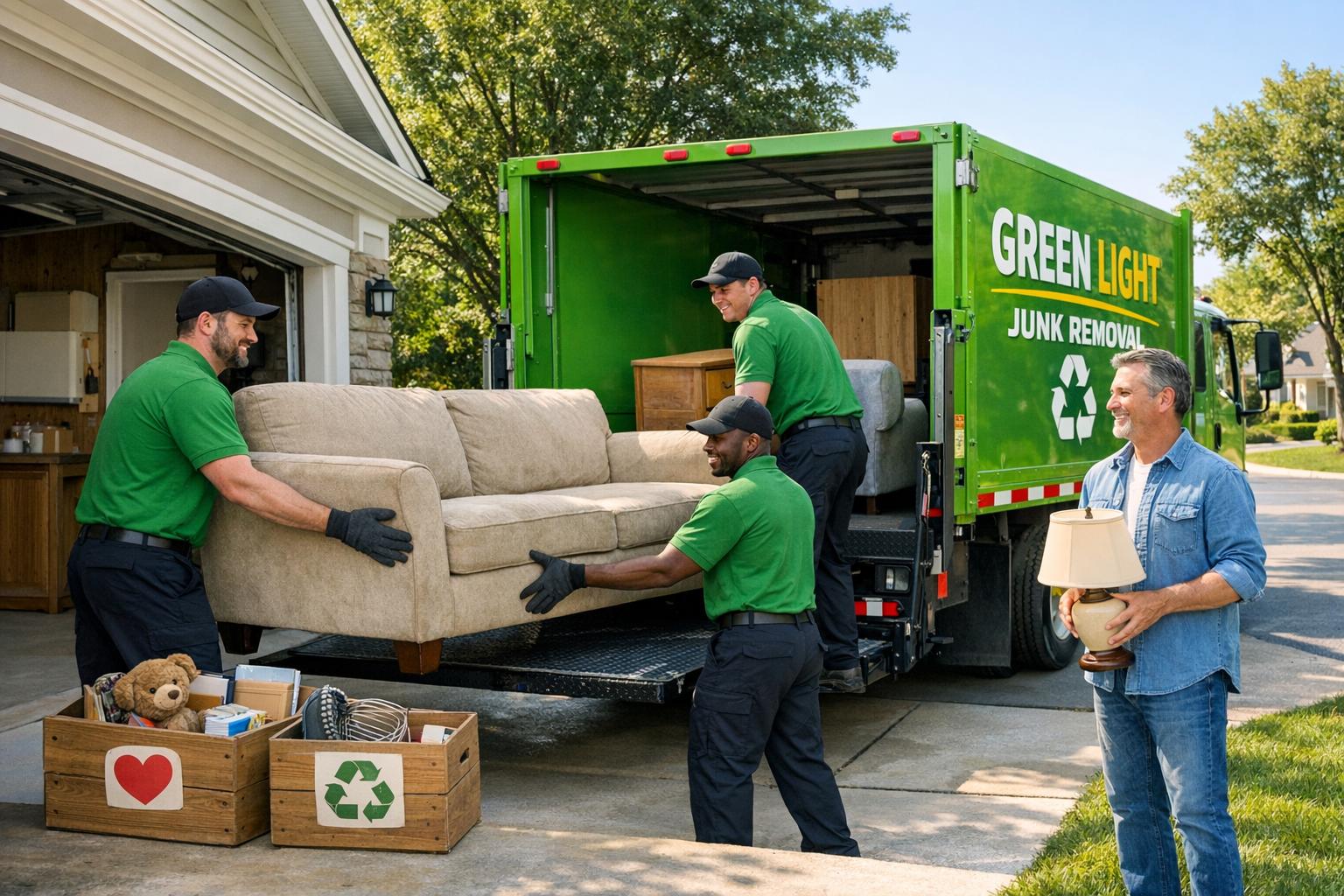
Getting rid of old furniture doesn’t have to be overwhelming. Whether you’re clearing space or replacing outdated pieces, there are several ways to do it responsibly and without hassle:
- Donate: Charities like Goodwill and Habitat for Humanity accept gently used furniture. Many even offer free pickups.
- Sell or Give Away: Use platforms like Facebook Marketplace, Craigslist, or Nextdoor to connect with local buyers or neighbors.
- Recycle: Disassemble unusable furniture and take recyclable materials (like wood or metal) to local recycling centers.
- Hire Professionals: Junk removal services handle heavy lifting and ensure proper disposal or donation.
- Upcycle: Repurpose old furniture into something new with simple DIY projects.
Start by assessing your furniture’s condition. Donate or sell items in good shape, recycle damaged pieces, and consider professional help for large or bulky items. These methods not only save you time but also reduce landfill waste.
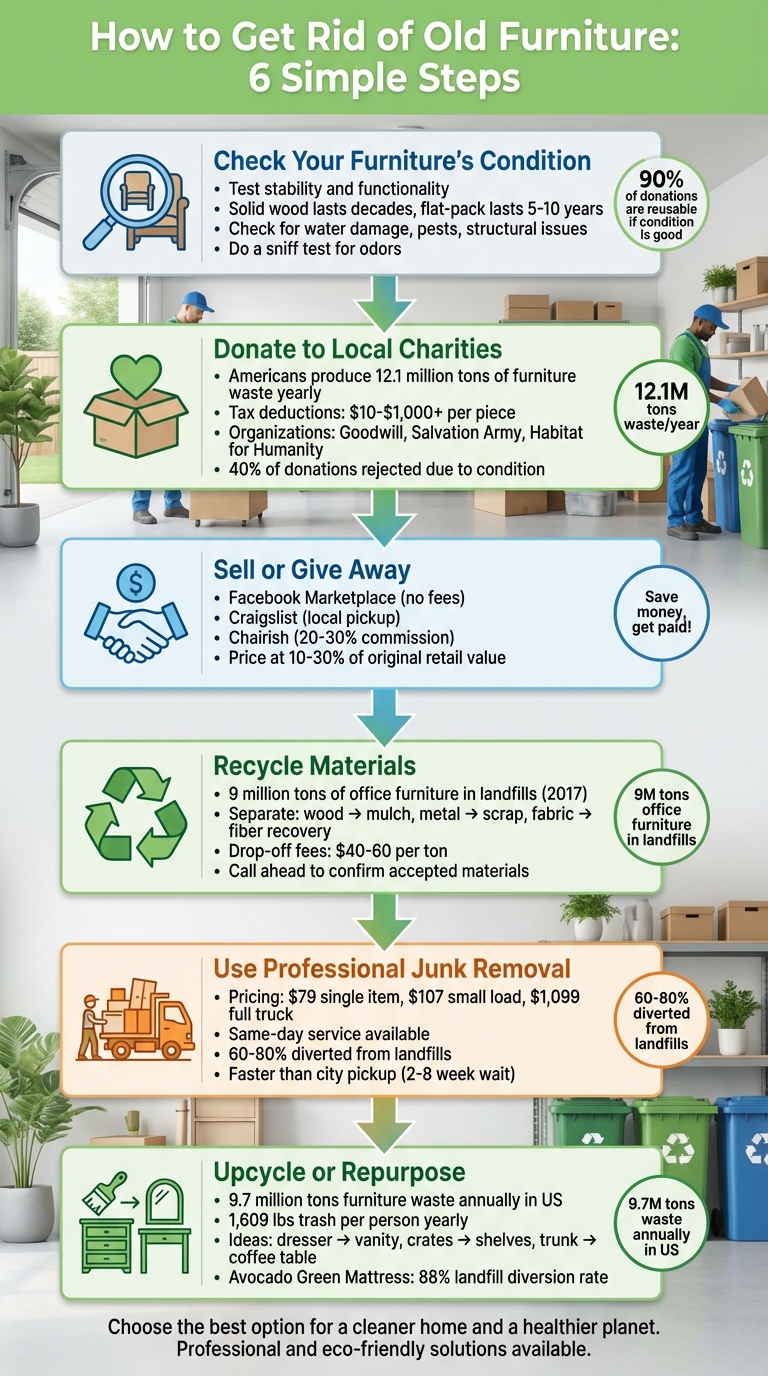
6-Step Process to Get Rid of Old Furniture Responsibly
How to Get Rid of Unwanted Furniture Before Moving | Movers.com
sbb-itb-096ce5b
Step 1: Check Your Furniture’s Condition
The first step in getting rid of furniture is figuring out its condition. This quick assessment not only saves time but also helps you decide how to handle each piece. Your goal is to separate furniture that still has some use left from items that are beyond saving.
Find Items Worth Keeping
Start by checking if your furniture is still in good shape. Test chairs, drawers, and shelves to ensure they’re stable and functional. As the design team at Havenly says: "We’re firm believers that your furniture should work for you, not against you, so anything that isn’t holding it’s weight (literally), it’s time to offload!"[3] If a piece is sturdy but looks outdated, a simple refresh might be all it needs.
Pay attention to quality. Solid wood furniture and antiques often last for decades and might be worth keeping or passing on. On the other hand, flat-pack furniture usually lasts around 5–10 years[2]. Make sure all parts are intact – like drawers, cushions, or hardware – since charities won’t accept incomplete items[1]. Also, think creatively: could that bookshelf or console work in another room before you decide to part with it?
Spot Damaged or Broken Furniture
Next, identify furniture that’s beyond repair. Watch for signs like water damage, pest infestations, or structural issues that make the piece unsafe[4]. Gemma Johnstone from Angi cautions: "You can’t give away a sofa with a pest infestation or one your puppy has used as a potty place one too many times."[2]
Do a quick sniff test to check for lingering pet or smoke odors – these are common reasons charities turn down donations[1]. Look for problems like deep stains, worn-out fabric, or sagging frames, which usually mean the piece has reached the end of its life[2]. If something is missing parts or has severe damage, it’s better suited for recycling or disposal. Always recycle unusable furniture whenever possible[2].
Once you’ve sorted everything, you’re ready to look into donation, selling, or recycling options.
Step 2: Donate to Local Charities
Donating furniture is a fantastic way to clear up space while making a meaningful difference. Gently used furniture can help families furnish their homes and reduce the amount of waste ending up in landfills. Danielle Groton, Ph.D., Associate Professor at Florida Atlantic University, highlights this issue:
"I’ve worked with many clients who had sufficient income to cover their monthly rent and utilities… but did not have extra income to cover one-time expenses such as furniture… This often leaves folks needing to make decisions about which items are most important."[8]
By donating, you’re not only helping others but also contributing to waste reduction. Americans produce 12.1 million tons of furniture waste every year, so keeping large items out of landfills is a big win[10]. On top of that, donations can come with tax benefits. If you itemize deductions, you could claim anywhere from $10 to over $1,000 per piece[8]. For example, The Salvation Army values a dining room set donation between $156 and $934[8].
Locate Donation Centers Near You
Finding a place to donate is simpler than you might think. Start by searching online with terms like "donate furniture near me" or "furniture donation pickup [Your City]"[6]. Well-known organizations like Goodwill, The Salvation Army, and Habitat for Humanity ReStore have extensive networks and often offer free pickup services[5].
If you’re looking for more specific options, dialing 211 can connect you with local furniture banks and services[5]. Some nonprofits cater to particular groups, such as AMVETS for veterans or The Arc for individuals with developmental disabilities[5]. Mike Kerkorian, Chief Development Officer at Family Promise, also points out:
"Habitat ReStores, run by local Habitat for Humanity organizations, are a great resource for low-cost furnishings. They accept donations of furniture and household items and sell them at a fraction of the retail price."[5]
Call ahead before arranging a pickup. Policies on what can be accepted vary widely, and up to 40% of furniture donations are turned away due to condition, size, or storage limitations[9].
Once you’ve identified a donation center, it’s time to prepare your furniture.
Get Furniture Ready for Donation
Taking the time to prepare your furniture properly increases the chances it will be accepted. Start by cleaning each piece thoroughly. Vacuum upholstered items, use a lint roller to remove pet hair, and wipe all surfaces clean[9]. For small stains on fabric, an upholstery cleaner can work wonders[7].
Fix any structural issues and empty out drawers or cushions to remove personal belongings[7][9]. Keep furniture fully assembled, as many charities, including Goodwill, won’t accept items that are disassembled[9].
When scheduling a pickup, be upfront about any scratches, dents, or other imperfections. Some organizations have strict standards and may refuse items with visible flaws upon arrival[8]. If you’re planning to claim a tax deduction, ask for a receipt that includes the charity’s name, the date, and a description of the donated items. For donations exceeding $250, you’ll need an itemized document listing the fair market value of each piece[7].
Step 3: Sell or Give Away Furniture
Once you’ve explored donation options, the next step is to sell or give away furniture that still holds value. If your items are in good condition, this approach not only clears up space but also keeps furniture in use, reducing waste. The second-hand furniture market in the U.S. is growing as more people turn to affordable, pre-owned options instead of buying new[11]. Online platforms make it simple to connect with local buyers who can pick up items directly from your home.
Facebook Marketplace is a popular choice for fast, local transactions without listing fees. Items marked "Free" often get claimed in just a few hours[11][12]. For larger pieces like sofas or dining tables, Craigslist is another great option, as buyers typically handle their own pickup[11]. If you’re in a close-knit neighborhood, Nextdoor can be a convenient way to arrange pickups with nearby residents[11].
For high-end or designer furniture, platforms like Chairish or 1stDibs are ideal. Be aware that Chairish takes a commission of 20%–30%[11]. In major cities like New York, Washington D.C., or Philadelphia, AptDeco offers a curated sales process, allowing sellers to keep 60%–80% of the sale price[11].
When creating listings, include clear photos taken from multiple angles, along with dimensions and any details about wear or damage[12]. If you’re giving items away for free, set a firm pickup deadline (e.g., "Must be picked up by Saturday or will be discarded") to avoid unreliable responses[12].
List Items on Online Platforms
The platform you choose will depend on how quickly you want to move your furniture and whether you’re selling or giving it away. For local sales, OfferUp is a solid choice, with a mobile app and a "Promote" feature to boost visibility[11]. If you’re focused on hyper-local giveaways, Buy Nothing Groups on Facebook often result in pickups within 1–3 days[12].
Most platforms, like Facebook Marketplace, Craigslist, OfferUp, and Nextdoor, don’t charge commissions for local transactions[11]. However, if you use platforms like eBay, expect a final value fee of about 13.25%, while Mercari charges a flat 10% selling fee deducted from the sale price[11].
Good photography can make or break your listing. Use well-lit, clear images from multiple angles to give buyers confidence in what they’re purchasing. Adding specific details like style, age, make, and model in your description can also help attract the right audience[11].
If online platforms aren’t your thing, consider hosting an in-person sale.
Organize a Garage Sale or Swap
For those with multiple items to sell, a garage sale can be a great way to clear out furniture quickly. Price items between 10%–30% of their original retail value[11]. This method works especially well in busy, walkable neighborhoods where passersby can easily spot your sale.
Another option is teaming up with neighbors to host a community swap event. These larger gatherings draw more people, increasing the chances of finding someone interested in your furniture. If you’re simply looking to give items away, placing a "FREE" sign on furniture left at the curb can lead to quick pickups – but make sure to check local rules to avoid fines[12].
No matter the method, set clear pickup deadlines to avoid no-shows and keep the process efficient. If you’re unable to sell or give away everything, local bulk trash pickup services are an option, though wait times can range from 1 to 8 weeks[12].
Step 4: Recycle Furniture Materials
When furniture can’t be donated or sold, recycling is a smart, eco-conscious option. In 2017, approximately 9 million tons of office furniture waste ended up in landfills – a staggering amount[15]. By separating furniture into wood, metal, and fabric, you can ensure it’s properly processed and repurposed.
The secret to effective recycling lies in material separation. For instance, wood can be turned into mulch or biomass fuel, metals can be melted and reused, and certain fabrics can go through fiber recovery processes[15]. However, mixed materials, adhesives, and synthetic components can complicate recycling efforts[13]. To make the process smoother, it’s essential to disassemble your furniture correctly.
Disassemble Furniture for Recycling
Safety first! When dismantling heavy furniture, wear gloves, sturdy footwear, and a back brace to avoid injuries like cuts or strains[15]. Start by removing mechanical fasteners such as screws, bolts, and nails. However, skip over sections that are heavily glued or sealed, as these are typically not recyclable[17].
For metal parts like bed frames or couch springs, strip away any fabric, padding, or stuffing before heading to a scrap yard[13]. Use a magnet to test the metal type: ferrous metals (iron-containing) will attract the magnet, while non-ferrous metals won’t – and the latter often fetches a higher scrap value[13]. Once disassembled, bundle smaller parts with tape or twine for easier handling[14].
If you’re dealing with glass furniture or mirrors, tape the surface to prevent shattering. Should the glass break, double-bag the pieces to protect anyone handling the waste[14]. For electronic or exercise equipment, make sure to remove any batteries[14]. And in places like New York City, mattresses must be sealed in plastic bags to prevent bed bug issues – failure to comply can result in fines as high as $300[14].
Find Recycling Centers in Your Area
Once your furniture is disassembled, the next step is finding a recycling center that can handle the materials. Many waste management companies, such as WM, provide online tools to locate nearby recycling facilities and transfer stations[16]. You can even filter your search to find centers that accept specific materials instead of general landfills[16].
Before visiting a facility, call ahead to confirm they accept the materials you’ve prepared. Some centers may not take treated wood or upholstered items[16]. Expect drop-off fees to range between $40 and $60 per ton, with additional charges for items like mattresses or electronics[13][16].
For scrap metal, tools like the iScrap App can help you find dealers that accept components like steel springs[13]. Keep in mind that some facilities may require documentation, such as a customer agreement or proof of identification, so it’s a good idea to have these ready before you go[16].
| Material | Recycling Process |
|---|---|
| Metal | Remove fabric/padding; take to a scrap yard for shredding and melting[13][15] |
| Wood | Can be chipped into mulch or used as biomass fuel[15] |
| Fabric/Carpet | Processed for fiber recovery or specialized recycling[15] |
Step 5: Use Professional Junk Removal Services
Sometimes, tackling furniture removal on your own can feel like too much – either because of the time it takes or the physical effort involved. That’s where professional junk removal services come in. These services not only make the process easier but also ensure that your old furniture is disposed of responsibly. If hauling heavy items or figuring out how to recycle them sounds like a headache, professional junk removal can take that burden off your shoulders. Companies like Green Light Junk Removal handle everything, from the heavy lifting to eco-conscious disposal.
The standout benefit here is convenience. These professionals can navigate tricky spots in your home – whether it’s a basement, attic, or garage – and remove items on your schedule. You won’t need to rent a dumpster or make repeated trips to donation centers or recycling facilities.
Another major advantage is their focus on responsible disposal. Many services work hard to donate or recycle items whenever possible. For example, they might collaborate with organizations like Big Brothers or the Salvation Army to give your furniture a second chance at life. This approach significantly reduces the amount of waste that ends up in landfills, which is a win for everyone.
Why Choose Green Light Junk Removal
Green Light Junk Removal stands out with its clear and upfront pricing. Whether it’s $107 for a small load, $1,099 for a full truck, or $79 for single-item curbside pickups, you’ll know exactly what you’re paying – no sneaky fees included. Plus, they handle everything: labor, loading, cleanup, and eco-friendly disposal.
Another big plus is their flexible booking options. You can schedule online or by phone, and many services even offer same-day appointments for those last-minute needs. Once you book, the team gives you a call 15–30 minutes before they arrive to provide a free, on-site estimate based on the volume of items. If you agree to the quote, they’ll take care of everything right then and there, leaving your space clean in just one visit.
Before hiring a service, it’s a good idea to confirm that the company is fully licensed and insured. This protects you in case of any accidental damage during the removal process. Also, if your furniture is still in good shape, let the team know – they might be able to donate it, which could lower your overall cost by reducing landfill fees.
What Happens During Furniture Removal
The removal process is designed to be quick and hassle-free. After booking, the crew arrives on-site and evaluates your furniture. They’ll provide a no-obligation quote based on how much you’re getting rid of.
Once you approve the estimate, they get to work immediately. The team handles all the heavy lifting, loading everything onto their truck, and cleaning up the area before they leave. Afterward, the furniture is sorted and sent to the appropriate destination, whether that’s a donation center, recycling facility, or another responsible disposal site.
This efficient, all-in-one service is a huge time-saver compared to city bulk pickup programs, which often require a 2–8 week wait. With professional junk removal, you can have your space cleared in as little as a day – perfect for tight moving schedules or estate cleanouts.
Step 6: Upcycle or Repurpose Furniture
Before tossing that old dresser or table, consider upcycling it. This approach not only breathes new life into worn-out furniture but also helps tackle the staggering 9.7 million tons of furniture waste generated annually in the United States [19]. By reimagining and repurposing your furniture, you can reduce waste and create something functional without spending a fortune.
Upcycling doesn’t require advanced skills or expensive tools. A bit of paint, new hardware, or a small structural tweak can completely transform a piece, often at a fraction of the cost of buying something new.
Easy DIY Upcycling Projects
If you’re just getting started, focus on simple updates that make a big difference. Swapping out old knobs or handles for sleek brass or matte black ones can instantly modernize a dresser or cabinet. For a bigger transformation, try chalk paint – it’s easy to use and gives furniture a trendy matte finish, perfect for a vintage vibe.
Old furniture can also be reimagined for entirely new purposes. For example:
- Turn a dresser into a chic entryway bench by removing the top drawers and adding a cushioned seat.
- Convert a dresser into a bathroom vanity by cutting a hole for a sink basin.
- Stack wooden crates to create modular bookshelves or storage benches.
- Use an antique trunk as a unique coffee table with hidden storage.
If reupholstering feels intimidating, start with chairs that have removable seat pads. All you need is fabric and a staple gun to give them a fresh look. You can also add personality to bookshelves or cabinets by lining the back panels with peel-and-stick wallpaper. Even small touches, like stenciling patterns onto tabletops, can add charm without requiring advanced skills.
Upcycling not only refreshes your home decor but also aligns with eco-friendly practices by extending the life of your furniture.
How Upcycling Reduces Waste
Upcycling does more than save money – it’s a powerful way to cut down on waste. By repurposing old furniture, you reduce the need for new raw materials like timber and metal. Unlike recycling, which often degrades materials during processing, upcycling preserves or enhances the value of the original item while keeping it out of landfills.
"Nothing is inherently waste. It becomes so once we cease to imagine and implement its use." – Autumn Basinger, EDI ’23 Graduate, Northwestern University [19]
The environmental benefits are substantial. On average, each person in the U.S. produces about 1,609 pounds of trash annually [15], with furniture making up a significant chunk. When furniture ends up in landfills, it breaks down and releases methane, a potent greenhouse gas. Even damaged materials can have a second life – wood can be turned into mulch or biomass fuel, and metal can be recycled into new products.
Businesses are also embracing upcycling. For instance, Avocado Green Mattress achieved an 88% landfill diversion rate in 2025 by repurposing organic latex and wood offcuts into new products like pillows and furniture. They aim to reach a 90% diversion rate by 2026 [18], proving that creative reuse isn’t just for individuals – it works on a larger scale too.
Conclusion
Getting rid of old furniture doesn’t have to be overwhelming. Whether you choose to donate, sell, recycle, or repurpose, each option offers an efficient and environmentally friendly way to handle unwanted items. Donating usable furniture to organizations like the Salvation Army or Habitat for Humanity, selling items through online platforms, recycling materials at specialized facilities, or giving furniture a second life through creative upcycling projects can help reduce waste while benefiting your community.
Start by evaluating your furniture’s condition. Items in good shape are ideal for donation or resale, while damaged pieces can often be dismantled and recycled. Proper disposal not only helps the environment but also ensures you avoid potential fines.
If you’re pressed for time or need assistance with large items, services like Green Light Junk Removal can make the process easier. These professionals often divert 60% to 80% of collected items from landfills through recycling and donation programs[20][21]. With options like same-day or next-day pickups and transparent pricing, you can clear out your space without the hassle of doing it all yourself.
FAQs
What furniture won’t charities accept?
Charities typically decline items such as mattresses, upholstered furniture, flat-pack particleboard pieces, oversized items, or furniture that has pet damage, strong odors, or missing parts. It’s always a good idea to check with the specific charity for their donation guidelines before dropping anything off.
How can I move heavy furniture safely?
To move heavy furniture without risking injury, consider using furniture sliders. These handy tools reduce friction, making it much easier to slide heavy pieces across the floor. Another option is lifting straps, which help evenly distribute the weight and reduce strain on your body. Before you start, make sure to clear the path of any obstacles. And if the furniture is especially large or heavy, don’t hesitate to ask for help – teamwork can make the process much safer.
Do I need to disassemble furniture before recycling it?
Disassembling furniture before recycling isn’t typically necessary since many services accept items as they are. That said, taking apart larger pieces can make them easier to handle and transport. To be sure, check with your local waste or recycling service. Some facilities might have specific rules or require disassembly for certain types of furniture.