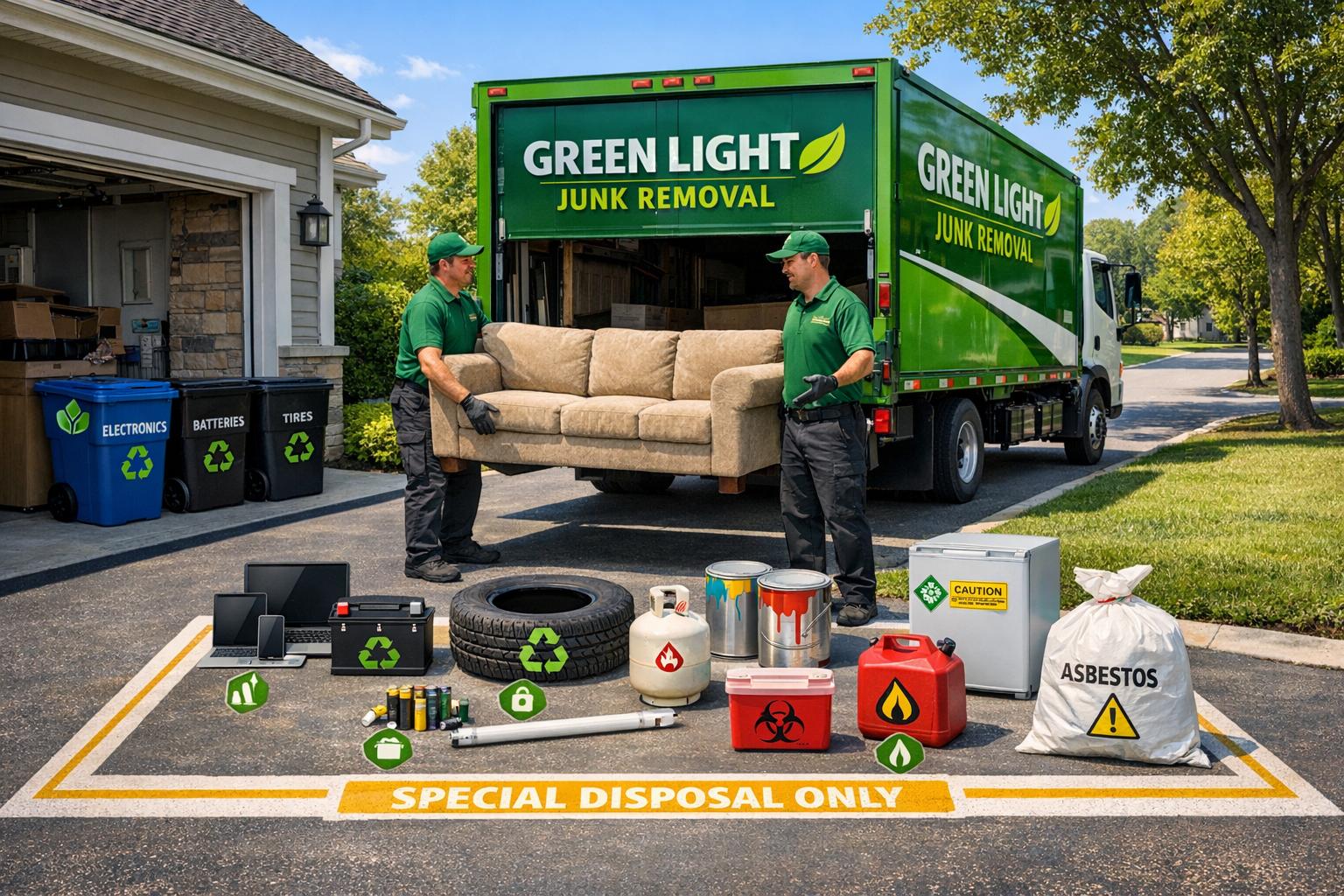
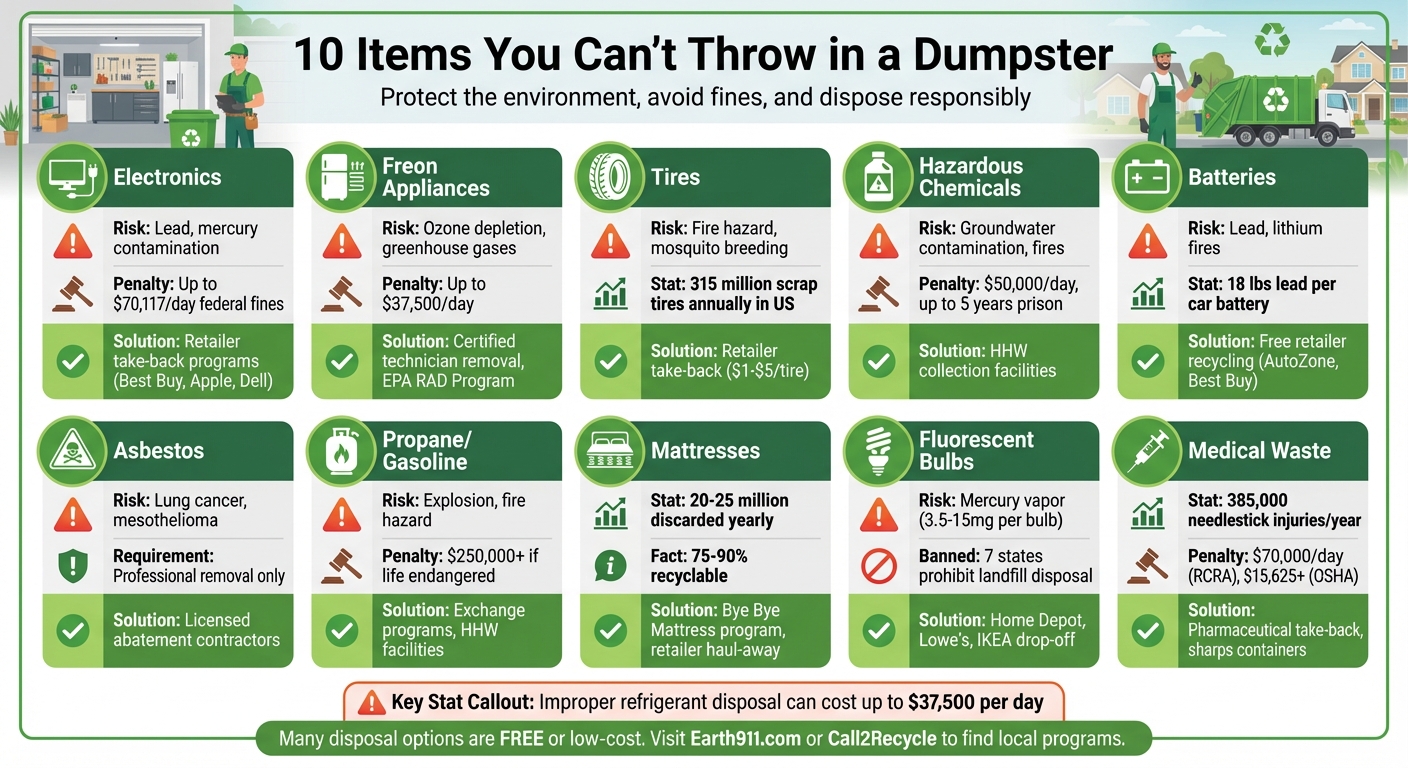
When it comes to waste disposal, not everything belongs in a dumpster. Tossing restricted items like electronics, batteries, or chemicals can cause harm to the environment, create safety hazards, and lead to hefty fines. For example, improper disposal of refrigerants can cost up to $37,500 per day, and some hazardous materials can contaminate groundwater or ignite fires. Here’s a quick rundown of 10 items you should never throw in a dumpster:
- Electronics: Contain toxic metals like lead and mercury; recycle through take-back programs or certified facilities.
- Freon-Containing Appliances: Harmful refrigerants must be removed by certified technicians before recycling.
- Tires: Non-biodegradable, flammable, and often banned from landfills; recycle or repurpose instead.
- Hazardous Chemicals and Paints: Toxic and flammable; dispose of at Household Hazardous Waste (HHW) facilities.
- Batteries: Lead, lithium, and other toxic materials; recycle through retailers or drop-off programs.
- Asbestos: Requires professional removal due to severe health risks.
- Flammable Materials: Propane tanks and gasoline pose fire risks; use proper disposal services.
- Mattresses: Bulky and hard to process; recycle or donate if in good condition.
- Fluorescent Bulbs: Contain mercury; recycle through retailers or HHW programs.
- Medical Waste: Needles, bandages, and medications require specialized disposal to prevent contamination.
Proper disposal protects public health, reduces safety risks, and avoids penalties. Many items can be recycled or handled through specialized programs, often at little to no cost.
10 Items Banned from Dumpsters: Disposal Guide and Penalties
1. Electronics (TVs, Computers, Smartphones)
Environmental Impact of Improper Disposal
Tossing electronics in the trash harms more than just the environment – it wastes valuable resources too. Devices like TVs, computers, and smartphones are packed with hazardous materials, including lead, mercury, cadmium, and beryllium. When these substances break down in landfills, they can contaminate soil and groundwater, posing serious risks to ecosystems and human health [6][8][9].
Beyond the toxic effects, improper disposal means losing precious resources. Believe it or not, a ton of e-waste often contains more gold than a ton of mined ore [6]. When electronics are thrown away instead of recycled, metals like gold, silver, copper, and lithium are lost forever. Recycling electronics isn’t just about reclaiming materials – it’s also energy-efficient. For example, recycling one million laptops saves enough energy to power over 3,500 U.S. homes for a year [7].
| Hazardous Substance | Common Source in Electronics | Potential Impact |
|---|---|---|
| Lead | CRT monitors, circuit boards | Damages nervous systems, especially in children [6] |
| Mercury | Fluorescent bulbs, switches, relays | Contaminates waterways and fish [6][10] |
| Cadmium | Batteries, circuit boards | Known carcinogen and respiratory hazard [6] |
| Lithium | Rechargeable batteries | High fire and explosion risk in waste streams [4] |
| Beryllium | Computer equipment, cell phones | Toxic substance requiring special handling [8] |
Strict regulations now aim to curb these risks and encourage proper e-waste management.
Legal Restrictions and Regulations
As of 2026, at least 25 states and Washington, D.C. have banned electronics from landfills [12]. These laws come with hefty penalties for violators – ranging from thousands of dollars in fines to jail time. Federal fines can even hit $70,117 per day [11][12].
Big companies have already faced consequences. In 2025, Comcast paid $25.95 million to settle claims of illegal e-waste dumping in California [11].
"If it has a cord or runs on batteries, it’s likely illegal to throw away in dumpsters." – CJD E-Cycling [11]
But the risks don’t stop at legal trouble – improper disposal can also endanger public safety.
Potential Health and Safety Hazards
Lithium batteries, commonly found in smartphones, laptops, and tablets, are a major safety concern. When crushed or damaged during disposal, these batteries can catch fire, creating dangerous situations [4].
Eco-Friendly Disposal Alternatives
Thankfully, disposing of electronics responsibly is easier than ever. Many manufacturers, including Apple, Dell, HP, Lenovo, and Samsung, offer take-back programs. These often include mail-in kits or trade-in credits, making it convenient to recycle old devices [6][13]. Retailers like Best Buy, Staples, Lowe’s, and Home Depot also accept items like laptops, monitors, cables, and ink cartridges at in-store drop-off bins [6][7].
If you’re looking for certified recycling, check for facilities with R2 or e-Stewards certifications. These programs ensure safe dismantling of electronics and proper data destruction [6]. Local governments also pitch in by hosting Household Hazardous Waste collection events or maintaining permanent drop-off sites [6][7]. While smaller items like cell phones and tablets are usually accepted for free, recycling CRT TVs and monitors might cost $5 to $35 depending on their size [6][11].
Before handing over your device, don’t forget to back up your data, remove SIM and SD cards, and perform a factory reset to safeguard your personal information [7]. Recycling electronics not only complies with legal standards but also contributes to a cleaner, safer environment.
sbb-itb-096ce5b
2. Freon-Containing Appliances (Refrigerators, Air Conditioners)
Environmental Impact of Improper Disposal
Freon-containing appliances, like refrigerators and air conditioners, need careful handling to avoid serious environmental harm. When improperly discarded, these appliances release refrigerants such as CFCs and HCFCs, which damage the ozone layer. Even modern refrigerants like HFCs contribute significantly to greenhouse gas emissions [10][16]. Additionally, the polyurethane foam insulation in these appliances contains gases that can harm the ozone layer and exacerbate climate change if not properly recovered during disposal [10].
For instance, recycling 1,000 refrigerators responsibly can prevent about 8,200 metric tons of CO₂-equivalent emissions [17]. The EPA’s Responsible Appliance Disposal (RAD) Program highlights the impact of proper recycling: between 2006 and 2025, it processed over 9 million appliances, avoiding emissions comparable to the energy needed to power 5 million homes for a year [10].
These risks emphasize the need for strict compliance with proper disposal methods to protect the environment.
Legal Restrictions and Regulations
Federal law mandates specific procedures for disposing of Freon-containing appliances. Under Section 608 of the Clean Air Act and 40 CFR Part 82, Subpart F, refrigerants must be recovered by certified technicians before disposal [14][15].
"The final person in the disposal chain (such as a scrap metal recycler or landfill owner) is responsible for ensuring that refrigerant is recovered from equipment before its final disposal." – U.S. Environmental Protection Agency [14]
This means that landfills and dumpster rental companies can face penalties for accepting improperly processed appliances. EPA regulations require that final disposers maintain signed statements or contracts confirming that refrigerants have been safely recovered [14]. These strict rules highlight the importance of certified disposal methods, which help minimize environmental damage and legal risks.
Potential Health and Safety Hazards
Improper disposal can expose individuals to hazardous substances like mercury and PCBs, which pose serious health risks. This makes specialized disposal processes essential [10].
Eco-Friendly Disposal Alternatives
Some electric utilities offer bounty programs, paying around $35 for old, functional refrigerators and freezers [17]. Retailers often provide haul-away services for new appliance purchases, ensuring the proper recovery of refrigerants [16].
The EPA’s RAD Program goes even further by recovering not just refrigerants but also the foam blowing agents from insulation. This voluntary effort maximizes environmental protection. Between 2006 and 2025, RAD partners safely disposed of over 543,000 hazardous internal components while recycling 1.5 billion pounds of metals, plastics, and other materials [10].
If you’re using municipal bulk pickup or a private service, make sure a certified technician removes the refrigerant first. They should provide a signed statement with their name, address, and the recovery date [14]. Licensed recyclers have the tools to safely process these appliances [15]. Avoid leaving appliances at the curb without scheduling a pickup, as this could lead to illegal venting of refrigerants by scavengers looking to sell the metal [14].
3. Tires
Environmental Impact of Improper Disposal
Tires are a prime example of the dangers that arise when certain items are improperly discarded. Dumping tires in landfills or dumpsters isn’t just careless – it’s harmful. Made from rubber and steel, tires can take anywhere from decades to millennia to break down. During this long process, they release toxic chemicals into the soil and groundwater, creating a lasting environmental threat [18].
One of the most pressing landfill concerns with tires is methane gas. Tires have a hollow core that’s about 75% empty space, which traps methane produced by decomposing waste [19]. This trapped gas can cause tires to rise to the surface, damaging landfill liners and making containment difficult. Even more alarming, tires are highly flammable. Fires involving tires can burn for months, releasing toxic smoke filled with harmful chemicals like sulfur dioxide, carbon monoxide, and cyanide [18]. A notable example occurred in 1999 in California when millions of tires caught fire, burning for weeks and spreading toxic fumes over a wide area [19].
"Tires pose unique challenges in landfills due to their 75% void space, which traps methane gases and causes them to bubble upward." – California Integrated Waste Management Board [19]
Beyond landfills, discarded tires create other hazards. They collect rainwater, providing a perfect breeding ground for disease-carrying mosquitoes [18]. With the U.S. generating around 315 million scrap tires annually – a number projected to climb to 350 million by 2030 – the risks tied to improper disposal are only increasing [18].
These dangers have prompted strict regulations, as detailed below.
Legal Restrictions and Regulations
Due to the environmental and safety risks, tire disposal laws across the U.S. are stringent. Currently, 38 states ban the disposal of whole tires in landfills, while 35 states allow shredded tires to be disposed of, leaving only 8 states where whole tire disposal is still permitted [18]. Additionally, most dumpster rental services refuse to accept tires because landfills impose high fees for bulky items that don’t compress.
Penalties for illegal tire dumping vary widely depending on the location. For instance, in Akron, Ohio, offenders can face fines between $500 and $25,000, along with prison sentences ranging from 6 months to 4 years [18]. Meanwhile, in Alabama, a single violation can result in a $10,000 fine and up to 10 years in prison [18].
Eco-Friendly Disposal Alternatives
Thankfully, there are several responsible ways to dispose of old tires. One of the easiest options is through tire retailers. When you buy new tires, most dealers will take your old ones for a small fee, typically ranging from $1 to $5 per tire [18]. In some cases, this fee is included in the installation cost, making the process seamless. If you’re not purchasing new tires, disposal fees may range from $5 to $20 per tire.
Many communities also host "tire amnesty days", allowing residents to drop off a limited number of tires for free [18]. In South Carolina, for example, residents can use RecycleHereSC to locate proper waste tire management services in all 46 counties. When hiring waste tire haulers, ensure they are registered to avoid being held responsible for illegal dumping. These haulers typically charge between $0.75 and $1.50 per tire for collection [18].
Recycling is another excellent option. About 43% of recycled tires are turned into tire-derived fuel (TDF), which is used in industries like cement production and paper manufacturing. TDF provides 25% more energy than coal, making it an efficient alternative [19]. The remaining recycled tires are often shredded and repurposed into materials like rubberized asphalt for roads, playground surfaces, and athletic tracks [20]. Recycling one million tires can recover approximately 35,000 pounds of copper and 75 pounds of gold from steel belting, while also using 75% less energy than producing new synthetic rubber [19].
For smaller quantities, consider upcycling old tires into creative projects like garden planters, swings, or outdoor furniture. Just be sure to clean them thoroughly with a pressure washer and non-toxic degreaser to remove any road grime or oils before repurposing [21].
4. Hazardous Chemicals and Paints
Environmental Impact of Improper Disposal
Hazardous chemicals and paints, like electronics and tires, require special care when it comes to disposal because of their harmful effects on both the environment and human health. Dumping these materials can lead to severe consequences, especially for water sources. Chemicals can seep through landfills, infiltrate storm drains, and eventually contaminate groundwater, streams, and rivers, where they can linger for years, impacting drinking water and aquatic ecosystems [22][23].
The toxic substances in paints can also harm the soil, affecting plants, beneficial organisms like worms, and essential microbes [22]. Volatile organic compounds (VOCs) from paints, solvents, and aerosols contribute to smog, harm air quality, and even deplete the ozone layer [22]. Additionally, garden chemicals such as pesticides and herbicides pose significant risks to aquatic life, pollinators, and even household pets, as even small amounts can be highly toxic [22].
Flammable materials like gasoline, solvents, and paint thinners add another layer of danger. These substances can ignite or explode under pressure, and even empty containers may contain hazardous residues that pose a risk [23][4].
Legal Restrictions and Regulations
Disposing of hazardous waste improperly is not just dangerous – it’s illegal. Under the Resource Conservation and Recovery Act (RCRA) of 1976, violators can face steep penalties, including up to five years in prison and fines of $50,000 per day [23]. If this kind of disposal endangers others, the penalties can jump to 15 years in prison and fines exceeding $250,000 [23].
The Land Disposal Restrictions (LDR) program, introduced in 1984, further tightened the rules by banning the land disposal of untreated hazardous waste [25]. While household hazardous waste (HHW) is excluded from federal regulation under 40 CFR Section 261.4, many states and local governments enforce stricter rules [26][27]. For instance, many municipalities prohibit disposing of hazardous chemicals in regular trash or dumpsters.
"Improper disposal of HHW can include pouring them down the drain, on the ground, into storm sewers, or in some cases putting them out with the regular trash." – US EPA [26]
These regulations underscore the importance of responsible handling to safeguard public health and the environment.
Potential Health and Safety Hazards
Exposure to hazardous chemicals can lead to immediate and serious health problems. Skin contact or inhalation may cause chemical burns, poisoning, or respiratory issues [22]. Over time, prolonged exposure can result in chronic health conditions, particularly for vulnerable groups like children and older adults.
Mixing chemicals is particularly dangerous. For example, combining bleach with ammonia produces toxic chloramine gas, which can be life-threatening. Corrosive wastes can damage metal dumpsters, while flammable or reactive chemicals increase the risk of fires and explosions, endangering sanitation workers and equipment [22][4][26]. These risks highlight why proper disposal methods are so critical.
Eco-Friendly Disposal Alternatives
To mitigate these dangers, proper disposal of hazardous chemicals and paints is essential. Many communities offer Household Hazardous Waste (HHW) collection programs, which provide safe drop-off sites or periodic collection events for items like oil-based paints, pesticides, and solvents [23][1]. Resources like the Earth911 database or local government websites can help you locate collection programs nearby [1].
Some retailers, including paint stores and auto shops, participate in take-back programs for specific hazardous items. It’s a good idea to call ahead to confirm what they accept. The importance of proper disposal can’t be overstated – just one gallon of motor oil can contaminate up to a million gallons of water [5].
For latex (water-based) paint, small amounts can often be dried out with materials like cat litter or sawdust. Once solidified, it may be safe to dispose of it with regular trash, depending on local guidelines [22][24]. However, oil-based paints, lacquers, thinners, and wood stains must always be treated as hazardous waste due to their risks [4][27].
When transporting hazardous materials to a collection site, keep them in their original, labeled containers. Ensure they are sealed tightly, kept upright, and transported in your vehicle’s trunk rather than the cabin for added safety [22][23]. Proper precautions during transport can help prevent spills and accidents.
5. Batteries (Car Batteries, Rechargeable Batteries)
Environmental Impact of Improper Disposal
Batteries can cause serious harm to the environment when not disposed of correctly. Take lead-acid car batteries, for example – they contain up to 18 pounds of lead and about one gallon of corrosive, lead-contaminated sulfuric acid. If these batteries end up in landfills, toxic metals like lead, cadmium, nickel, mercury, and silver can seep into the soil and groundwater, polluting drinking water sources for years [30][31][33].
Throwing away batteries also wastes critical materials. Valuable minerals like lithium, cobalt, and graphite are lost, and replacing them requires energy-intensive mining. This adds to air and water pollution and increases greenhouse gas emissions [28][30][31].
Lithium-ion batteries bring additional risks, particularly fire hazards. When crushed or damaged – whether in garbage trucks or at disposal facilities – they can overheat, triggering fires and releasing toxic fumes [28][30][32].
"Recycling old batteries keeps you safe, keeps the waste industry safe, keeps the first responders safe and responsibly sees that battery reach a proper end of life" – Michael Hoffman, President of the National Waste and Recycling Association [30]
These dangers highlight the importance of strict regulations around battery disposal.
Legal Restrictions and Regulations
To address these risks, both federal and state governments enforce strict battery disposal rules. At the federal level, the Resource Conservation and Recovery Act (RCRA) requires hazardous waste batteries, like lithium-ion and lead-acid types, to be managed under "universal waste" standards (40 CFR Part 273). This approach encourages recycling over disposal [32][29]. Additionally, the Mercury-Containing and Rechargeable Battery Management Act (Public Law 104-142) has phased out mercury in batteries and mandates manufacturers to provide recycling programs for nickel-cadmium and small sealed lead-acid batteries [31].
State laws vary widely. In California, nearly all household batteries are classified as universal waste, making it illegal to dispose of them in standard trash bins [33]. New York imposes steep penalties for improper disposal, with businesses facing fines of up to $37,500 per day of violation. In California, fines can reach $25,000 per incident [34]. Most lithium-ion and lithium primary batteries are considered hazardous waste because of their potential to ignite or react [32].
Eco-Friendly Disposal Alternatives
Recycling batteries responsibly is easier than you might think. Many national retailers offer free take-back programs. Stores like AutoZone, O’Reilly Auto Parts, Best Buy, Home Depot, Lowe’s, and Staples accept batteries for recycling [31][33][35]. Some even offer perks – O’Reilly Auto Parts gives a $10 gift card for old car batteries, and Walmart provides core charge refunds [35].
You can also use online tools like Call2Recycle or Earth911 to find certified collection points near you by entering your zip code [33]. Local Household Hazardous Waste (HHW) facilities accept batteries too, either during special collection events or at permanent drop-off locations. To ensure safe handling, cover battery terminals with non-conductive tape or place each battery in a plastic bag to prevent short circuits [28][31][33]. If you’re transporting lead-acid car batteries, keep them upright to avoid acid leaks and wear gloves and safety glasses for protection [35][36].
6. Asbestos
Potential Health and Safety Hazards
Asbestos, like other hazardous materials, demands specialized care to prevent contamination and protect health. When asbestos is disturbed, it releases tiny fibers into the air. Inhaling these fibers can lead to severe health issues, including lung cancer and mesothelioma, which may not appear for decades after exposure [3][37]. This makes handling asbestos a serious matter requiring caution.
Homes built before 1980 often used asbestos in materials such as floor tiles, insulation, roofing shingles, and siding [3][2]. If you’re planning to renovate an older home, it’s crucial to have any suspect materials tested for asbestos before starting demolition or cleanup [3][2].
Because of the significant health risks, strict regulations govern the handling and disposal of asbestos.
Legal Restrictions and Regulations
Federal laws set clear rules for asbestos disposal. The National Emission Standards for Hazardous Air Pollutants (NESHAP) under the Clean Air Act and the Toxic Substances Control Act (TSCA) (40 CFR 763) outline how asbestos must be managed [38][39]. These laws require specific containment methods, protective gear, and disposal at certified facilities [3].
In states like California, asbestos-containing materials are classified as hazardous waste if they are "friable" (easily crumbled by hand when dry) and contain at least 1.0% asbestos [38]. To prevent fiber release, asbestos must be wetted and sealed in leak-proof containers, such as plastic bags with a minimum thickness of 6 mil [38]. Each container must also display a warning label: "Danger – Contains Asbestos Fibers – Avoid Creating Dust – Cancer and Lung Disease Hazard" [38].
Transporting more than 50 pounds of hazardous asbestos waste in California requires a registered hazardous waste transporter and a uniform hazardous waste manifest [38]. Violating these regulations can lead to hefty fines and legal consequences [37]. Additionally, facilities producing five tons or more of hazardous waste are subject to a Generation and Handling Fee [38].
Eco-Friendly Disposal Alternatives
Given the risks and legal requirements, asbestos removal should always be handled by certified professionals. Attempting to remove or dispose of asbestos yourself is not only dangerous but also illegal in many cases. Licensed contractors are trained to safely handle, transport, and dispose of asbestos to ensure it doesn’t contaminate the environment [3][1]. For assistance, contact your local health department for a list of approved contractors and disposal facilities in your area [3].
Before removal, have a state-certified lab test the materials. Licensed abatement contractors, registered with the appropriate state board and Cal/OSHA, must manage the removal and transport of asbestos waste to authorized landfills [1][2][38][39]. Always confirm with the landfill that they accept asbestos and check whether an appointment is required [38][39]. In some situations, encapsulation or enclosure – methods that safely contain asbestos without removing it – may be suitable alternatives to full removal. These options are also regulated and should be performed by professionals.
7. Flammable Materials and Fuels (Propane Tanks, Gasoline)
Potential Health and Safety Hazards
Disposing of propane tanks and gasoline in dumpsters is extremely dangerous. Even when a propane tank seems empty, it often contains residual gas that can ignite or explode when crushed by garbage truck compactors or exposed to high temperatures in landfills [2][4][3]. These materials pose serious risks for waste haulers and landfill workers, including chemical burns, lung damage from toxic fumes, and injuries caused by explosions or fires [23][4]. Gasoline vapors can also collect in enclosed drainage systems, creating hidden risks of explosions [41].
Legal Restrictions and Regulations
Due to these dangers, federal laws strictly regulate the disposal of flammable materials. The Resource Conservation and Recovery Act (RCRA) oversees the safe handling of hazardous and reactive waste like propane and gasoline [23]. Regular household trash services are prohibited by federal law from collecting these items during normal pickups [40]. Propane tanks are classified as reactive waste because they can explode under typical temperature or pressure conditions [40][4]. Violating these regulations can lead to severe penalties, including fines of up to $50,000 per day and up to 5 years in prison. If human life is endangered, penalties increase to fines exceeding $250,000 and up to 15 years in prison [23]. Additionally, pouring gasoline into drains, storm sewers, or onto the ground is illegal in most areas across the U.S. [41].
Eco-Friendly Disposal Alternatives
To safely dispose of these materials, consider the following options:
- Propane Tanks: If the tank is still functional, use exchange programs available at grocery stores, hardware stores, or gas stations [42]. Many propane suppliers also accept old tanks for recycling, as they have the tools to safely remove any residual gas [42].
- Gasoline and Other Fuels: Take gasoline, kerosene, and diesel fuel to a local household hazardous waste (HHW) collection site or community collection event [40][23]. Keep gasoline in its original container or a certified gas can until it can be properly disposed of [40].
- Finding Facilities: Use tools like Earth911’s recycling locator to find nearby hazardous waste disposal sites [41]. You can also contact your local fire department or waste agency for advice on safely handling pressurized or flammable containers [4].
Professional hazardous waste removal services are another option and typically cost between $5 and $100, depending on the type and amount of material [42]. Proper disposal not only protects the environment but also prevents serious health and safety risks.
Things You Should Never Put In A Dumpster | Dumpster Rental FAQs
8. Mattresses and Upholstered Furniture
Bulky waste like mattresses and upholstered furniture presents unique challenges when it comes to landfill management.
Environmental Impact of Improper Disposal
The disposal of mattresses and box springs in the U.S. is a growing problem. Around 20–25 million mattresses are thrown out every year, each taking up 23–40 cubic feet of landfill space and needing 50–100 years to break down [44][46]. Shockingly, 50,000 mattresses are added to landfills daily [47].
Mattresses are particularly troublesome because their steel springs resist compression, taking up more space than other waste. These springs can also damage landfill machinery and create safety risks for workers. Meanwhile, materials like polyurethane foam and synthetic fabrics linger for decades, releasing harmful VOCs and methane gas – a greenhouse gas 28 times more potent than CO₂ – as they degrade [43][44].
The good news? Between 75% and 90% of a mattress’s components can be recycled [44]. For example, steel springs can be turned into construction rebar, foam can become carpet padding, and wooden frames can be processed into mulch. Recycling just one ton of steel from mattress springs can cut CO₂ emissions by 4,000 pounds, and products made from recycled materials use 50% to 90% less energy than those made from raw materials [44].
Legal Restrictions and Regulations
To address the issue, some states have introduced Extended Producer Responsibility (EPR) laws that prohibit mattress disposal in regular waste facilities [44]. States like California, Connecticut, and Rhode Island require consumers to pay a small fee – typically $9.00 to $16.00 – at the time of purchase. This fee funds free mattress recycling programs.
In areas without EPR laws, municipalities often treat mattresses as bulky waste that requires special handling. Simply leaving one at the curb without scheduling a pickup can result in fines ranging from $100 to $500 [4][44]. Additionally, many cities mandate that mattresses be wrapped in plastic before disposal to prevent the spread of pests like bed bugs [44][46].
Eco-Friendly Disposal Alternatives
When buying a new mattress, check if the retailer offers a haul-away service – many provide this for free or at a low cost. For residents of California, Connecticut, and Rhode Island, the Bye Bye Mattress program offers free drop-off sites and has recycled over 6 million mattresses since 2015, diverting more than 180 million pounds of waste from landfills [44].
If your mattress is in good shape (no stains, structural damage, or pest issues), donating it is another great option. Organizations like Goodwill, Salvation Army, or Habitat for Humanity ReStore often accept gently used mattresses. You can also use resources like Earth911 or the Bye Bye Mattress website to find certified recycling centers nearby. For those needing pickup, professional junk removal services typically charge $75 to $200 per mattress, while municipal bulk pickups range from free to $50 [44].
"Consumers should keep their mattress clean and dry so the components can be extracted and made into other products like carpet padding."
– Amanda Wall, Spokesperson, Mattress Recycling Council [45]
Before recycling or donating, inspect the mattress carefully. Look for signs of bed bugs, such as dark spots or rust-colored stains, and ensure it’s dry – many recycling centers won’t accept infested or water-damaged items [43][45].
9. Fluorescent Light Bulbs
Fluorescent bulbs, including compact fluorescent lamps (CFLs) and tubes, contain mercury – a dangerous neurotoxin. Because of this, throwing them in dumpsters is often prohibited by local regulations. Each bulb typically holds between 3.5 and 15 milligrams of mercury [48]. When these bulbs are crushed in dumpsters, the mercury can vaporize and seep into groundwater, potentially contaminating drinking water supplies [51][54]. Proper disposal is essential to reduce environmental damage and avoid legal penalties.
Environmental Impact of Improper Disposal
When fluorescent bulbs break during disposal, the mercury they release doesn’t just disappear – it can infiltrate soil and water systems. Over time, it accumulates in aquatic ecosystems, impacting fish and wildlife [51][54]. The good news? These bulbs are recyclable. Their glass, metal, and phosphor powder components can all be reused [48][50].
"Recycling prevents the release of mercury into the environment." – US EPA [48]
Legal Restrictions and Regulations
Fluorescent bulbs are classified as hazardous waste under federal law if they fail the Toxicity Characteristic Leaching Procedure (TCLP) test. This test measures mercury leachate, and bulbs with more than 0.2 milligrams per liter are deemed hazardous [49]. The EPA’s Universal Waste Rule (40 CFR Part 273) simplifies handling for businesses, allowing them to store bulbs for up to a year before recycling. However, breaking or crushing bulbs is strictly prohibited [49][53].
Certain states, including California, Maine, Massachusetts, Minnesota, New Hampshire, Vermont, and Washington, have gone further by banning the disposal of mercury-containing lamps in landfills [50]. While federal law exempts household waste from hazardous waste rules, many local governments still restrict residents from tossing these bulbs in regular trash to protect sanitation workers and the environment [49][53]. These rules not only safeguard ecosystems but also reduce the immediate risks of mercury exposure.
Potential Health and Safety Hazards
Mercury exposure is no joke, especially in its vapor form. If a fluorescent bulb breaks, leave the area for 10–15 minutes to let the vapors dissipate [51][53]. Avoid vacuuming, as it can spread mercury particles. Instead, use items like stiff cardboard or duct tape to carefully pick up debris, then seal it in a container [51][53].
Standard fluorescent bulbs contain between 8 and 14 milligrams of mercury, while "low-mercury" options with green end caps still carry 3.5 to 4 milligrams [49].
"Mercury is hazardous and must not be thrown away in your regular garbage because toxins seep into landfill groundwater and make their way into our drinking supply." – Recycle Coach [54]
Given these risks, safe handling and disposal are critical.
Availability of Eco-Friendly Disposal Alternatives
Thankfully, safe disposal options are widely available. Many major retailers, including Home Depot, Lowe’s, IKEA, and Batteries Plus, offer free drop-off services for residential CFLs. For larger fluorescent tubes or bulk quantities, local Household Hazardous Waste (HHW) facilities often provide free municipal programs [50][52]. Mail-back services, like those from EcoLights or LampMaster, are another option – though they typically charge a fee [50][52]. To avoid breakage during transport, wrap bulbs in their original packaging or secure them with a towel [51].
CFLs are gradually being phased out across the U.S. A federal ban on most CFL sales began in 2022, with a complete phase-out planned for 2025. As the market transitions to mercury-free LED technology, these newer bulbs offer clear advantages. LEDs consume less energy, last significantly longer – 6 to 11 years compared to the 0.8 to 1.9 years of fluorescent tubes – and don’t require special disposal [52][55].
10. Medical Waste
Medical waste – such as used needles, blood-soaked bandages, expired medications, and other contaminated materials – requires special handling and cannot simply be tossed in regular dumpsters. In the United States, healthcare facilities produce around 6.0 million tons of regulated medical waste every year [58]. Improper disposal of this waste can spread infectious pathogens and allow hazardous chemicals to seep into groundwater [56][57].
Potential Health and Safety Hazards
The risks of mishandling medical waste are serious. For example, 385,000 needlestick injuries occur annually among healthcare workers in the U.S., often due to mishandled sharps [58]. Additionally, when medical waste containers break during transport or in landfills, they can release infectious materials and harmful chemicals into the environment [57]. At home, unsupervised access to medications is another danger. In 2020 alone, 36,564 emergency room visits involved children aged 5 and under due to accidental medication exposures, with nearly 13% of these cases requiring hospitalization [65].
Legal Restrictions and Regulations
Although the federal Medical Waste Tracking Act expired in 1991, states now oversee medical waste regulations [57][61]. On a federal level, OSHA’s Bloodborne Pathogens Standard (29 CFR 1910.1030) outlines workplace handling requirements for infectious materials, while the Department of Transportation regulates how medical waste is packaged and transported on public roads [62][58]. Violations can be costly: RCRA penalties can reach up to $70,000 per day, and OSHA fines begin at $15,625 per violation [58]. Additionally, improperly disposing of prescription bottles without removing patient information violates HIPAA’s Privacy Rule [63].
Eco-Friendly Disposal Alternatives
Given the strict guidelines, safe and responsible disposal methods are essential. One of the best options for unused medications is pharmaceutical take-back programs, which are available at many retail pharmacies and hospitals [64][65]. For sharps, the FDA recommends using puncture-resistant containers that should be sealed once they’re three-quarters full [59][60].
Other options include mail-back programs, which are convenient for small waste generators and cost around $40 per month [59]. Professional disposal services are another route, with small clinics typically spending $100–$200 monthly, while dental practices pay between $75–$150 [58]. Licensed haulers ensure waste is treated through methods like autoclaving or incineration, meeting safety and legal requirements [59][61].
"Even if you outsource medical waste disposal, you’re still legally responsible for how it’s handled from generation to destruction. It’s called the Cradle-to-Grave Rule." – MedicalWasteDisposal.org [59]
Safe medical waste disposal not only protects public health but also prevents environmental damage and ensures compliance with the law. It’s a critical step in managing the risks tied to these materials.
Conclusion
Understanding what items can’t go in a dumpster helps safeguard public health, protect the environment, and avoid hefty fines. For instance, improperly disposing of refrigerants can lead to federal penalties of up to $37,500 per day [3]. These rules are in place to prevent dangers like fires, explosions, groundwater pollution, and damage to waste management systems.
This guide highlights practical ways to handle waste responsibly. Many retailers, such as Best Buy and auto parts stores, offer free recycling programs for electronics and batteries. Similarly, municipal Household Hazardous Waste collection events provide safe drop-off points for items like chemicals and paints. For materials that need special handling – like appliances with Freon, mattresses, or medical waste – certified professionals ensure proper and compliant disposal.
"The biggest mistake we see is customers assuming all waste is the same – these restrictions exist for everyone’s safety." – Prime Dumpster Pro [3]
If you’re dealing with several restricted items, Green Light Junk Removal can make the process easier. Their team takes care of sorting, transporting, and delivering these materials to authorized recycling centers and hazardous waste facilities. Whether you’re tackling a home renovation, estate cleanout, or business project, they manage the details so you can focus on what matters most.
FAQs
What happens if I put a banned item in a dumpster?
Improperly discarding banned items in a dumpster can lead to serious consequences. Hazardous materials – such as chemicals, paints, or electronics – can release toxins that contaminate the soil, water, and air. Beyond environmental damage, this poses health risks to people and wildlife. Additionally, tossing such items in the trash may violate local laws, potentially resulting in fines, legal trouble, or even disruptions in waste collection services.
To steer clear of these problems, opt for the right disposal methods. Many communities offer hazardous waste centers or specialized recycling programs designed to handle these materials safely. These options protect both the environment and your compliance with local regulations.
How do I find the right drop-off site near me?
To find a drop-off site for items that aren’t allowed in a dumpster, start by contacting your local waste management provider or checking their website. Many regions have specific facilities for disposing of electronics, hazardous materials, or large appliances. Additionally, keep an eye out for community recycling events or hazardous waste collection programs. These options help ensure your items are disposed of responsibly and in line with local rules.
Can Green Light Junk Removal take restricted items for me?
Green Light Junk Removal is equipped to handle restricted items responsibly. They adhere to waste disposal regulations, ensuring proper management of hazardous materials, electronics, and other items that aren’t suitable for regular dumpsters. Their team ensures these materials are disposed of safely and in full compliance with legal guidelines.